Labour · 3 min read
Canadians went back to the office. Working from home still more than doubled.
In May 2026, 17.0% of Canadian workers did most of their hours from home, up from 7.1% in 2016 and down from 37.8% in 2020. B.C. and Ontario lead. Saskatchewan is the only province lower than in 2016.
Return-to-office headlines make it sound like Canada has gone back to 2019. It hasn't. In May 2026, 17.0 percent of Canadian workers did most of their hours from home. In May 2016 it was 7.1 percent.
That is the finding of a new paper by economist René Morissette, published on 24 September by CIRANO, a Quebec research centre. It uses the 2016 Census and Statistics Canada's Labour Force Survey supplements from 2020 to 2026. The rate has fallen every year since the 2020 peak of 37.8 percent, but it has not come close to falling back to where it started.
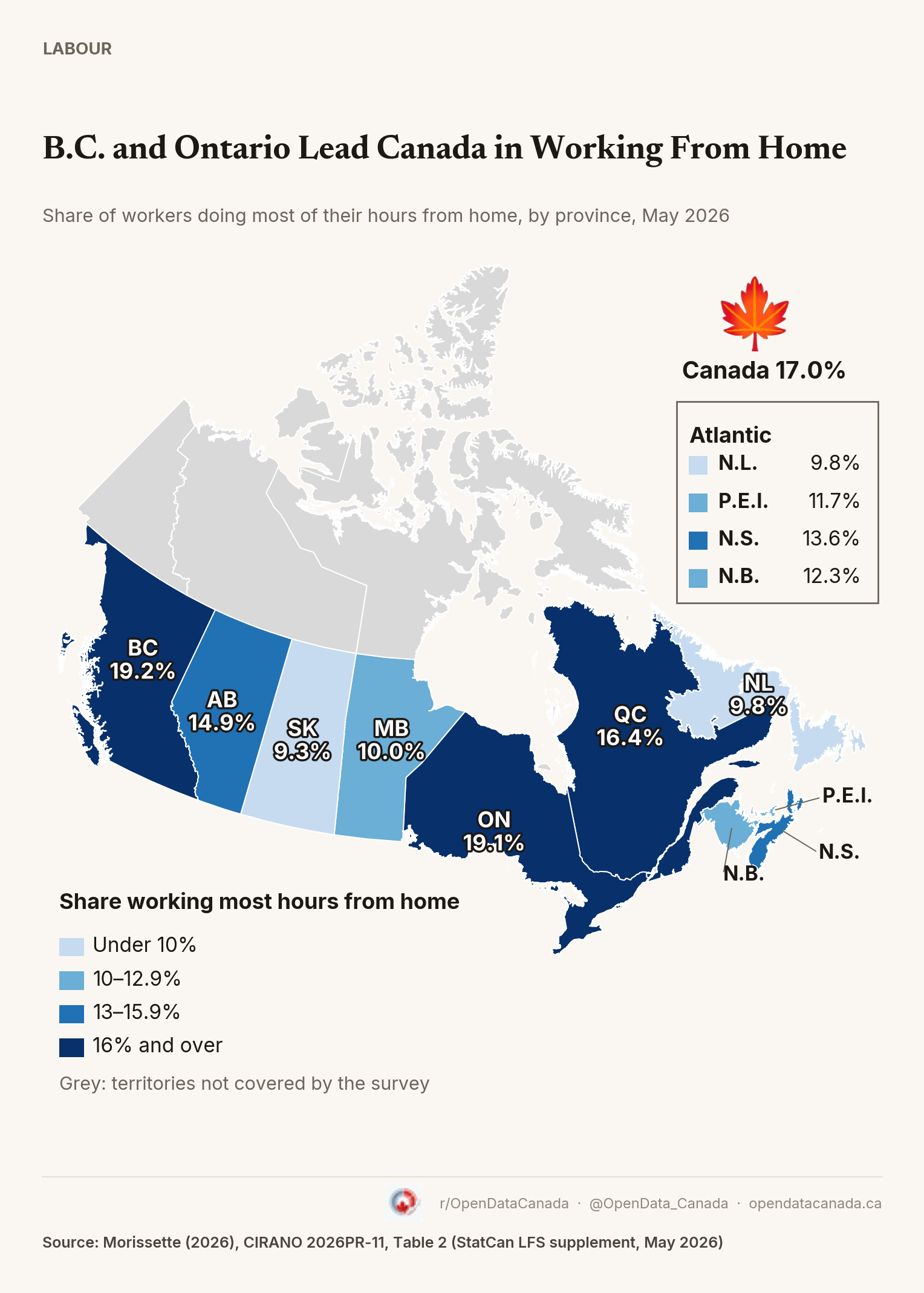
B.C. and Ontario lead Canada. Saskatchewan is the exception
British Columbia (19.2 percent) and Ontario (19.1 percent) are effectively tied at the top. Quebec is at 16.4 percent and Alberta at 14.9 percent. Newfoundland and Labrador (9.8 percent), Manitoba (10.0 percent) and Saskatchewan (9.3 percent) are at the bottom.
Saskatchewan is the only province where the rate is lower than in 2016: 9.3 percent now, versus 10.0 percent then. The four biggest provinces, plus Newfoundland and Labrador, New Brunswick and Nova Scotia, all at least doubled. The paper says the provincial differences partly reflect which industries each province is built on.
| Province | 2016 | 2026 |
|---|---|---|
| British Columbia | 8.2 | 19.2 |
| Ontario | 7.0 | 19.1 |
| Quebec | 6.6 | 16.4 |
| Alberta | 7.4 | 14.9 |
| Nova Scotia | 6.4 | 13.6 |
| New Brunswick | 5.6 | 12.3 |
| Prince Edward Island | 6.6 | 11.7 |
| Manitoba | 6.5 | 10.0 |
| Newfoundland and Labrador | 4.5 | 9.8 |
| Saskatchewan | 10.0 | 9.3 |
Share of workers doing most of their hours from home, per cent, May of each year.
Where the office won: government
The shift back to the office is especially visible in public administration. There, the rate fell from 37.9 percent in 2023 to 20.3 percent in 2026, a drop of about 18 points. Professional, scientific and technical services (think engineers, lawyers, accountants and IT firms) fell only from 53.4 to 48.5 percent over the same years. Finance, insurance and real estate is at 40.9 percent.
In those two private-sector fields, many people work entirely from home: 36.4 percent in professional services and 25.2 percent in finance, insurance and real estate.
Morissette reads this as some firms still choosing these arrangements, not just carrying leftovers from lockdown. He notes that the Canadian evidence does not establish whether they improve firms' profitability or productivity. Fewer commuters also matters for cities: see what the recovery in transit ridership looks like.
What this number does not tell you
It counts people who did most of their hours from home in the survey week. Someone who worked three days in the office and two at home could therefore fall outside this measure, depending on their hours. So 17.0 percent likely understates how many Canadians work from home at least some of the time.
The 2016 Census asked where people usually worked, while the Labour Force Survey asks where they worked most of their hours during the reference week. The comparison is therefore best read as a broad decade-long change rather than a perfectly identical measure.
The territories are not covered by the survey and are grey on the map.