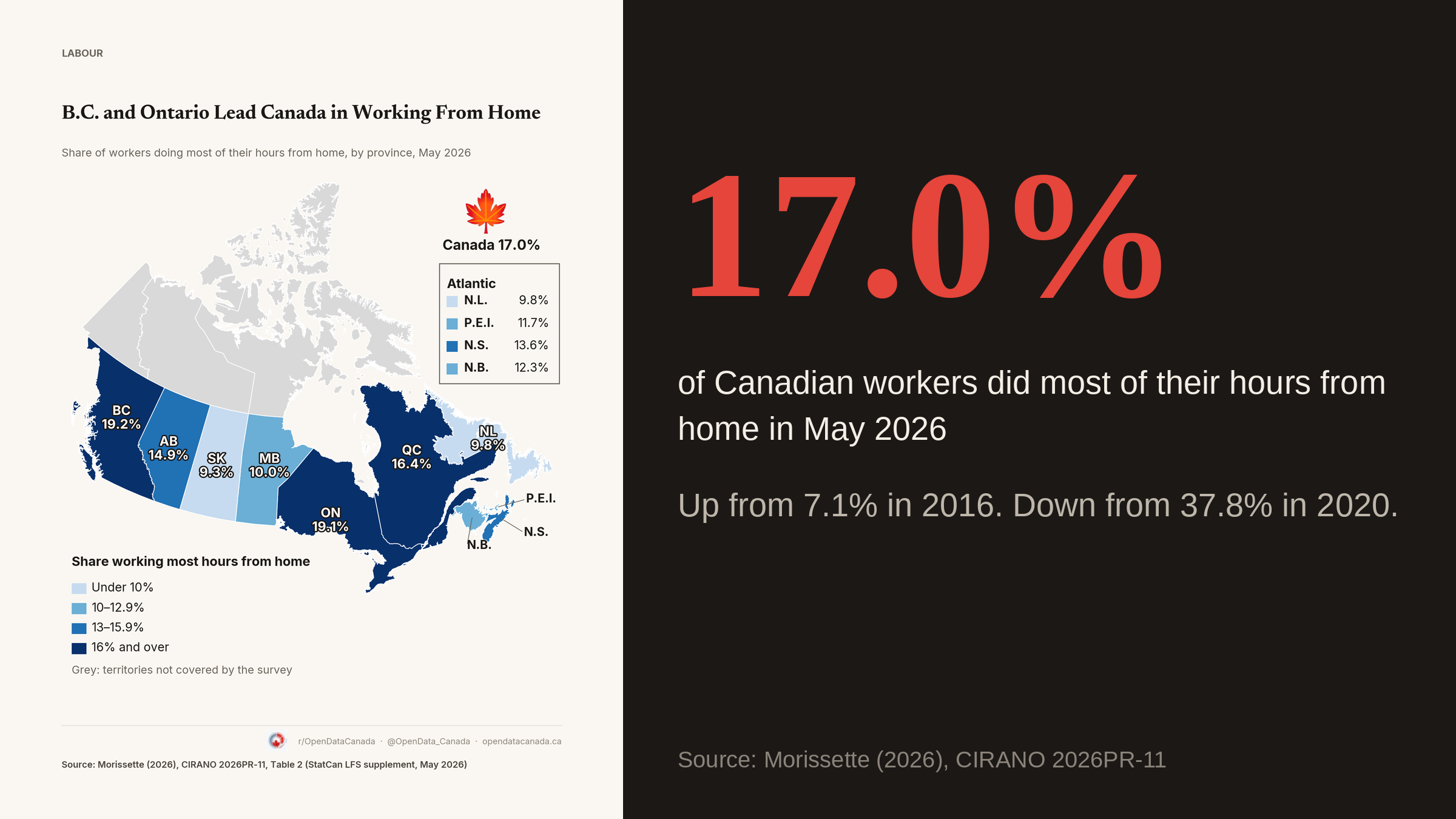
Labour · 4 min read
Government Workers Went From 38% Working From Home to 20%
In May 2026, about 13% of Canada's broader public sector worked mostly from home, against 19% of other workers. Government alone was 20%, above the 17% average.
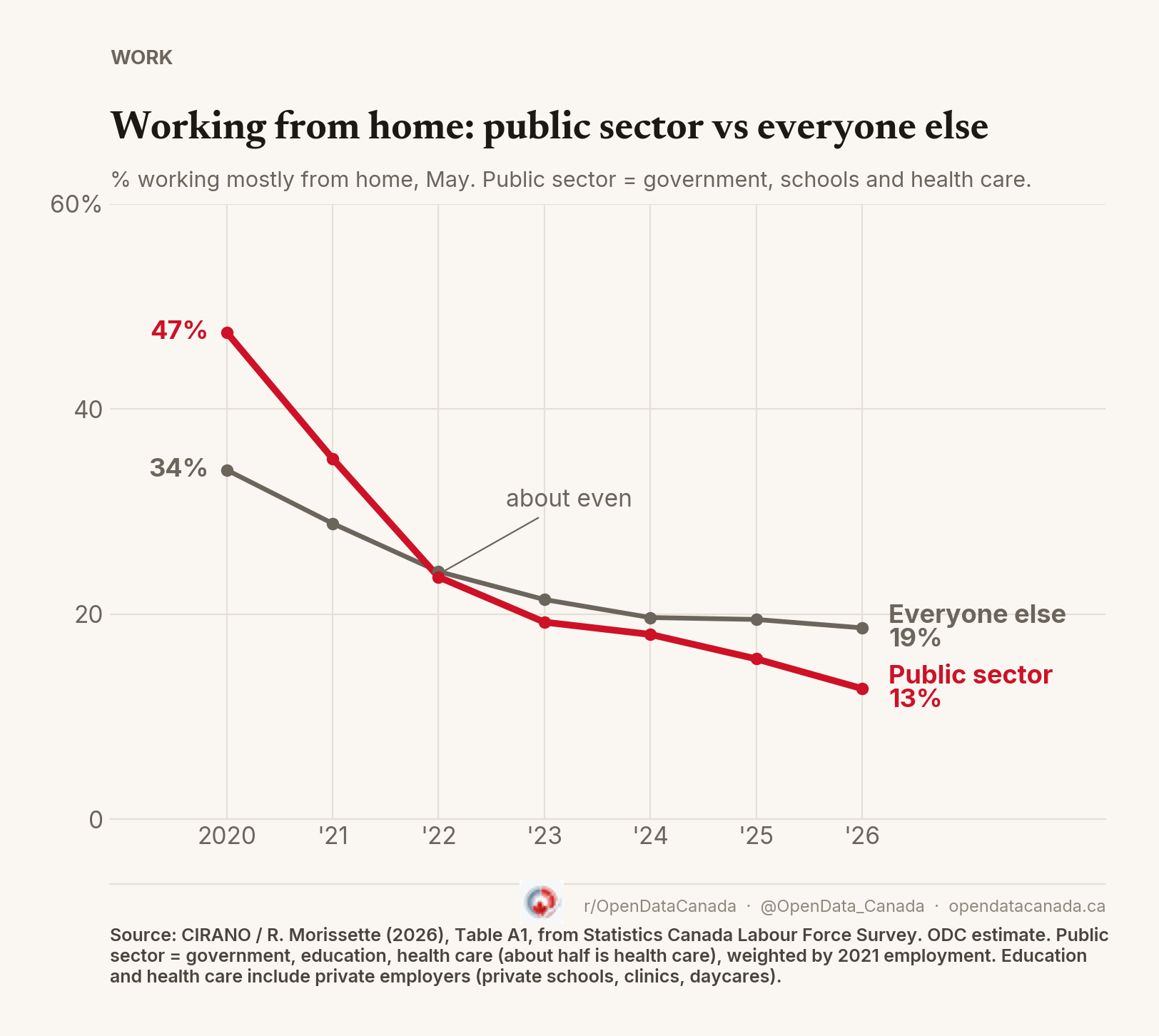
In May 2026, about 13% of workers in Canada's broader public sector (government, schools and health care) worked mostly from home. For everyone else, it was about 19%. In 2020 it was the other way around: about 47% of the public sector worked mostly from home, against 34% of other workers. The two groups were about even in 2022, and the public sector has been a little lower every year since.
That is our estimate, built from new figures by economist René Morissette, published by the Montreal research centre CIRANO. "Mostly from home" means a person did most of their paid hours at home in the survey week. Someone who works from home two days a week and goes to the office three is not counted.
Most of the public sector is hospitals, clinics and schools
Statistics Canada does not publish this measure split by public and private employer. So we grouped three industries that make up most of the broader public sector: government (public administration), education, and health care and social assistance, weighted by 2021 Census employment.
Health care makes up about half of that group (49%), education about 28% and government about 24%. Most health-care and teaching jobs are done in person.
On its own, government looks different. In May 2026, 20% of government workers worked mostly from home. That is above the 17% average for all workers, and 6th highest of 17 industries.
Where the drop came from
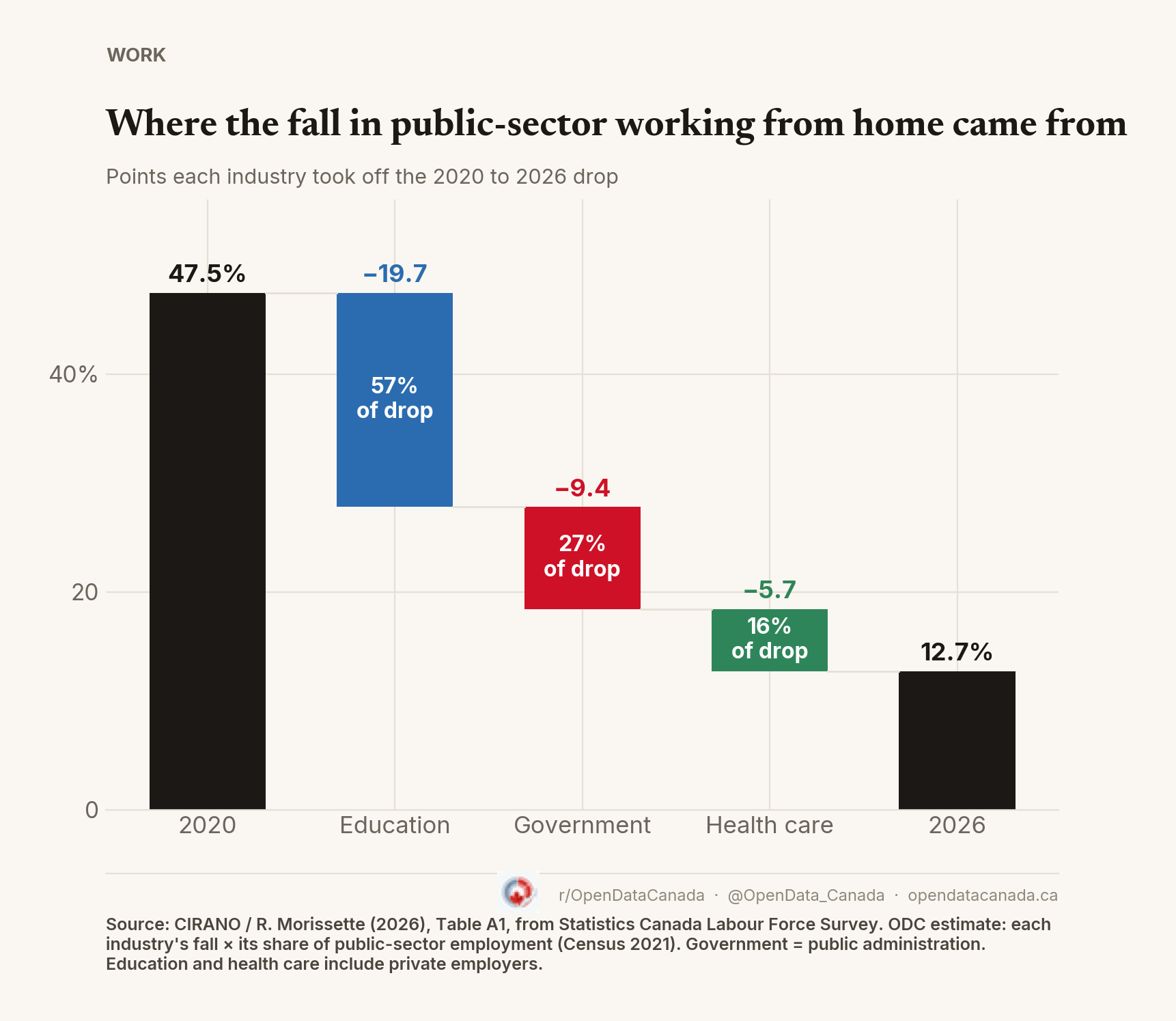
Between 2020 and 2026, the public-sector figure fell by about 35 percentage points (a percentage point is the plain difference between two percentages: 20% to 10% is a 10-point drop). More than half of that drop (57%) came from education, the period when schools went back to in-person classes. About a quarter (27%) came from government, and 16% from health care.
Government had the biggest drop since 2023
From May 2023 to May 2026, the share of government workers who worked mostly from home fell from 38% to 20%. That drop of 18 percentage points is the largest of any industry. Finance and real estate came next, down 10 points. Across all workers, the drop was 4 points.
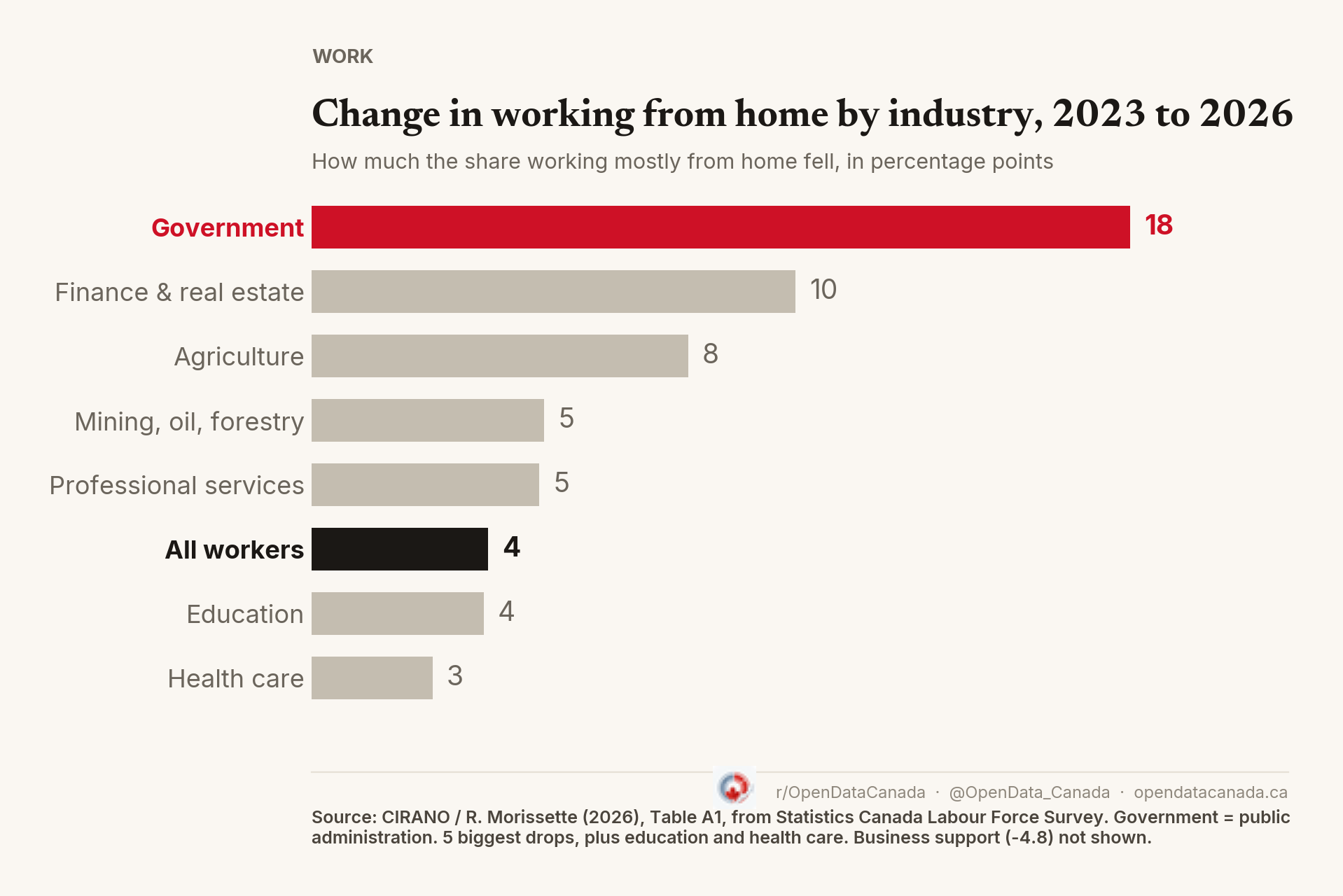
Government employers' office-attendance rules may be part of the reason, but these figures cannot show why the numbers changed.
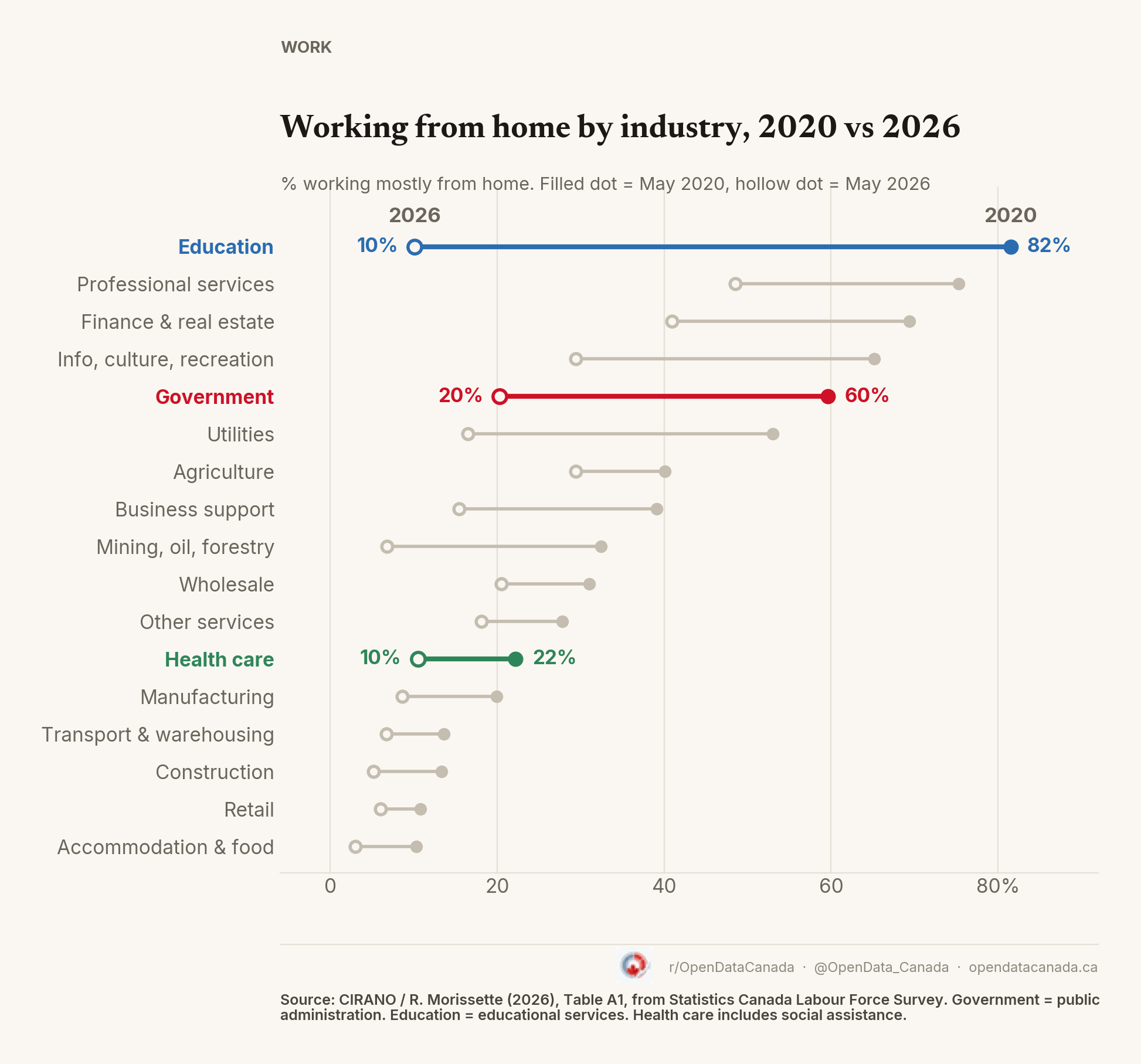
Education went from the top of the list in 2020 (82%) to 11th of 17 in 2026 (10%). Government went from 5th to 6th.
Before the pandemic
The public sector was already behind before COVID. In the 2016 Census, about 4% of workers in these three industries usually worked from home, against about 8% of everyone else. But the Census asks the question differently from the monthly jobs survey used in the chart, so the two cannot be joined into one line. In May 2021, when both were collected, the survey put the public sector at about 35% and the Census at about 24%. Read 2016 as a rough starting point, not a point on the same line.
Other studies count hybrid work, and show the public sector ahead
Other published figures count anyone who works from home at least some of the time, including hybrid workers. On that wider measure, the public sector comes out slightly ahead. In February 2024, Statistics Canada reported that 25.9% of public-sector employees worked from home at least some of the time, against 21.3% of private-sector employees. A 2024 C.D. Howe Institute study found 26.9% vs 24.2% for 2022–23.
Both results can be true at once. More public-sector workers have some home days, but fewer work mostly from home.
For the provincial picture, see how many Canadians work from home in 2026.