Health · Food safety
Are Driscoll's berries safe? Why some imported berries exceed Canada's pesticide limits
A whistleblower says half of Driscoll's shipments to Canada broke pesticide limits. Seven years of government tests on imported berries show why fruit can pass US rules and still fail Canada's.
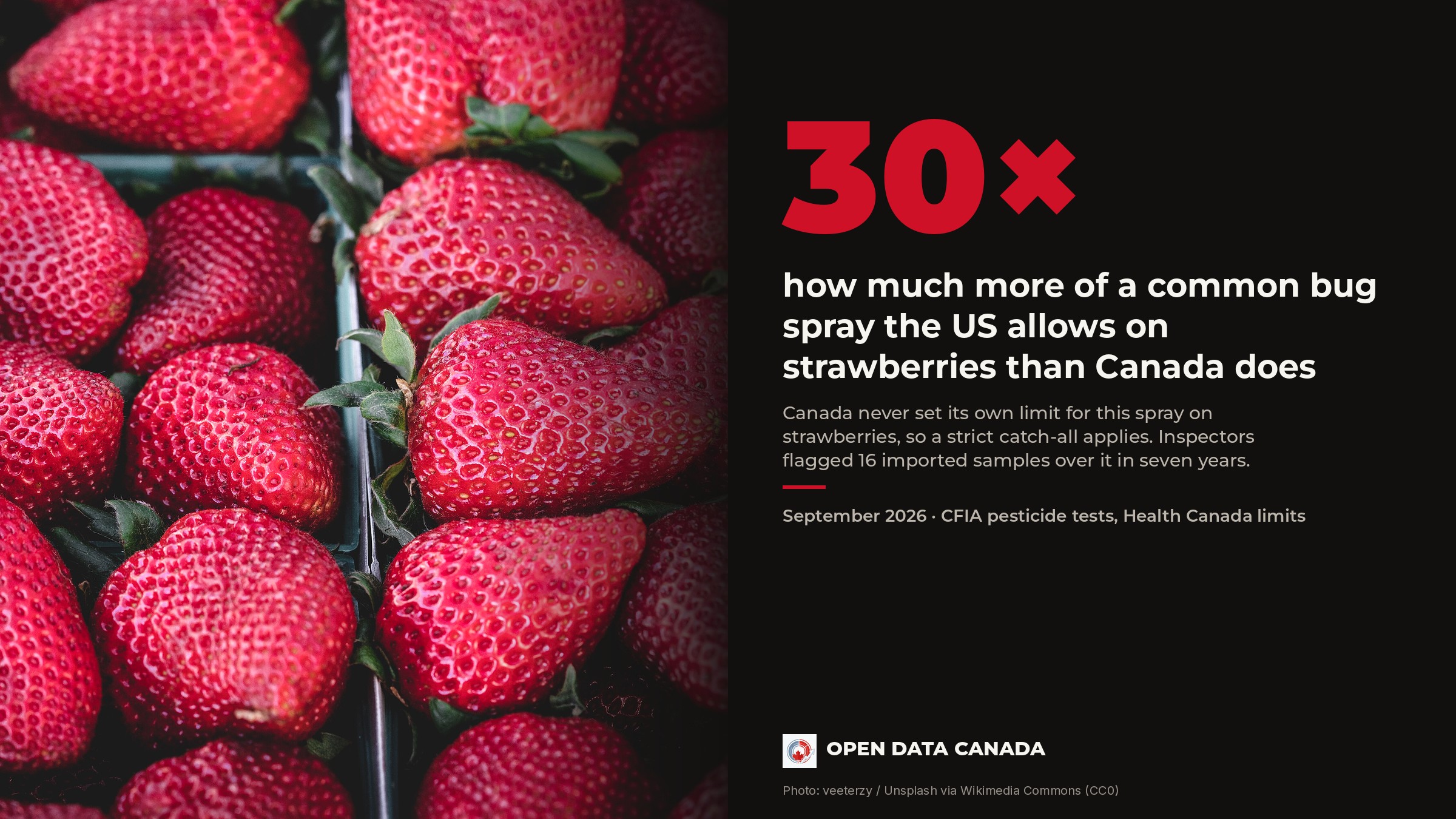
On Saturday, CBC News reported that a former Driscoll's food safety manager, David Harada, is suing the company in California. He claims that by Driscoll's own estimates, about half of its shipments to Canada from 2022 to 2024 had fruit over Canada's pesticide limits. Driscoll's denies the allegations and says it has never knowingly shipped products it believed to be unsafe.
The Canadian Food Inspection Agency (CFIA), the federal agency that tests food sold here, confirmed part of the picture. It told CBC that several of its inspections of Driscoll's berries between 2022 and 2024 found too much of three farm chemicals: bifenthrin, a common bug spray, and captan and iprodione, two sprays that protect fruit from mould and rot. None led to a recall.
So how does fruit sold across North America end up over the line in Canada? The agency's own testing points to a simple answer. We went through seven years of its random checks on imported fresh berries, 2016-17 to 2022-23, and compared the results with Canadian and American limits. For some sprays on some berries, Canada's limit is a tiny fraction of the US one.
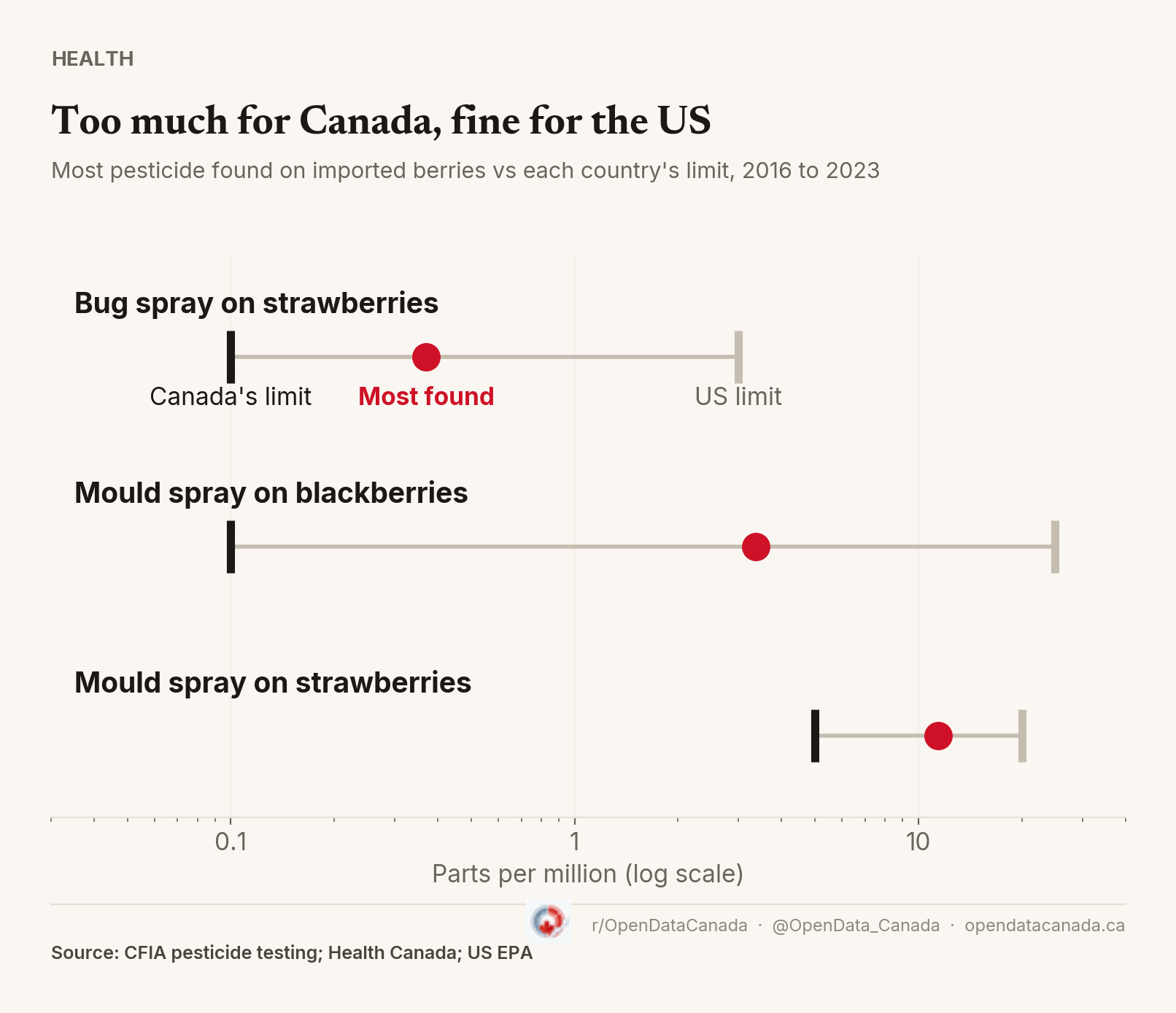
Same amount of spray, two different verdicts
Limits are measured in parts per million (ppm). One ppm means one milligram of pesticide in a kilogram of fruit.
Take bifenthrin, the bug spray. CFIA found traces of it on 103 of 495 imported strawberry samples and flagged 16 as over the limit. The highest reading was 0.37 ppm.
On blackberries, the highest reading was also 0.37 ppm. Flagged: zero.
Same spray, same amount, different result. Health Canada, which sets the limits, allows up to 1.0 ppm of bifenthrin on blackberries. For strawberries, it never set a number. When there's no specific limit, Canadian law falls back on a strict catch-all of 0.1 ppm. The US allows 3 ppm on strawberries, 30 times more.
The mould spray captan works the same way, on a different berry. Canada allows 5 ppm on strawberries, raspberries and blueberries, but never set a limit for blackberries, so the 0.1 catch-all applies. The US allows 25 ppm. CFIA flagged captan on 13 imported blackberry samples, about one in eleven. The highest reading, 3.36 ppm, was 33 times Canada's limit and well under the American one.
| Spray | Berry | Canada's limit (ppm) | US limit (ppm) | Most CFIA found (ppm) | Samples over Canada's limit |
|---|---|---|---|---|---|
| Bug spray (bifenthrin) | Strawberry | 0.1 (catch-all) | 3 | 0.37 | 16 |
| Bug spray (bifenthrin) | Blackberry | 1.0 | 1.0 | 0.37 | 0 |
| Mould spray (captan) | Blackberry | 0.1 (catch-all) | 25 | 3.36 | 13 |
| Mould spray (captan) | Strawberry | 5.0 | 20 | 11.43 | 15 |
Across strawberries, blueberries, raspberries and blackberries, CFIA recorded 100 over-limit results in seven years. More than a third, 36, involved a spray and berry where Canada had no specific limit, so the 0.1 catch-all applied. Seven of those were for THPI, the chemical captan turns into as it breaks down. Not every case comes down to a missing limit, though. Captan on strawberries went over Canada's real 5 ppm limit 15 times, with readings up to 11.4 ppm. Those would still have passed in the US, where the limit is 20.
Is it dangerous?
Not from a single container. A pesticide limit is a legal line, not the point where food turns harmful. "Exceedance one time of the maximum residue limit might not be translated as a risk for the health of consumers," McGill food scientist Stéphane Bayen told CBC. Toxicologist Daniel Green said the berries CFIA tested wouldn't make someone sick from eating a few: in one example, "To get an effect, one would have to eat 19 kilograms." His worry is exposure that adds up over a lifetime, from food and everything else.
Where Driscoll's fits in
Harada says Driscoll's switched off a system in 2022 that timed spraying and picking so the chemicals would fade below Canadian limits before fruit shipped north. Driscoll's denies it.
The CFIA data doesn't say which brand any sample came from. It does show why a system like that would matter. Fruit grown to US rules can be perfectly legal there and still be over the line in Canada, and the same three chemicals CFIA found in Driscoll's berries show up in its wider berry testing year after year.
Health Canada could close the gap by setting its own limits for these sprays on these berries, as it did for bifenthrin on blackberries. The public data can't settle whether Driscoll's shipments fell into this gap. It does show that for some sprays on some berries, growers face very different limits depending on whether the fruit is headed to Canada or the United States.
Related: what Canadians are paying at the grocery store and how Canada polices what crosses the border.