Jobs
Teens' share of Canada's retail and restaurant jobs hits a record low
About 118,000 fewer teenagers work in retail and food services than in 2022, even though the two industries added 133,000 workers. Students have been hit hardest.

The cash register and the fryer have been the classic first job in Canada for decades. But teenagers are becoming a much smaller part of the workforce in the industries that have traditionally hired them.
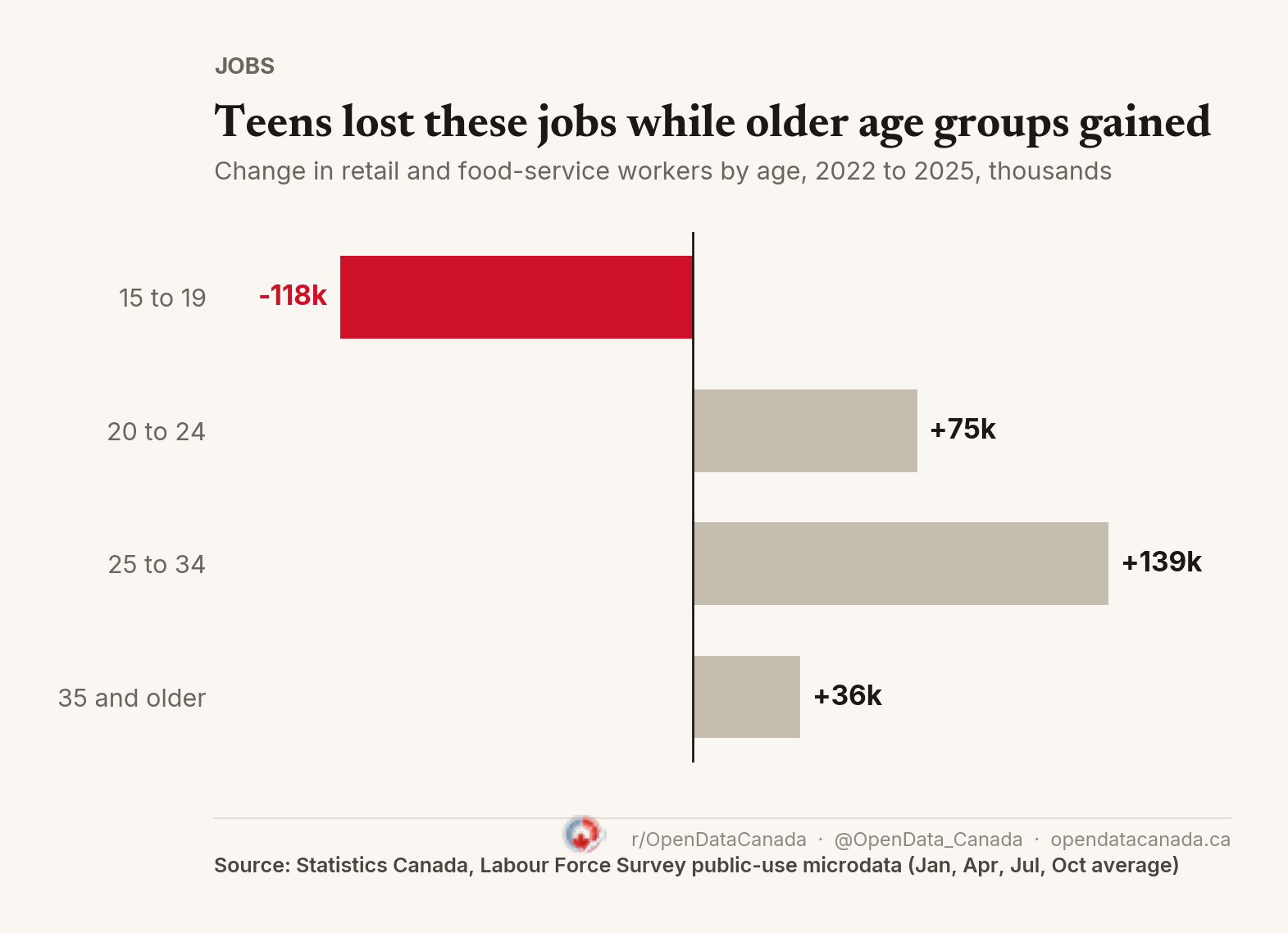
In 2022, about 606,000 teenagers aged 15 to 19 worked in retail stores, restaurants, coffee shops and hotels. By 2025 that number had fallen to about 488,000, a drop of 118,000, or nearly one in five.
The industries didn't shrink. Retail and food services employed about 133,000 more people in 2025 than in 2022. But the growth came from older age groups while teen employment fell.
Teens hold their smallest share of these jobs on record
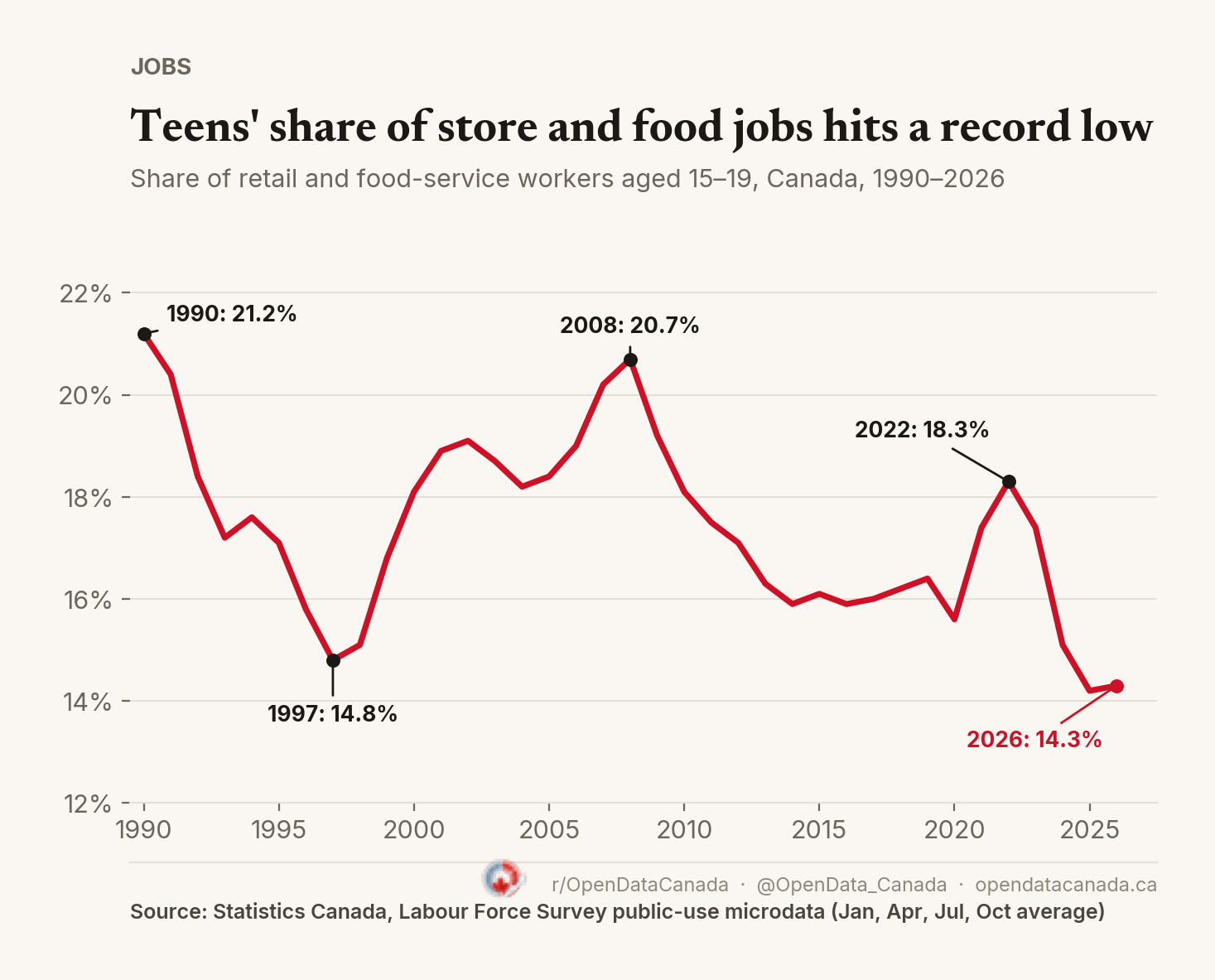
In 2022, about 18 of every 100 retail and food-service workers were teenagers. In 2025 it was about 14 (14.2%), and 2026 so far is the same (14.3%). Both are the lowest in records going back to 1990, just below the previous low of 14.8% in 1997.
The drop hit both halves of the sector:
| Teens' share of workers | 2022 | 2025 |
|---|---|---|
| Restaurants, coffee shops and hotels | 25.1% | 18.4% |
| Stores | 15.3% | 11.9% |
In stores, about 1 in 8 workers is now a teenager. In 1990 it was nearly 1 in 5.
The growth went to workers in their twenties
Between 2022 and 2025, workers aged 20 to 24 in these industries grew by about 75,000 and workers aged 25 to 34 by about 139,000. Teens were the only one of these broad age groups that shrank.
The survey doesn't show who was hired in place of whom. But a September 2026 study by the Centre for the Study of Living Standards, an Ottawa research group, found evidence of a broader shift. By May 2026, retail job vacancies were only 3% above their January 2016 level, compared with 37% for all industries. Vacancies in accommodation and food services were up just 11%. Between early 2023 and mid-2026, the number of university graduates aged 20 to 24 working in retail and food services rose 54%. The researchers conclude that these employers "have recently shifted labour away from teenagers to older, more highly educated workers." They also point to a weak economy, productivity gains that let businesses do more with fewer staff, and, likely, competition from the fast-growing number of temporary residents.
Employers say much the same. A Toronto bike shop owner told CP24 in August that the store "may have hired four youth versus 10 or 12 in the last few years," as it moved to full-time, year-round staff. At the Canadian National Exhibition's 2025 summer job fair in Toronto, 5,000 openings for cashiers, food staff and ride operators drew 54,000 online applications, CBC News reported.
There are more teenagers, but fewer are working
The teen population grew from about 2.07 million in 2022 to 2.30 million in 2025.
The share of teenagers actually working has fallen sharply, from 45.3% in 2022 to 37.6% in 2025. Students took the biggest hit. Teens in school holding retail and food-service jobs fell from about 377,000 to 289,000, down 23%. Teens not in school fell 13%.
Across all industries, 37% of teens in school had a job in 2022. In 2025 it was 29.7%, and 2026 so far is 29.1%. That is about level with the 28.9% recorded in 1997, the low in records going back to 1990.
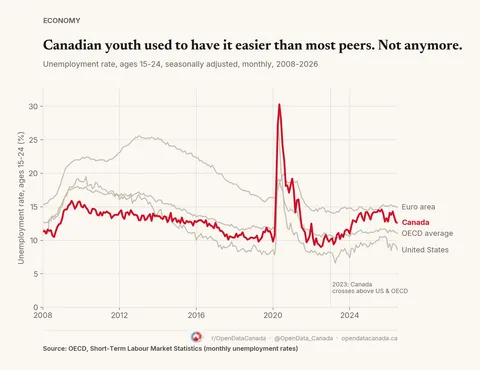
Unemployment, which counts only teens actively looking for work, tells the same story. It averaged 20.8% for 15- to 19-year-olds in July to September 2025, up from 12.6% in the same months of 2022, Statistics Canada reported.
Outside the pandemic, the last comparable low came in 1997
Setting aside 2020, when lockdowns pushed the teen employment rate to 36.7%, the closest match is 1997. After the early-1990s recession and a slow recovery, it fell to 37.1% that year, almost exactly where it was in 2025.
The difference is who else was hurting. In 1997 only 77.3% of adults aged 25 to 54 had a job. In 2025 it was 83.3%, a bit below 2022 but far above 1997. Back then the whole job market was weak, and teens recovered when it did: by 2008 they held 20.7% of retail and food-service jobs again.
This time adults are working and teens are not. Youth unemployment eased over summer 2026, but October's jobs report showed wholesale and retail trade, a broader grouping that includes stores, down 29,000 jobs in a month. The teen share of retail and food-service jobs hasn't moved off its low.
A first job teaches showing up on time, handling a rush and dealing with customers. For generations, stores and restaurants have provided it. A much smaller share of those jobs now goes to teenagers, and the latest numbers show little sign of that reversing.