Transportation · 2 min read
Private planes account for 55% of Canada's aircraft accidents. But are they more likely to be fatal?
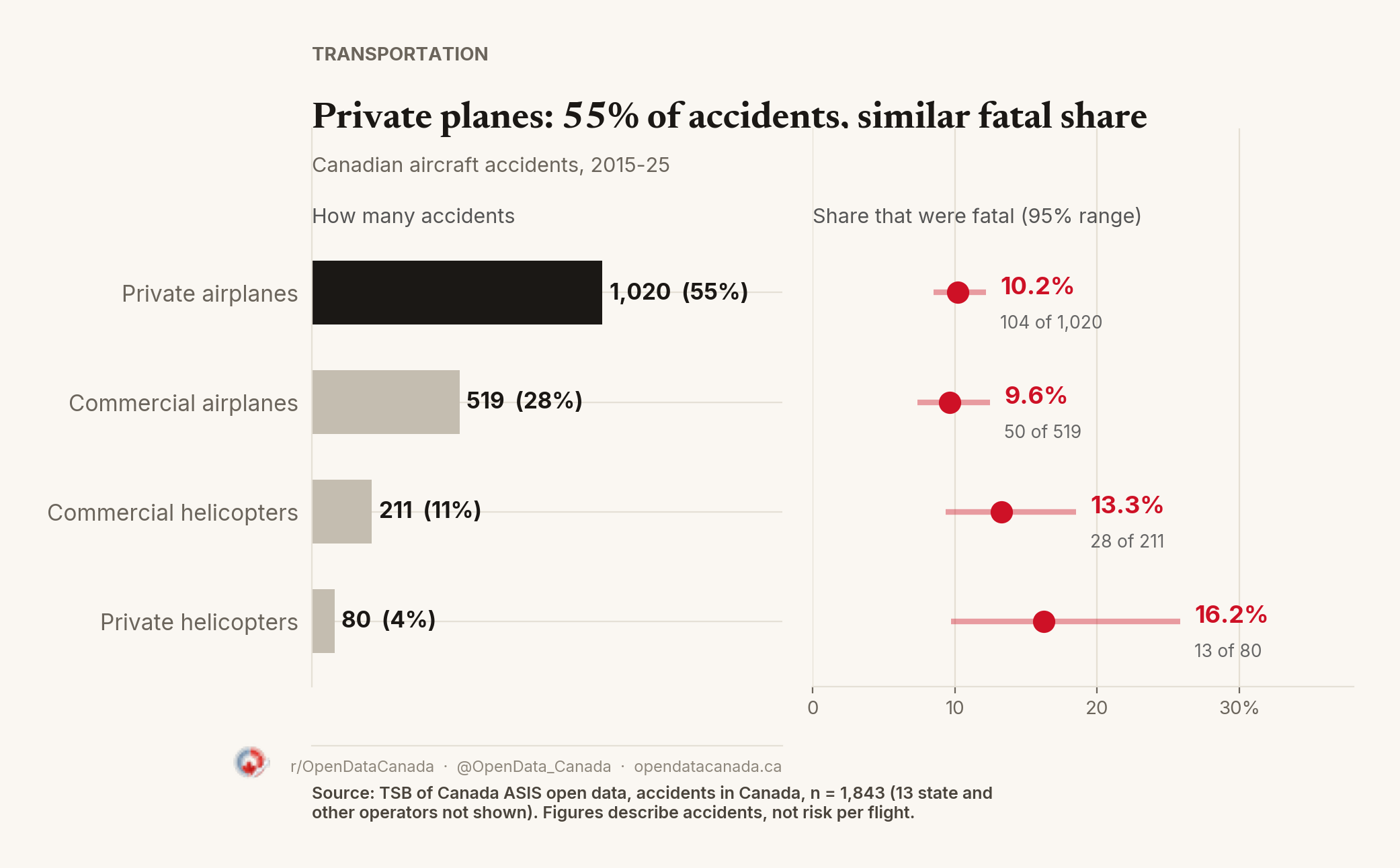
Private airplanes were involved in 1,020 of 1,843 Canadian aircraft accidents between 2015 and 2025. About 1 in 10 of them was fatal, close to the share for commercial airplanes.
Private airplanes account for more than half of Canada's recorded aircraft accidents. But when an accident happens, they are about as likely to be fatal as accidents involving commercial airplanes.
Between 2015 and 2025, private airplanes were involved in 1,020 of 1,843 accidents involving Canadian-registered airplanes and helicopters in Canada. That is 55 percent of the total. Of those 1,020 accidents, 104 were fatal, or 10.2 percent. For commercial airplanes the figure was almost identical: 50 of 519, or 9.6 percent.
| Aircraft and operator | Accidents | Fatal | Fatal share | Likely range |
|---|---|---|---|---|
| Private airplanes | 1,020 | 104 | 10.2% | 8.5% to 12.2% |
| Commercial airplanes | 519 | 50 | 9.6% | 7.4% to 12.5% |
| Commercial helicopters | 211 | 28 | 13.3% | 9.3% to 18.5% |
| Private helicopters | 80 | 13 | 16.2% | 9.8% to 25.8% |
The 95 percent likely ranges for private and commercial airplanes overlap. The data do not show a meaningful difference between them. Leaving out 2020 and 2021, when flying fell during the pandemic, gives the same result: 10.4 percent for private airplanes and 10.8 percent for commercial airplanes.
A larger share of helicopter accidents was fatal: 13.9 percent of 294, compared with 9.9 percent of 1,549 for airplanes. But helicopter accidents are far fewer, so the estimates are less precise, and the gap is only just large enough to rule out chance. Helicopters also do riskier jobs, such as moving external loads and fighting fires.
What counts as private and commercial?
The board classes every accident by the kind of operator. "Private" is that class. It describes who was flying and whether it was for hire, not the type of aircraft. In 86 percent of private accidents (951 of 1,100), the recorded purpose was pleasure or travel. The other 149 included training (39) and business (30) flights.
"Commercial" covers flying for hire or reward: airlines and air taxis, flight schools, air ambulances, crop spraying, forest-fire fighting and helicopter skiing. Thirteen accidents involving state or other operators fit neither group and are left out of the table. None was fatal.
What the numbers do not say
These figures describe what happens after an accident, not the chance of having one. The files do not say how many flights or hours each group flew, so they cannot show whether private flying is safer or riskier than commercial flying.
Across all four groups, between about 10 and 16 percent of accidents were fatal.
Related reading: Canada's road fatality rate.