Government · 7 min read
Ottawa cut 22,490 public servants. Outside spending rose 10% after inflation.
The public service shrank 6.1% in two years while spending on outside services rose 10% after inflation. The growth sits at National Defence and the Coast Guard it absorbed. Across the rest of government, the outside bill fell 1% after inflation.
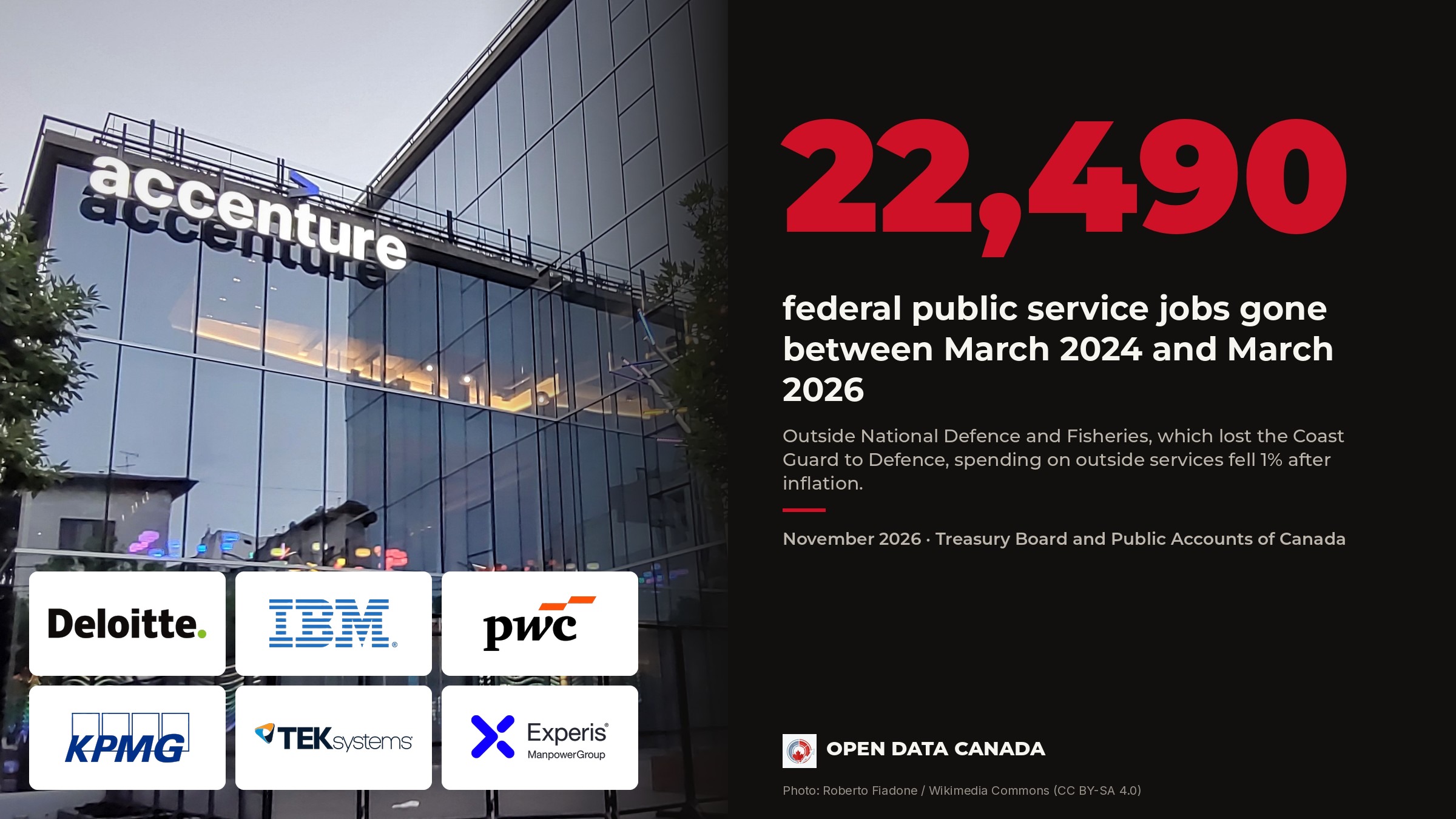
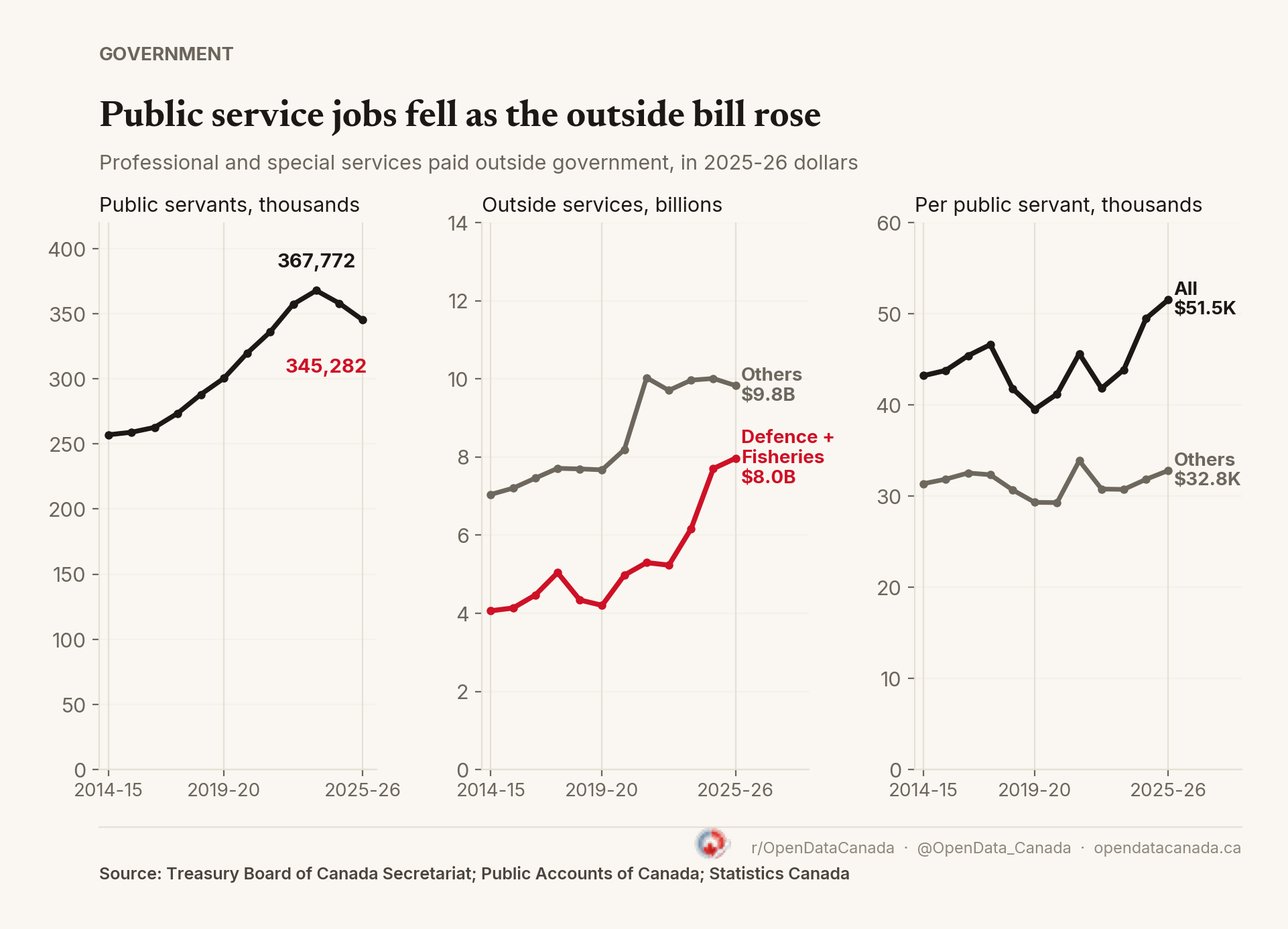
The federal government had 367,772 public servants in March 2024 and 345,282 in March 2026. Over those two years, what departments paid organizations outside the federal government for professional and special services rose from $16.1 billion to $17.8 billion after inflation.
Payment records for each department show little sign of outside firms moving in where staff moved out. The jobs went at departments like the Canada Revenue Agency. The money went mostly to National Defence, which gained staff and, in September 2025, the Canadian Coast Guard.
The Liberal platform promised in 2025 to reduce reliance on consultants "while improving the capacity of the public service to hire expertise in-house." Two years of records show the workforce shrinking and the outside bill growing, in separate parts of government.
The Canadian Press reported that Ottawa spent $19 billion on external consultants last year. That is the government's consolidated total for all professional and special services. It fell slightly from $19.6 billion, because about $900 million for a refugee health program moved to a different column. Without that program, it rose about 2%.
| 2025-26 | Billions | What it counts |
|---|---|---|
| Departments' own bills | $22.8 | Includes payments between federal bodies |
| Consolidated total, the Canadian Press figure | $19.2 | Subtracts $3.65 billion in official internal adjustments |
| Traceable outside spending, used here | $17.8 | Subtracts $5.0 billion paid to named federal payees, and the refugee health program |
The $17.8 billion is a traceable subset and should not be read as a rival to the official total, which also reflects Crown corporations and accounting entries that can't be followed payee by payee.
Most departments that shrank spent less outside
Of the 46 departments and agencies with at least 500 staff and a comparable outside bill, 35 got smaller. Twenty-two of those spent less on outside services and 13 spent more.
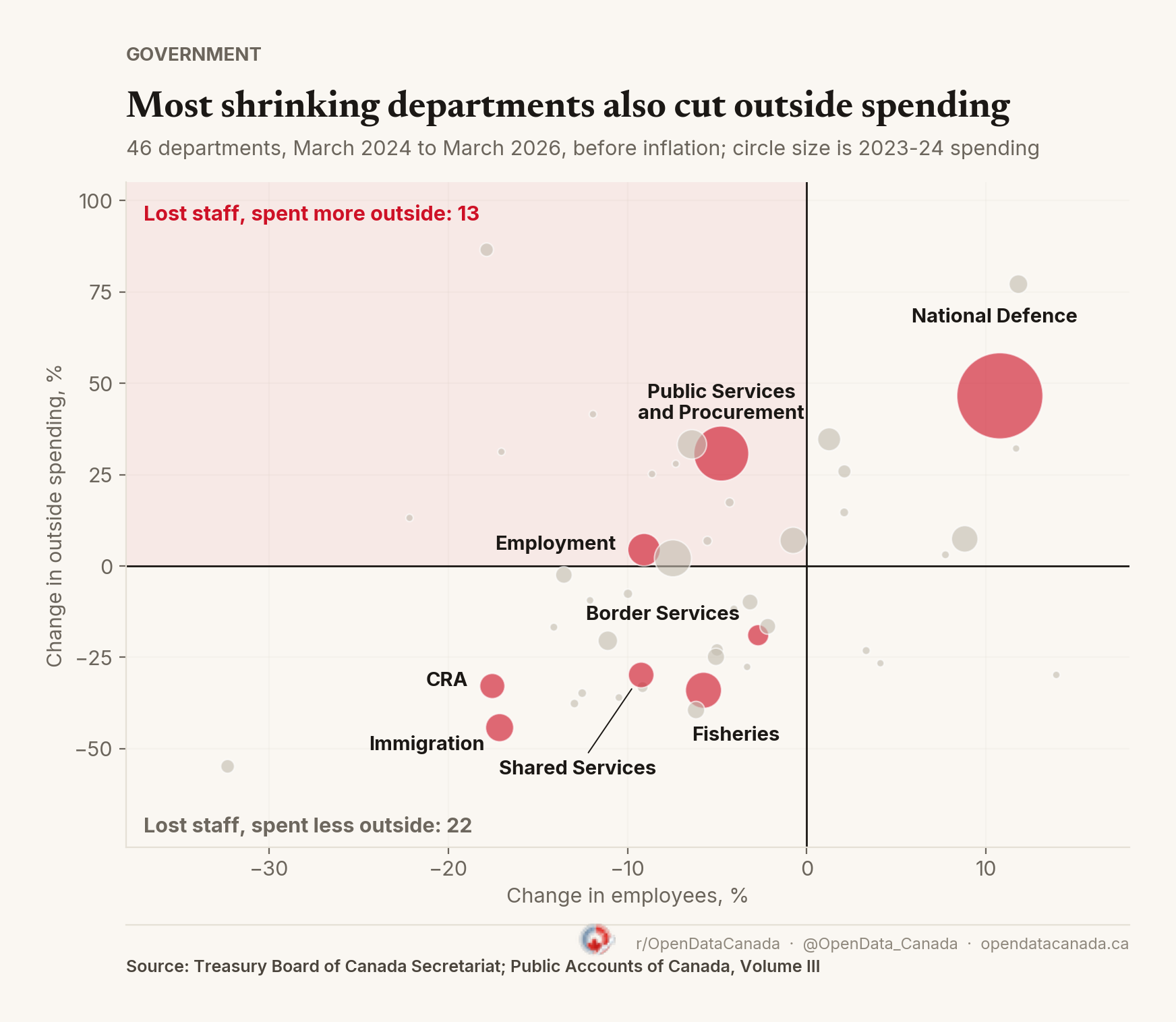
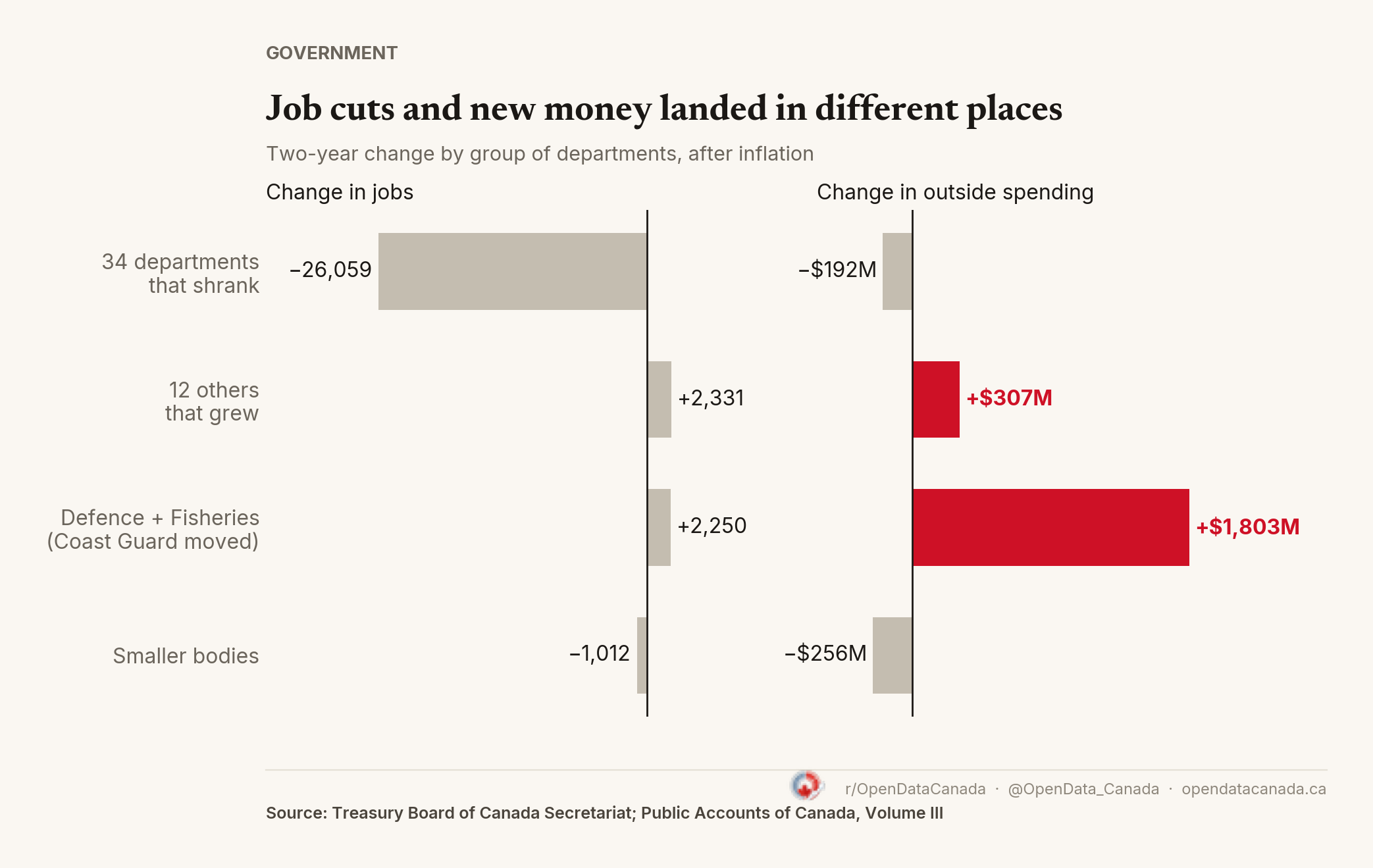
Setting Fisheries and Oceans aside for the reason below, the 34 shrinking departments lost 10.1% of their workforce. Their outside spending went from $8.1 billion to $7.9 billion after inflation, about 2% less. The Canada Revenue Agency lost 10,381 people, the most of any department, and spent $131 million less on outside services. Shared Services and Health Canada also cut both.
Defence's civilian workforce grew, partly through transfers
National Defence's civilian workforce grew from 28,740 to 31,838, a count that leaves out military members. Part of that is a reorganization. The Canadian Coast Guard moved to National Defence from Fisheries and Oceans on September 2, 2025, along with some of that department's internal-services staff.
Neither the staff table nor the payment records list the Coast Guard separately, and no official count of the people moved was found. The payments show the shift. Vancouver Shipyards received $570 million from Fisheries in 2024-25 and nothing from Defence, then $207 million from Fisheries and $367 million from Defence in 2025-26. Fisheries lost only 848 staff over the two years, which suggests the March 2026 count may not yet show the full move. Together the two departments added 2,250.
Counted together to remove the transfer, Defence and Fisheries went from $6.2 billion to $8.0 billion after inflation, more than the net increase across all of government. Everyone else combined went from $10.0 billion to $9.8 billion.
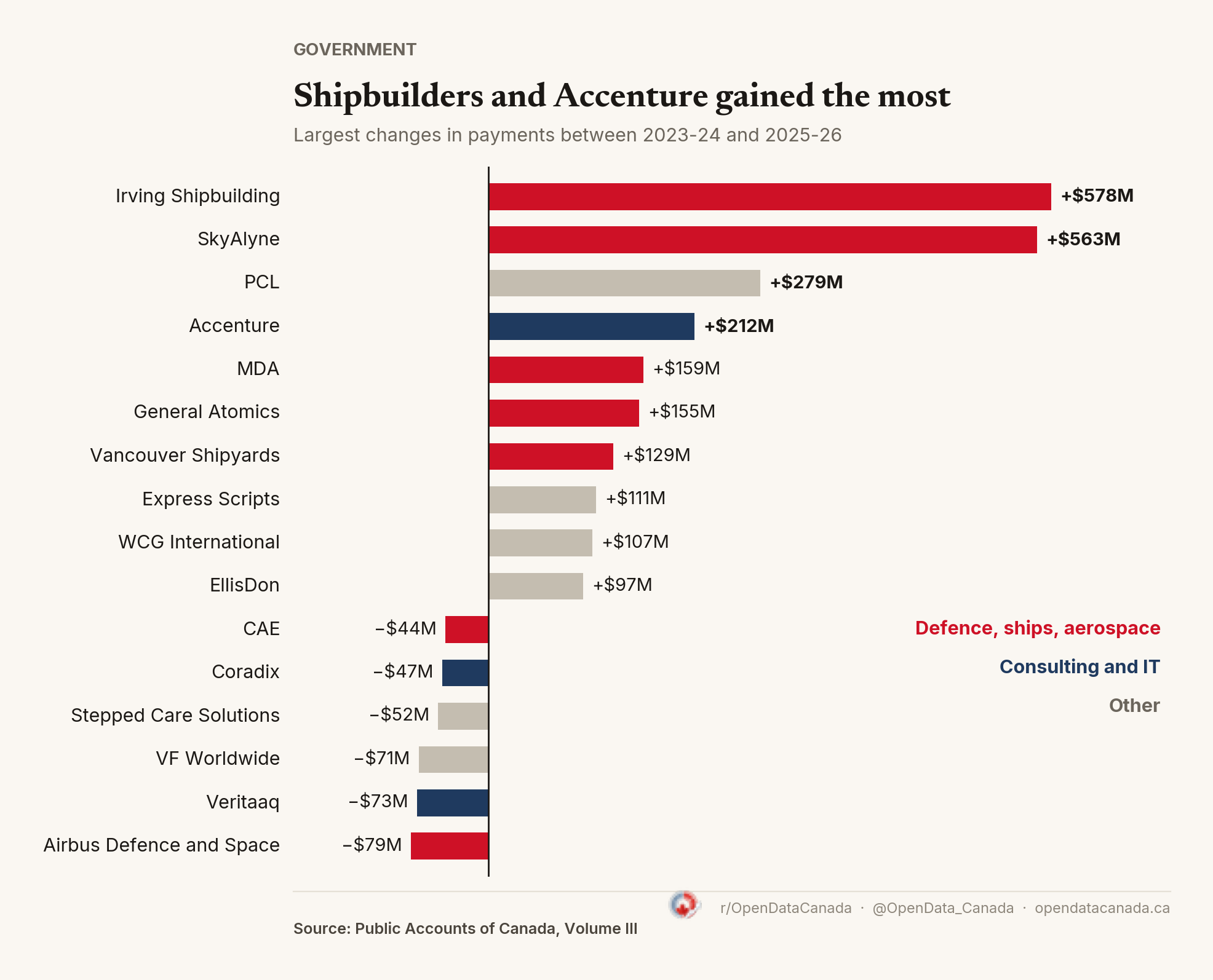
Irving Shipbuilding gained the most, $578 million. SkyAlyne, which runs the new military pilot training program, went from nothing to $563 million.
That spending is what pushes the bill per public servant up. In 2014-15, after inflation, Ottawa spent $43,200 on outside services for every public servant. In 2023-24 it spent $43,900, even though the public service had grown 43%. Two years later the figure was $51,500. Without Defence and Fisheries, in both the spending and the staff count, it was $32,800, up 7%.
Consulting-related services rose 12%, mostly on engineering and ships
The line labelled management consulting in the Public Accounts is a small slice of the expert advice Ottawa buys. To capture more of it, this analysis groups six lines: management, IT, business, engineering and architecture, science and legal services. That grouping is not the government's official consulting total. It went from $9.8 billion to $11.0 billion before inflation, or 7% more after it.
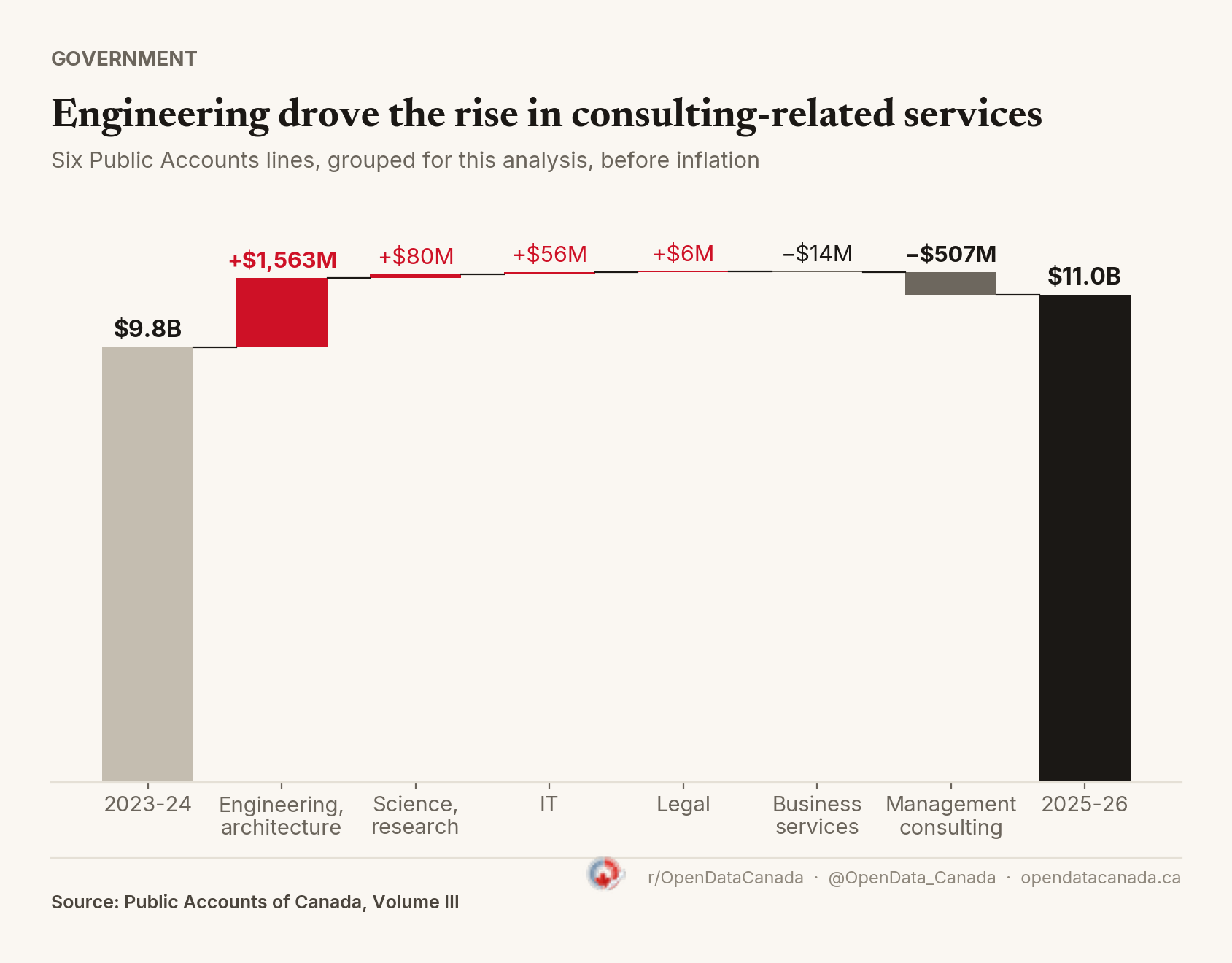
Engineering and architecture rose $1.6 billion, and 79% of that was at Defence and Fisheries. About $824 million of the wider increase went to shipbuilders and ship maintenance firms. Without them, the group rose 4% before inflation and stayed flat after it. Outside Defence and Fisheries, it fell 10% after inflation.
Management consulting fell from $751 million to $244 million. Deloitte's payments on that line dropped from $166 million to $7 million while its IT and "other services" lines rose by $113 million. Payment records can't show whether the work itself changed.
Ottawa's own count is a separate measure. The spring economic update put "management and other consulting" at $5.1 billion in 2024-25 and promised a 20% cut over three years, a saving Budget 2026 counts on.
Where the job cuts and the outside money overlap
Thirteen shrinking departments spent more on outside services anyway, $985 million more between them. Public Services and Procurement lost 904 people and added $628 million. Its payments to PCL, a construction firm, went from $271 million to $546 million. Veterans Affairs rose $186 million, mainly on health and welfare services.
The sharpest overlap is one company. Immigration, Refugees and Citizenship Canada lost 2,244 people, 17% of its staff, and its payments to Accenture for consulting and IT services went from $7.5 million to $99 million, even as its overall outside bill fell $225 million. Employment and Social Development Canada lost 3,549 people, and those Accenture payments went from $15 million to $143 million. The two departments now make up 95% of what the firm receives for consulting and IT.
Both jobs are large computer system replacements. At Immigration, Accenture won a contract in 2023 as systems integrator on a new client platform, worth $74.9 million at the time. At Employment and Social Development, it was one of four firms chosen in 2021 to move benefits onto a new platform. Those contracts came before the job cuts, and payment records can't show whether Accenture's staff now do work that departing public servants once did.
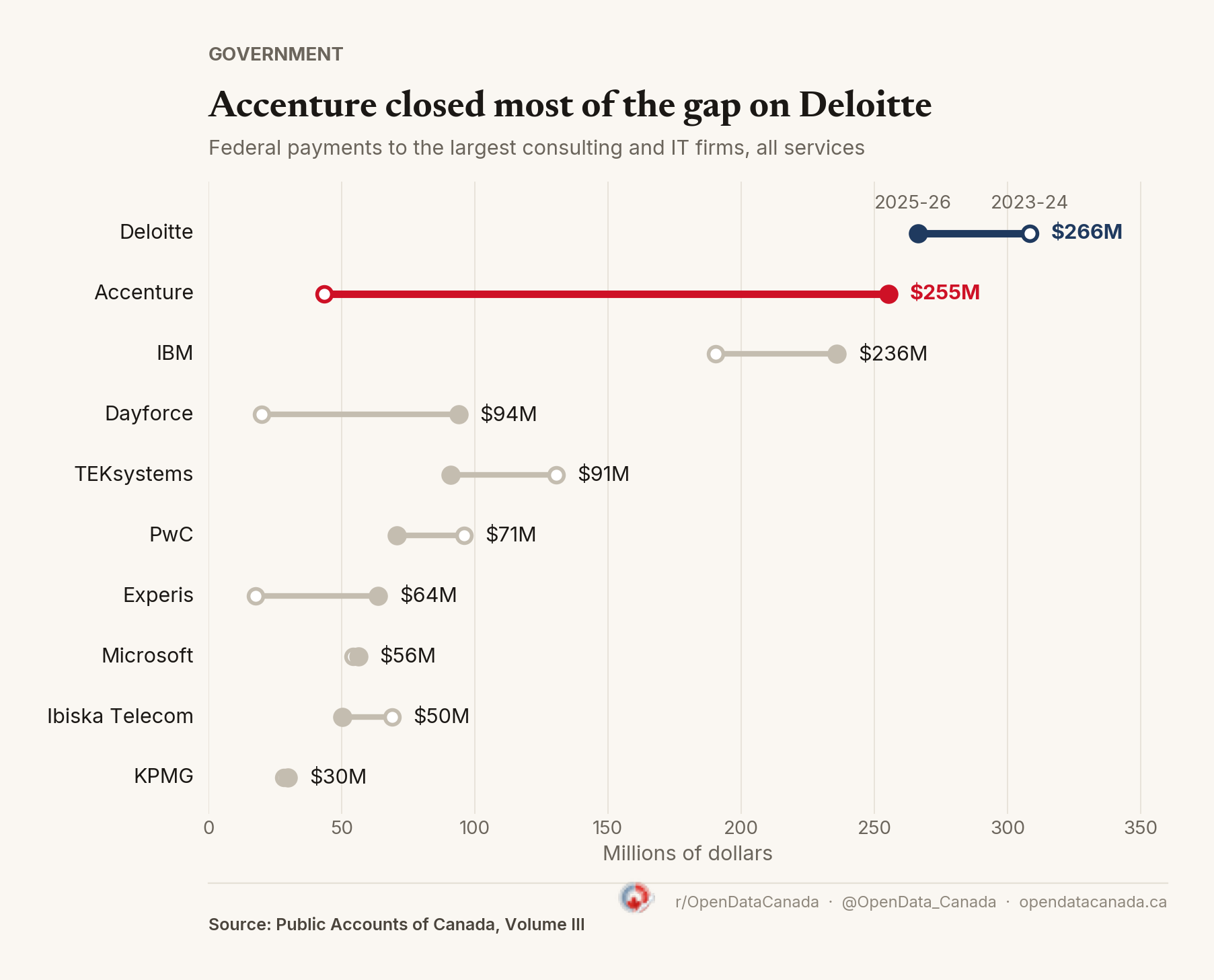
Accenture was $265 million behind Deloitte two years ago and is now $11 million behind. It stands out among firms that mainly sell management advice and IT, where 245 companies together went from $2.68 billion to $2.37 billion before inflation.
Dollars can't count contractors, and two years is a short window. Headcount is a snapshot on March 31 and includes term and casual workers, while spending covers a full year, so the per-person figures are approximate.
Budget 2025 expects the public service to reach "roughly 330,000" by the end of 2028-29, about 15,000 fewer than today. The departments that have already shrunk still pay almost the same outside bill they did two years ago.