Government · Federal public service
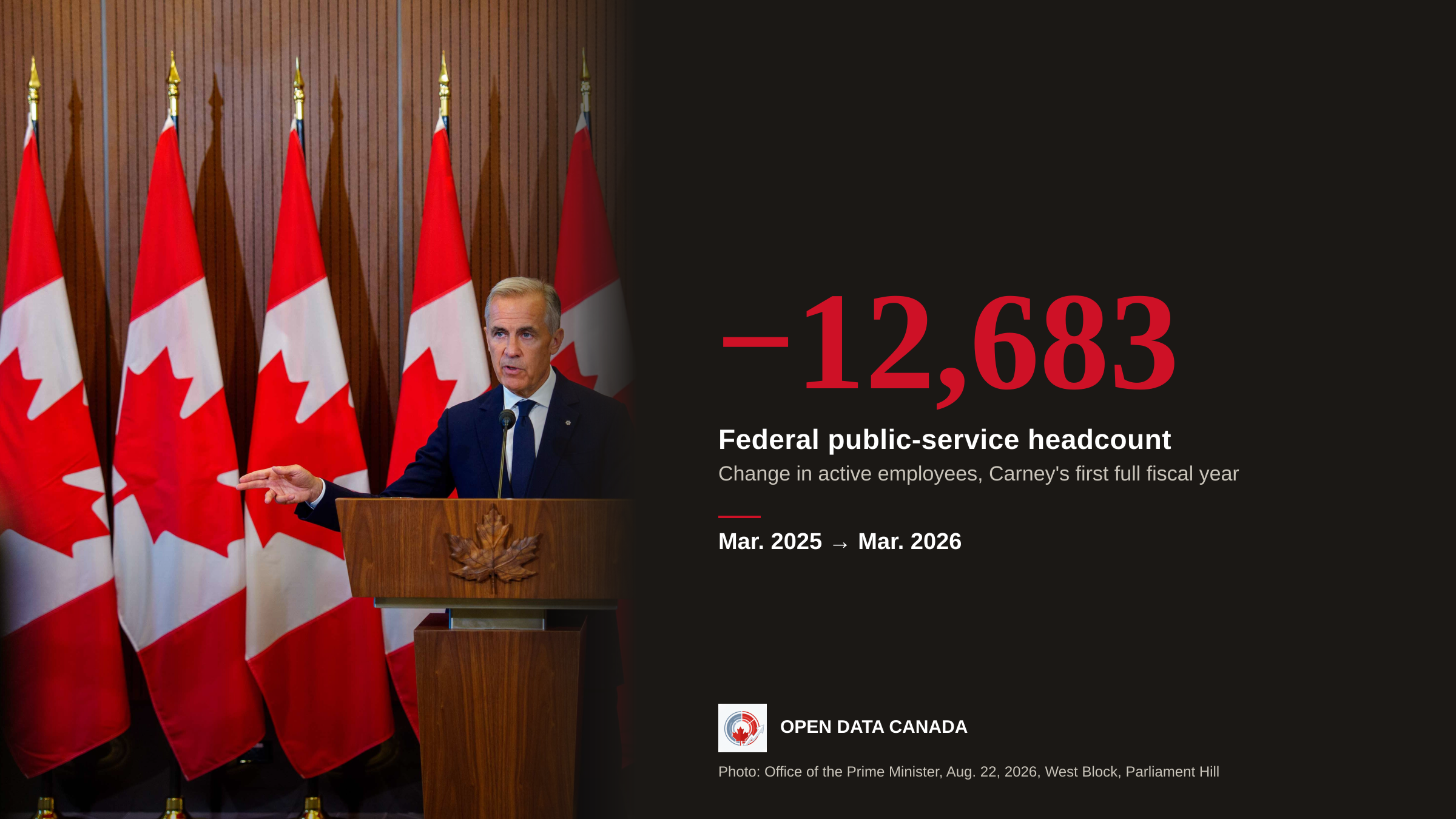
Federal public service fell by 12,683 in Carney's first full fiscal year
That's 54% larger in magnitude than the combined increase during Martin, Harper and Trudeau's first full fiscal years.
Every spring, the Treasury Board counts the active federal public service as of March 31, covering the core public administration and separate agencies included in its Pay System. Line up that count for the first full fiscal year of each of the last four prime ministers, and three of them show relatively small changes. Carney's first full fiscal year shows a much larger decline.
Paul Martin's first full fiscal year (2004-05) trimmed the headcount by 187 people, essentially flat. Stephen Harper's first full fiscal year (2006-07) added 4,690. Justin Trudeau's first full fiscal year (2016-17) added 3,717. Add those three together and the public service grew by 8,220 employees, net, across three very different governments and three different agendas.
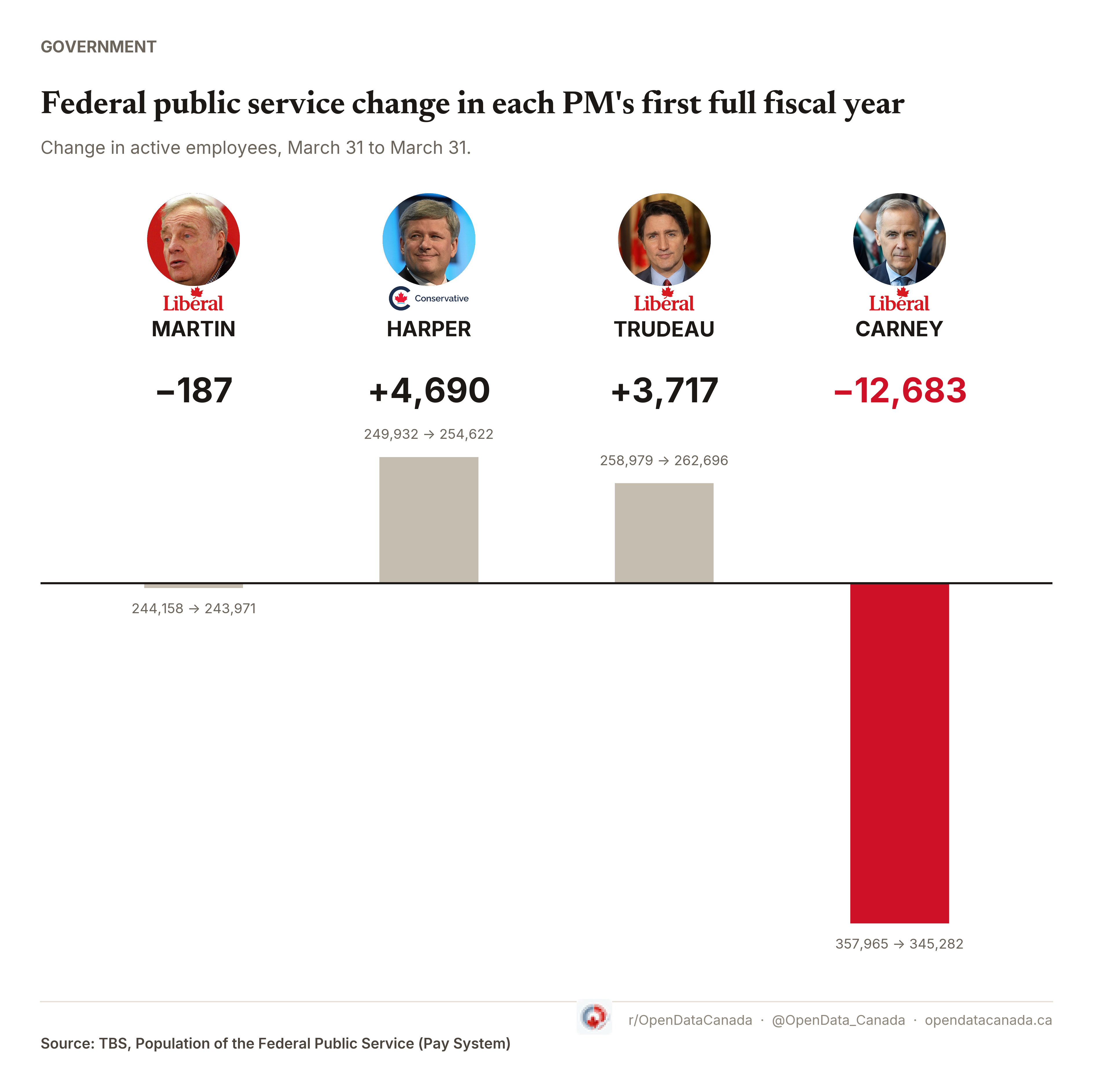
The federal public service fell by 12,683 employees in Mark Carney's first full fiscal year (2025-26), from 357,965 to 345,282. That's not just the biggest first-year move on this list. The decline was 54% larger in magnitude than the combined increase under the previous three prime ministers.
That's a change in headcount, not a tally of layoffs. The Treasury Board of Canada Secretariat's count includes everyone on the payroll — indeterminate, term, casual and student employees, plus governor-in-council appointees, deputy ministers and federal judges — and it falls when people retire or leave voluntarily, not only when a position is eliminated outright. The military, the RCMP and ministers' exempt staff aren't counted at all. The data show the public service is smaller by 12,683 people. They don't by themselves show how many of those departures were ordered versus chosen.
Why the comparison isn't quite apples to apples
The federal public service was much bigger walking into Carney's term than it was for the others. Martin, Harper and Trudeau began their first full fiscal-year comparisons with public-service populations of roughly 244,000 to 259,000. Carney's comparison began at nearly 358,000. The public service had grown substantially over the preceding decade, reaching 367,772 employees in March 2024. A bigger base gives more room to shrink, and a given percentage change off a larger number produces a larger raw headcount than the same percentage would have a decade ago.
Even accounting for that, the direction is the story: Harper and Trudeau both grew the public service in their first full fiscal year. It shrank in Carney's.
Where the decline fits
The decline is occurring alongside a broader government effort to shrink the public service. Budget 2025 projects the federal public service reaching roughly 330,000 employees by 2028–29, about 40,000 below its 2023–24 peak. The government says that decline would reflect the combined effects of the Comprehensive Expenditure Review, normal attrition and previous savings exercises. Government policy on workforce reductions generally favours attrition, voluntary departures and internal moves ahead of layoffs, with a formal layoff process kicking in only when comparable positions can't be found for everyone affected.
That's real, verifiable policy context. The 12,683 figure is a workforce-wide headcount change. It does not, by itself, establish how many departures resulted directly from the CER, how many resulted from normal attrition or other workforce changes, or how many involved layoffs.