Population & Migration
Edmonton is Canada's fastest-growing big metro area. Toronto barely moved.
Edmonton grew 3.1% in the year to July 1, 2025, the fastest of Canada's 45 metro areas with at least 100,000 people. Toronto, the country's largest, was flat as the number of temporary residents fell.
The fastest-growing big city in Canada is Edmonton. Its metro area, which includes the suburbs, added 50,717 people in the year to July 1, 2025, a gain of 3.1%. Moncton (3.0%) and Calgary (2.9%) were close behind, and Calgary added the most people of any city: 52,351.
These are the newest city figures Statistics Canada has. They come out once a year, in January, so the July 1, 2026 numbers are due in January 2027.
The bigger story is at the other end of the list. The Toronto area, home to 7.1 million people, was essentially flat: down 992 in the preliminary estimate. A year earlier it had added 269,143. Vancouver grew by 6,323, or 0.2%, after adding 111,705 the year before. Of the 45 metro areas with at least 100,000 people, 44 grew more slowly than the year before.
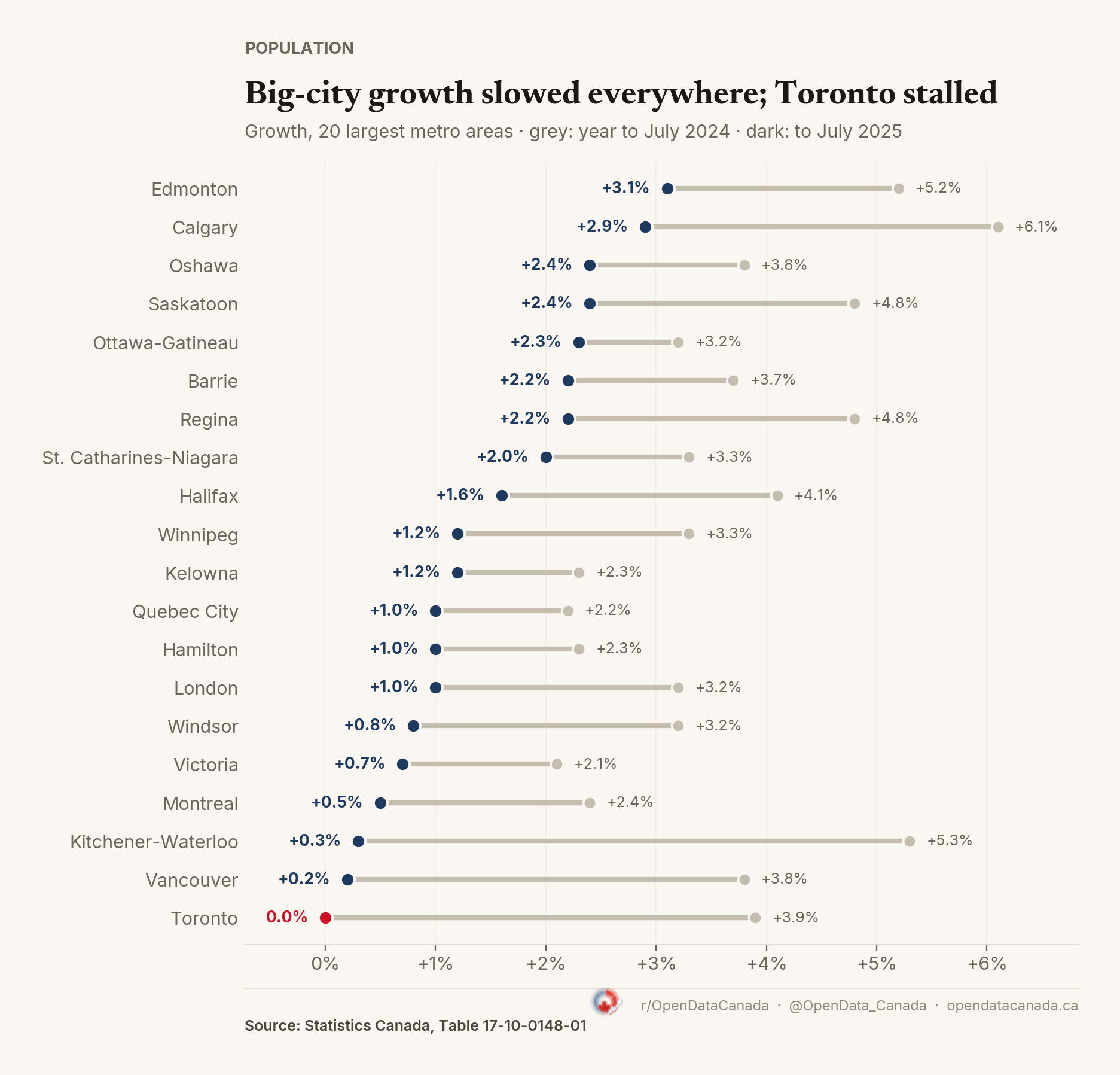
Population growth in the 20 largest metro areas, year to July 1, 2024 and year to July 1, 2025. Source: Statistics Canada, Table 17-10-0148-01. Download chart · Download data (CSV)
The 10 fastest-growing cities
Among metro areas with at least 100,000 people, growth in the 12 months to July 1, 2025:
| Rank | Metro area | Population, July 2025 | People added | Growth |
|---|---|---|---|---|
| 1 | Edmonton, Alta. | 1,692,385 | 50,717 | 3.1% |
| 2 | Moncton, N.B. | 196,143 | 5,666 | 3.0% |
| 3 | Calgary, Alta. | 1,836,012 | 52,351 | 2.9% |
| 4 | Chilliwack, B.C. | 130,283 | 3,257 | 2.6% |
| 5 | Oshawa, Ont. | 493,441 | 11,365 | 2.4% |
| 6 | Saskatoon, Sask. | 378,475 | 8,709 | 2.4% |
| 7 | Ottawa-Gatineau, Ont./Que. | 1,700,014 | 38,048 | 2.3% |
| 8 | Barrie, Ont. | 252,446 | 5,348 | 2.2% |
| 9 | Regina, Sask. | 291,187 | 6,148 | 2.2% |
| 10 | Lethbridge, Alta. | 143,143 | 2,962 | 2.1% |
Counting smaller towns too, the fastest was Wasaga Beach, Ont., up 3.3% to 29,039 people.
Why Toronto stopped growing
Toronto still drew newcomers. It received 115,348 immigrants, more than any other city. What changed was temporary residents, mainly international students, temporary workers, asylum claimants and their families. The number of temporary residents living in the Toronto area rose by 228,025 in the year to July 2024, then fell by 44,792 in the year to July 2025.
That drop was only part of it. Toronto also keeps losing people to the rest of Ontario: 64,794 more left for other parts of the province than arrived. It lost another 12,698, net, to other provinces, and 17,159 to net emigration (people leaving Canada minus those coming back). Together, the losses outweighed the 115,348 immigrants and the 23,103 more births than deaths.
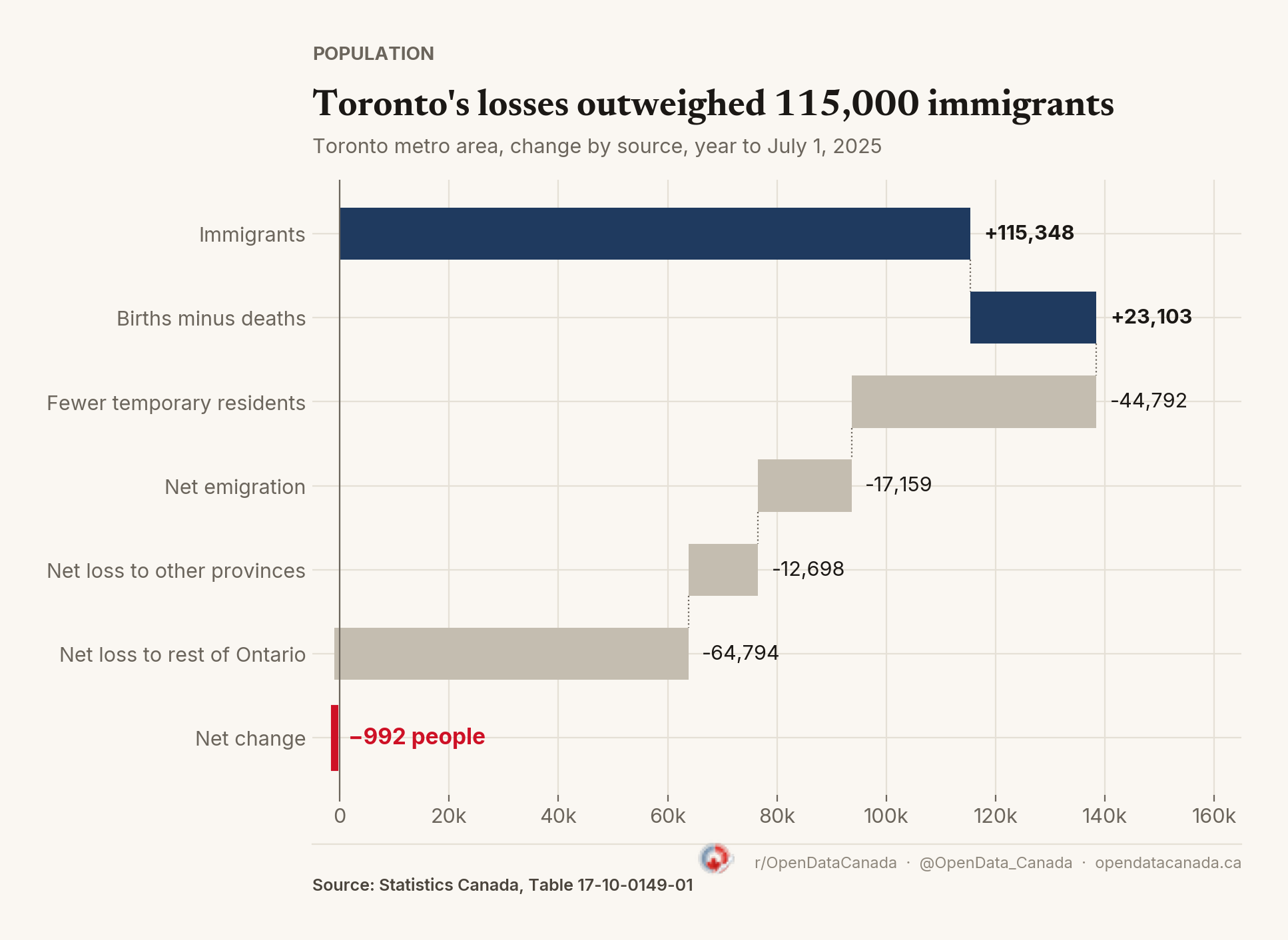
Sources of Toronto's population change, year to July 1, 2025. Source: Statistics Canada, Table 17-10-0149-01. Download chart · Download data (CSV)
The same swing hit other cities. Kitchener-Waterloo went from 5.3% growth to 0.3%, as its temporary-resident count went from up 27,432 to down 7,365. Vancouver's went from up 91,573 to down 10,098.
Three metro areas of 100,000 or more got smaller: Toronto, Kamloops (down 259) and Cape Breton (down 189). The year before, none of the 45 did.
Why Alberta kept growing
Edmonton and Calgary gained far fewer temporary residents too (Edmonton 8,972, down from 33,498). Immigrants were still their biggest source of growth (21,666 in Edmonton, 28,535 in Calgary), and both also drew more people from other provinces than they lost: a net gain of 11,742 for Edmonton and 11,195 for Calgary. Toronto and Vancouver went the other way, with net losses of 12,698 and 4,656.
Moncton's growth came almost entirely from immigrants. It received 5,728, about as many as its whole gain of 5,666, while more people left for other provinces than arrived.
Oshawa and Barrie, both on the edge of the Toronto area, grew largely on people moving from elsewhere in Ontario. Oshawa gained 6,921 that way, more than half its growth.
Canada's growth keeps slowing
National estimates, revised in September 2026, show Canada's growth falling from 2.8% in the year to July 2024 to 1.1% in the year to July 2025, then 0.5% in the year to July 2026, a gain of just 189,425 people. The city figures above come from the earlier January estimates, so they are not directly comparable. City figures for 2026 arrive in January 2027; the 2026 population by province shows where growth stands now. If temporary residents keep leaving, Toronto could shrink again.