Transportation · 3 min read
The most common phase in Canadian aircraft accidents is not the most deadly
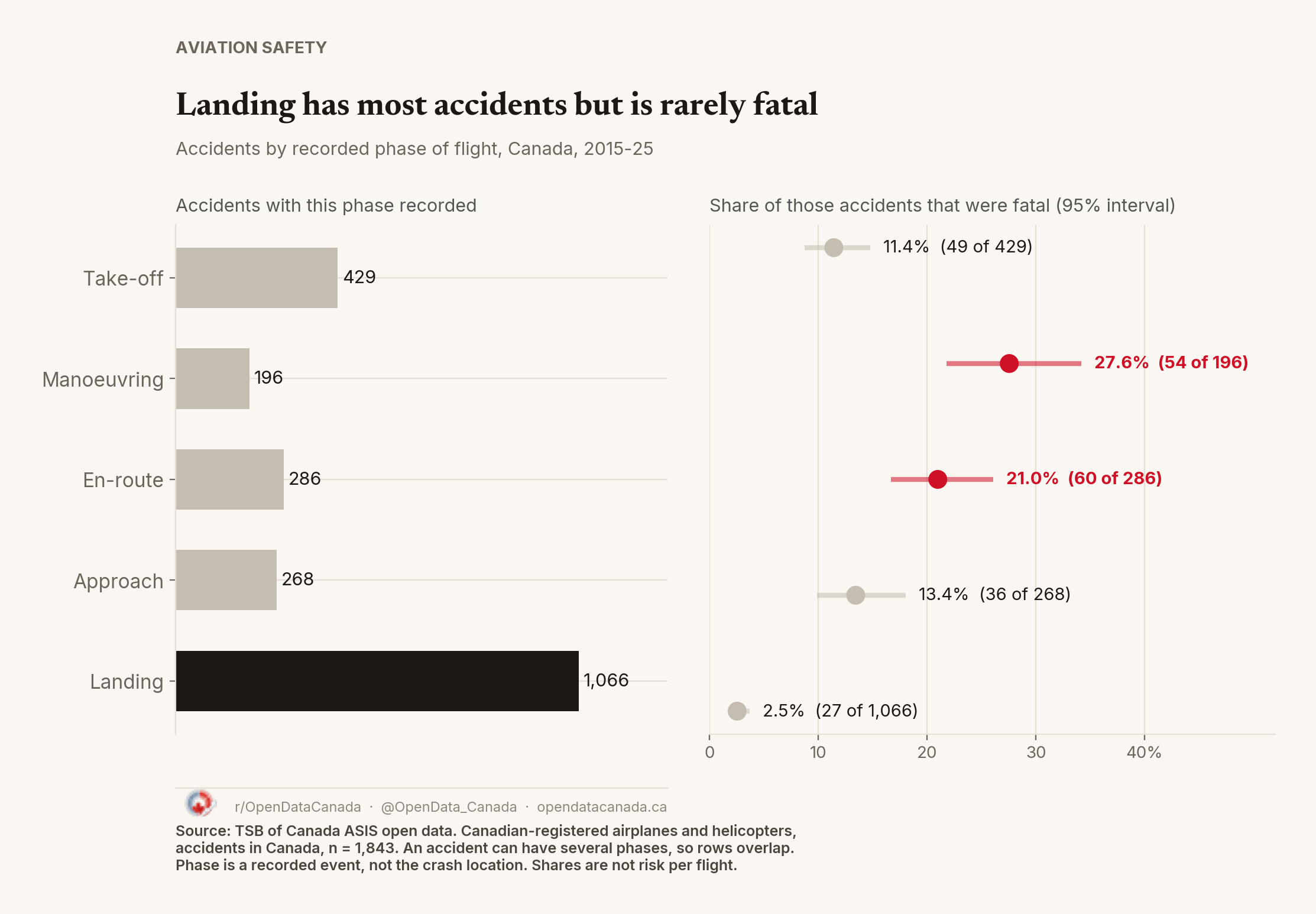
Between 2015 and 2025, more than half of Canadian aircraft accidents involved a landing-phase event, and only 2.5 percent of those were fatal. Accidents that involved manoeuvring were fatal 27.6 percent of the time, and en-route accidents 21.0 percent.
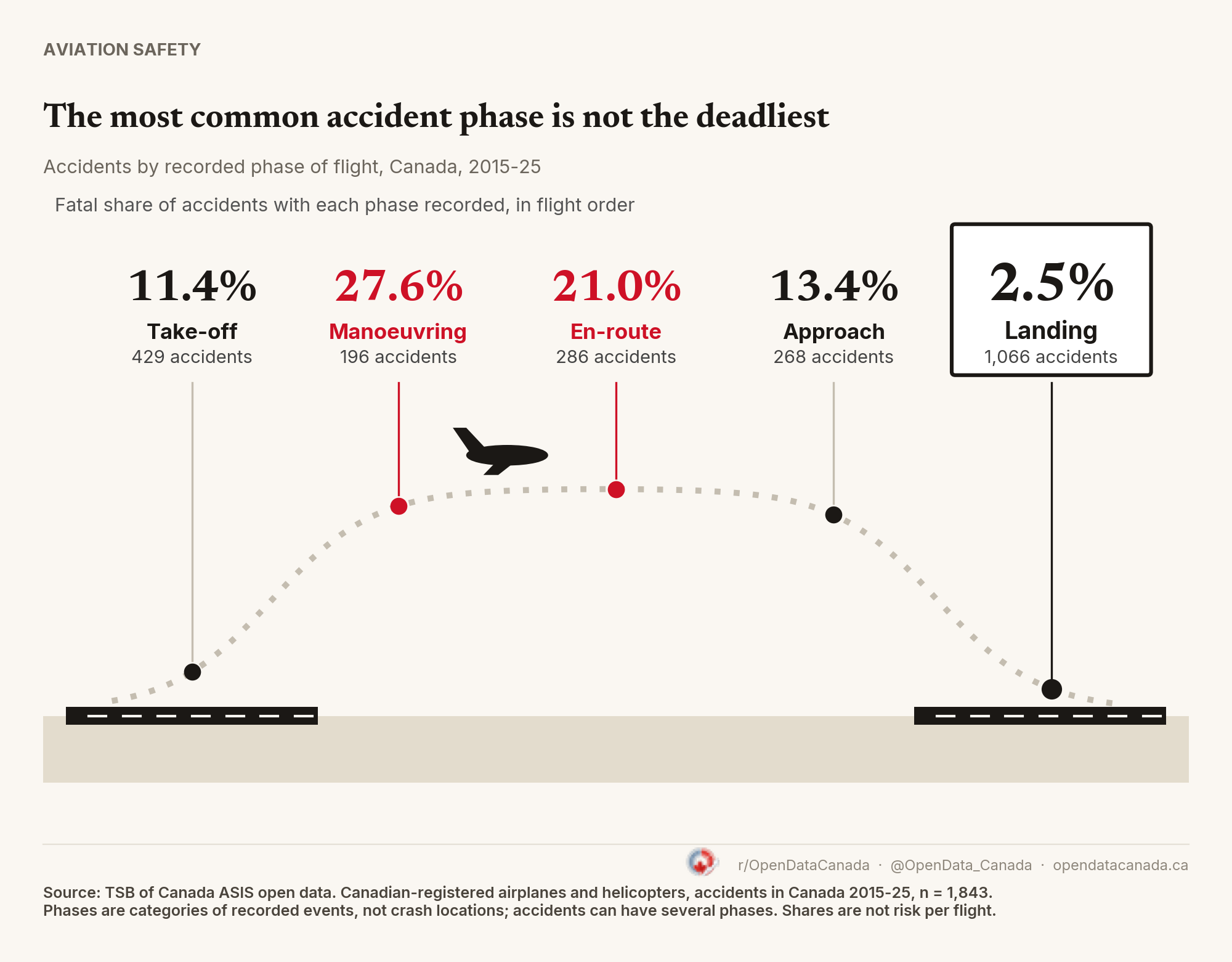
Of 1,066 Canadian aircraft accidents involving a landing from 2015 to 2025, 27 were fatal. Of 196 involving low flying, aerobatics or hovering, 54 were.
That is the pattern in 1,843 accidents involving a Canadian-registered airplane or helicopter in Canada. A landing-phase event is on record for 58 percent of them, far more than any other phase, yet only 2.5 percent of those were fatal. Accidents with a manoeuvring event were fatal 27.6 percent of the time. For en-route accidents it was 21.0 percent (60 of 286). Across all 1,843 accidents, 195 were fatal (10.6 percent) and 327 people died.

| Phase | Accidents | Fatal | Fatal share |
|---|---|---|---|
| Take-off | 429 | 49 | 11.4% |
| Manoeuvring | 196 | 54 | 27.6% |
| En route | 286 | 60 | 21.0% |
| Approach | 268 | 36 | 13.4% |
| Landing | 1,066 | 27 | 2.5% |
An accident can have more than one phase on record, so the rows overlap. The phase is the part of the flight where a recorded event took place, not where the aircraft ended up. Landing covers touchdown, the landing roll, aborted landings, emergency or off-runway landings and, for helicopters, hovering down to land. Manoeuvring covers low flying, aerobatics, helicopter hovering, practice autorotations, aerial work such as crop spraying, and picking up external loads. 97 accidents have none of these five phases on record.
These are shares of accidents, not risk per flight. The files have no count of flights or hours, and every flight ends with a landing, so landing may lead simply because it is part of every trip.
The gap holds after accounting for the kind of flying
Helicopters, training flights and small aircraft are not fatal equally often, so the gap could simply reflect who flies what. A statistical model compared accidents with and without each phase while holding aircraft type, kind of flying, weight class, season, region and year constant. The gap stayed large:
- Landing: 2.7 percent, compared with 20.1 percent for accidents without one.
- En route: 21.0 percent against 8.6 percent. This matches the raw share by coincidence.
- Manoeuvring: 19.7 percent against 9.0 percent, 11 points higher.
The same pattern appeared when 2020 and 2021 were dropped, when only single-aircraft accidents were used, and when the period was 2018 to 2025 or 2011 to 2025. Take-off showed no clear difference.
Approach is less certain. The model puts approach accidents about 5 points higher, but the result was no longer clear in two of seven re-checks.
What the numbers do not say
The counts are lower than the Transportation Safety Board of Canada's own tables (1,988 accidents and 217 fatal for 2015 to 2025). Accidents abroad involving Canadian-registered aircraft explain 63 of the 145 missing, and the other 82 are an unexplained difference in scope. The phase pattern is the same in the board's tables.
A recorded event is also not a cause. The data show that manoeuvring accidents are fatal more often, not why, and they cannot say which part of a trip is most dangerous for a passenger.
Related reading: Canada's road fatality rate and how US flights fell at Canadian airports.