Economy · Rail
11 billion dollars of rail upgrades could get Montreal to Toronto in 3 h 42, a farm-backed study says
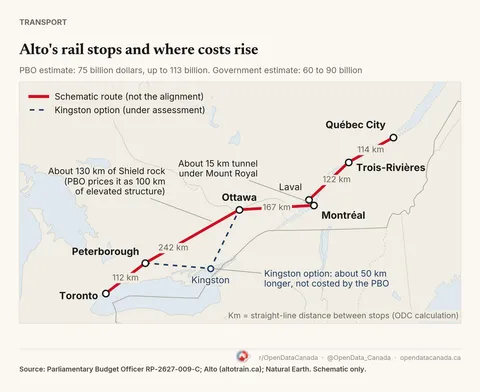
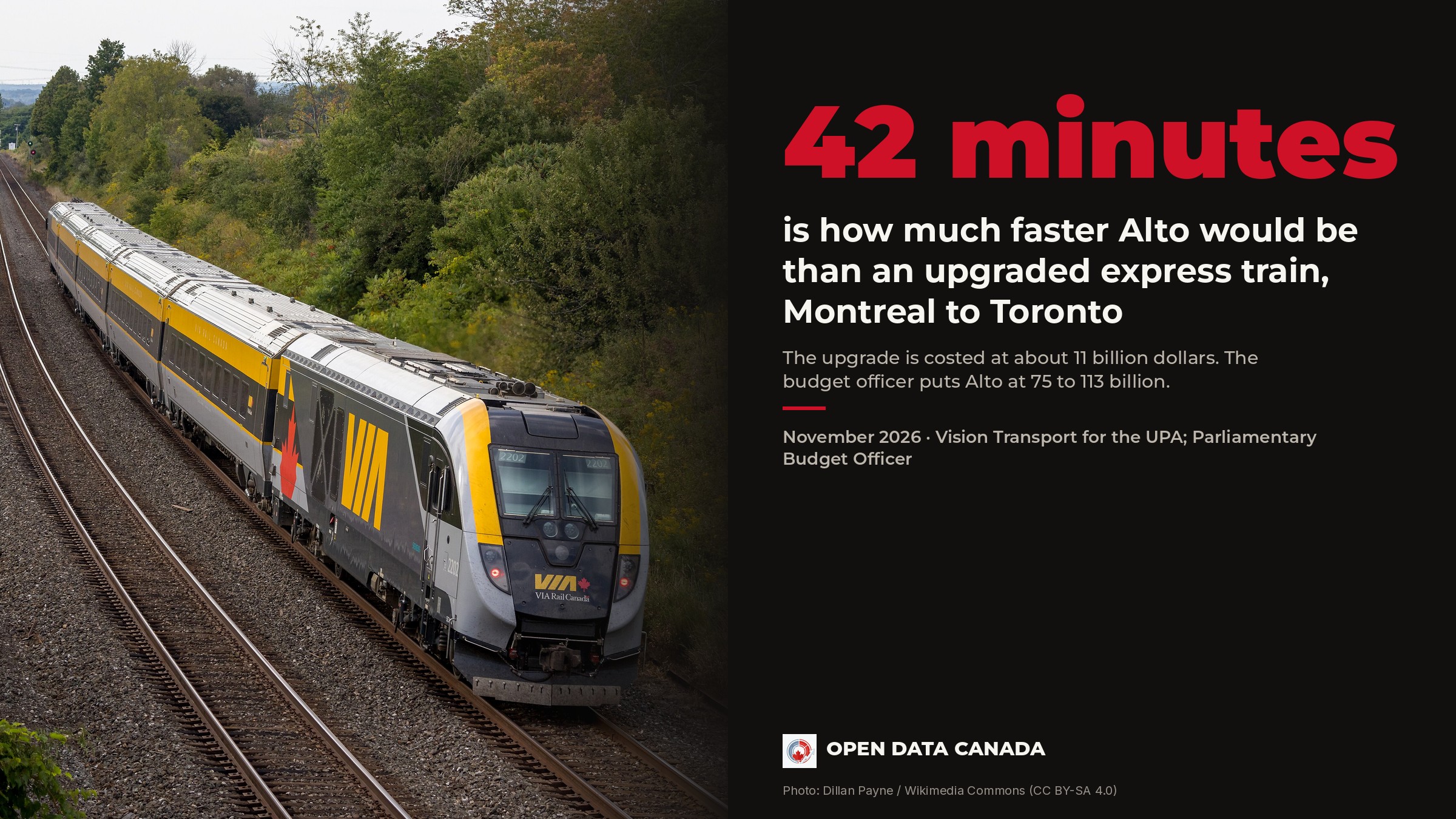
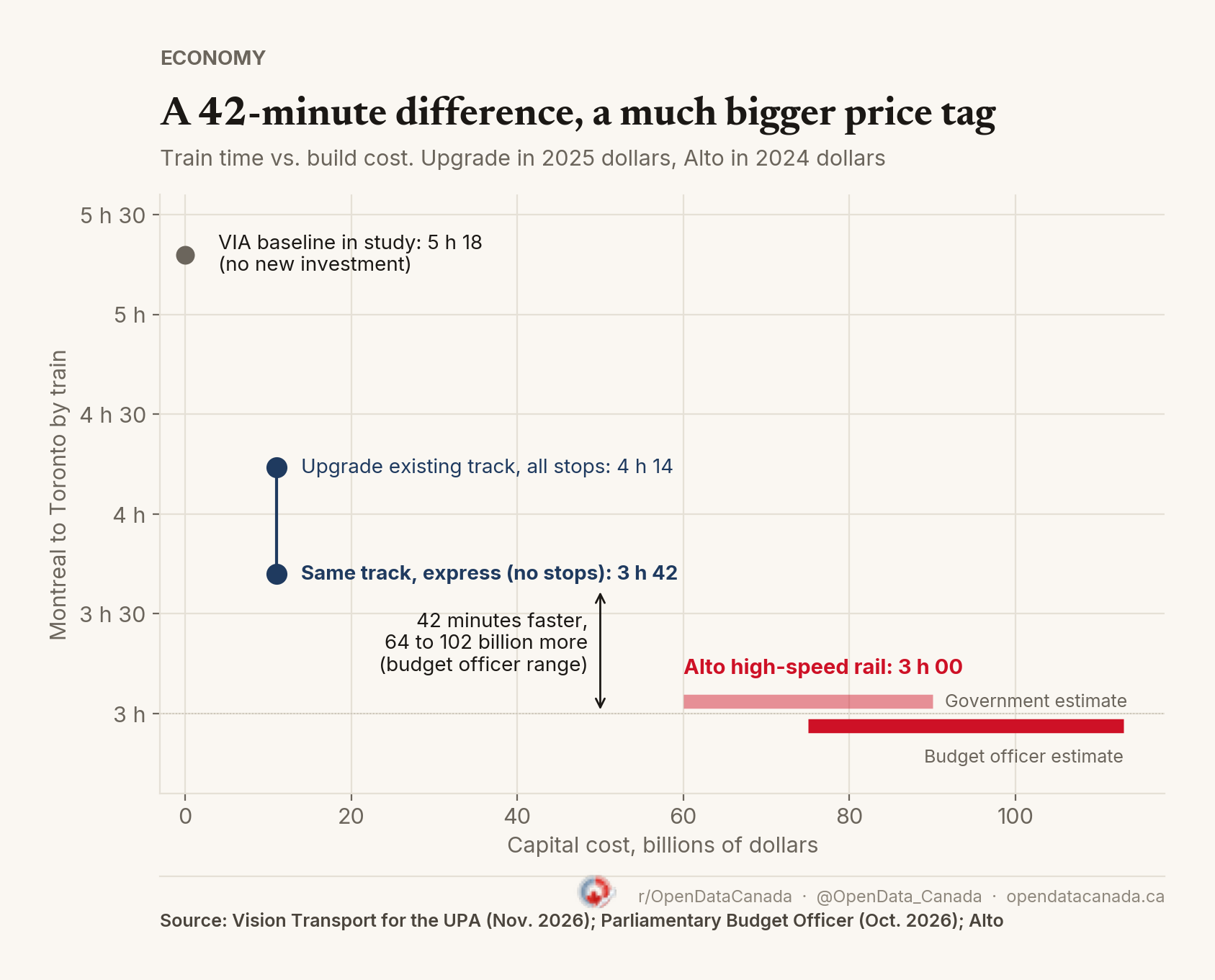
A study released by Quebec's farm union says about 11 billion dollars of work on today's Québec City to Toronto line could cut Montreal to Toronto from the 5 h 18 in VIA's timetable to 3 h 42 on an express train. Alto's high-speed line promises 3 hours. The budget officer puts Alto's construction at 75 to 113 billion.
Quebec's farmers don't want a high-speed rail line cutting through their fields. On Nov. 12 their union, the Union des producteurs agricoles (UPA), released a 54-page study arguing the country doesn't need one to get much faster trains.
The study was written by Vision Transport, a non-profit that promotes passenger rail. Pierre DuSablon, a former Canadian National (CN) operations head for the Montreal to Québec line, reviewed its assumptions and checked curves in the field. Its question is narrow: how fast could VIA Rail run between Québec City and Toronto if Ottawa fixed the track it already has, and what would that cost?
Its answer: about 11 billion dollars for the whole line. It estimates Montreal to Toronto would drop from the 5 h 18 it uses as VIA's baseline to 4 h 14 with every stop kept, or 3 h 42 on an express that skips the stops in between. Alto, the federal high-speed project, promises about 3 hours.
Where today's trains lose the time
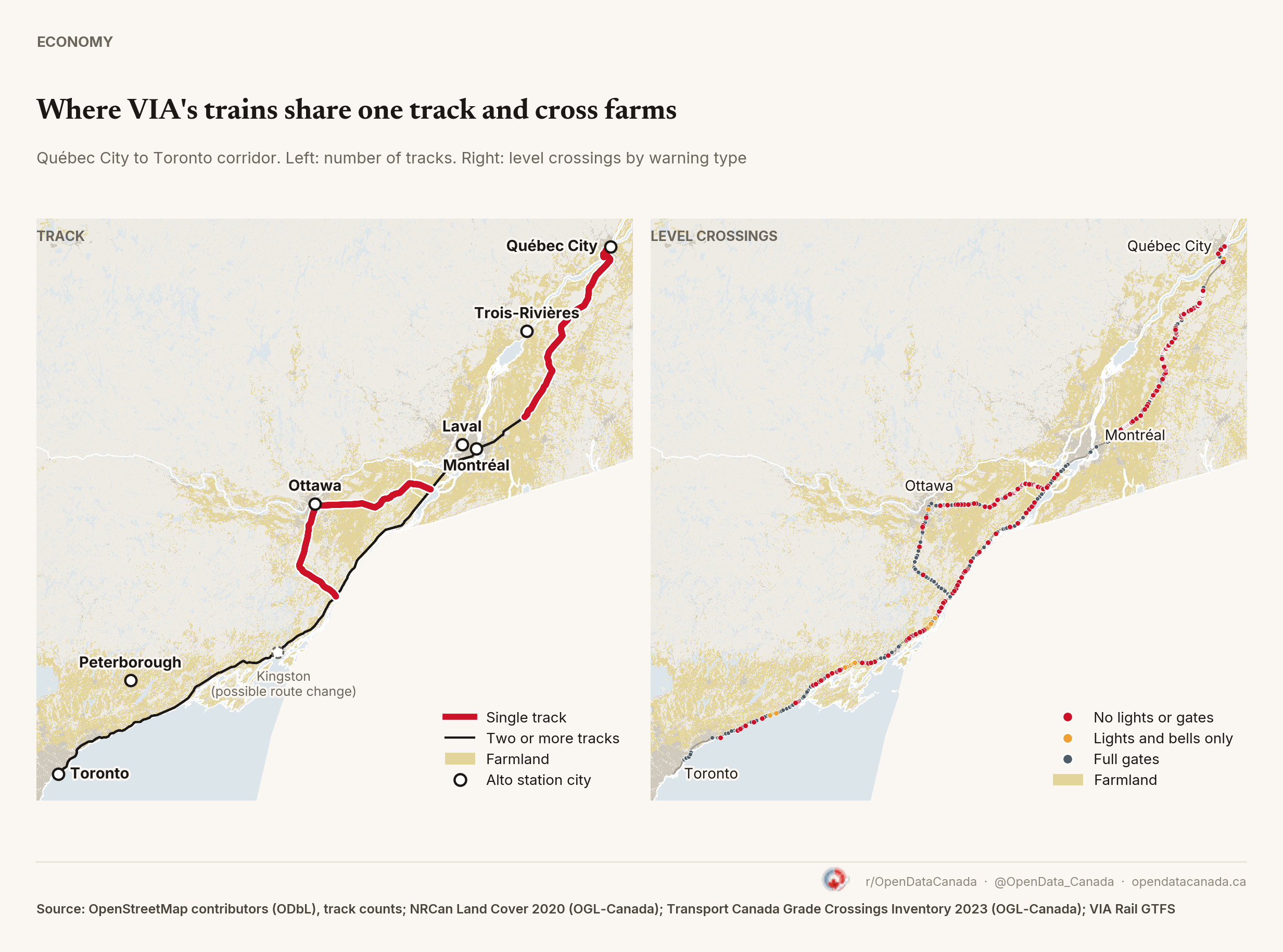
VIA's corridor trains mostly run on freight track. Across the whole Québec City to Toronto line, 407 km, or 37%, is a single track, so passenger trains wait in sidings for freight trains to pass. The study attributes 47% of the time it projects winning back to less delay from sharing track with freight.
It proposes five fixes:
- A second track on the 407 km of single track, 189 km of it owned by CN and 218 km by VIA.
- Cab signalling, which, once crossings are secured, would raise the top speed from 153 to 177 km/h.
- Stronger arbitration by the Canadian Transportation Agency, making its power to decide which trains go first permanent, with deadlines and penalties.
- Full gates at level crossings. The study would equip 533 crossings that lack them, 523 of them private or farm crossings. None would need to be removed.
- Tilting diesel trains that take curves faster, modelled on a British design. No manufacturer sells one today, so it would be a custom order.
| Trip | VIA baseline | Upgraded, all stops | Upgraded, express | Alto (announced) |
|---|---|---|---|---|
| Montreal to Québec City | 3 h 22 | 2 h 26 | 2 h 08 | about 1 h 30 |
| Montreal to Ottawa | 2 h 02 | 1 h 37 | 1 h 22 | about 1 h |
| Ottawa to Toronto | 4 h 35 | 3 h 55 | 3 h 10 | about 2 h |
| Montreal to Toronto | 5 h 18 | 4 h 14 | 3 h 42 | about 3 h |
| Québec City to Toronto | 8 h 50 | 6 h 51 | 6 h 00 | about 4 h 30 |
The all-stops times keep VIA's 22 intermediate stops; the express skips them. Both include a schedule cushion of 8 to 10%. Alto's plan names seven cities, with a Kingston stop under study. Alto publishes city-pair times only; its Québec City to Toronto figure is as reported by La Presse Canadienne.
What the money buys
The study's price is 9.0 to 9.4 billion dollars for the five fixes: 2.5 billion for track, 2.2 billion to add a second span at 78 bridges, 3.4 billion for trains and the rest for signals and crossings. With a 20% contingency, about 11 billion.
Going further gets expensive fast. Replacing a third of the crossings with bridges and underpasses (118 public road crossings and 190 private or farm crossings) adds 8.2 billion and saves up to 8 minutes between Montreal and Toronto. Electrifying adds 3 to 7 billion for 1 to 6 minutes per trip. Everything combined lands at 24 to 30 billion.
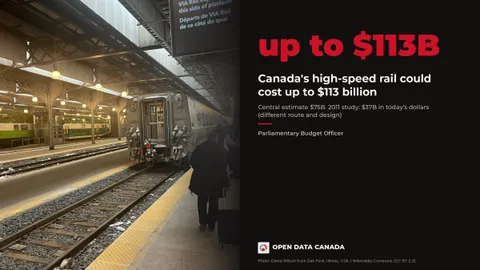
The federal government's range for Alto is 60 to 90 billion. The Parliamentary Budget Officer estimated 75 to 113 billion in October, construction only, and put a 1-in-40 chance on costs of 243 billion or more. Each year the start slips adds about 1.5 billion. The estimate leaves out a possible route change through Kingston, and it is the first of two reports; the second will test whether ridership can support the line.
Against the budget officer's range, the gap in upfront cost is 64 to 102 billion dollars. The two figures aren't like for like: the study's includes new trains and a 20% contingency, the budget officer's covers construction only, the dollar years differ, and Alto buys a dedicated passenger line plus a much faster Montreal to Québec City trip.
What the study can't promise
It's a preliminary study, not an engineered project. It used VIA's published timetables, OpenStreetMap track maps and Transport Canada's crossing list, and corrected its curve speeds against a field audit. It doesn't simulate train traffic, freight conflicts or timetable reliability, and its costs are order-of-magnitude. Nearly half its gain depends on CN sharing its line on better terms. If the slow sections inside Montreal and Toronto aren't fixed, the upgraded Montreal to Toronto trip is about 4 h 31, not 4 h 14. Its VIA baseline comes from a 2026 season of unusual speed restrictions, so the study says the delays it measured may be inflated. The authors reran the comparison on January 2023 schedules and say the pattern holds: trains lose far more time on CN's single track than on its double track.
Even the study's own rail expert has doubts. DuSablon questions whether a second track can be built along the whole Québec City to Saint-Hyacinthe section and proposes a gradual approach, starting by linking existing passing sidings. The study calls its full-doubling cost a cautious upper bound.
Alto also buys things the upgrade doesn't. Montreal to Québec City would take about 1 h 30 instead of 2 h 08. A dedicated line adds capacity and wouldn't share track with freight. The authors disclose that AI coding agents helped with the analysis under human direction, and that AI drafted the report under close human supervision before a line-by-line review.
The study's own precedent cuts both ways. It says Britain's West Coast Main Line upgrade, from 1998 to 2008, cut London to Manchester by 36 minutes, about 22%. It also notes the budget more than tripled along the way because the scope wasn't locked at the start.
Why farmers care
The first Alto segment, Montreal to Ottawa, is about 200 of the line's roughly 1,000 km. The UPA says it would cross about 1,700 properties, at least 500 of them farms, and has asked Ottawa to halt Alto's field work. It says it stayed out of Alto's route planning because Alto wanted it to sign confidentiality agreements that would have kept it from telling its members.
Alto's chief executive, Martin Imbleau, dismissed the plan the same day. "People have been looking at this concept for 30 or 40 years and, just as we're about to present the refined corridor for high-speed rail, we're still discussing something that isn't feasible," he told La Presse Canadienne. He said most of the existing corridor has no room for a second track, that building one would mean shutting CN and Canadian Pacific lines for years, and that it would mean buying "thousands and thousands of properties" from people who built close to the line. He added that electrifying lines that carry double-stacked containers would be hard and prohibitively expensive. On confidentiality, he said he had never heard of the issue before that morning and that it wasn't what ended talks, but that Alto would gladly keep working with the UPA without a confidentiality agreement.
The real question isn't whether Alto is faster. It is. It's whether 42 minutes between Montreal and Toronto, and a track of its own, are worth five to ten times the price of fixing the line already there.