Article · Transport · Federal Budget · 6 min read
PBO: Canada's High-Speed Rail Could Cost Up to $113 Billion. An Old Estimate Was a Third of That.
Canada's Parliamentary Budget Officer estimates the Toronto to Québec City high-speed rail line could cost about 75 billion dollars, with an upper estimate of 113 billion for the baseline route. A 2011 study, for a different route and design, came to 37 billion in today's dollars.
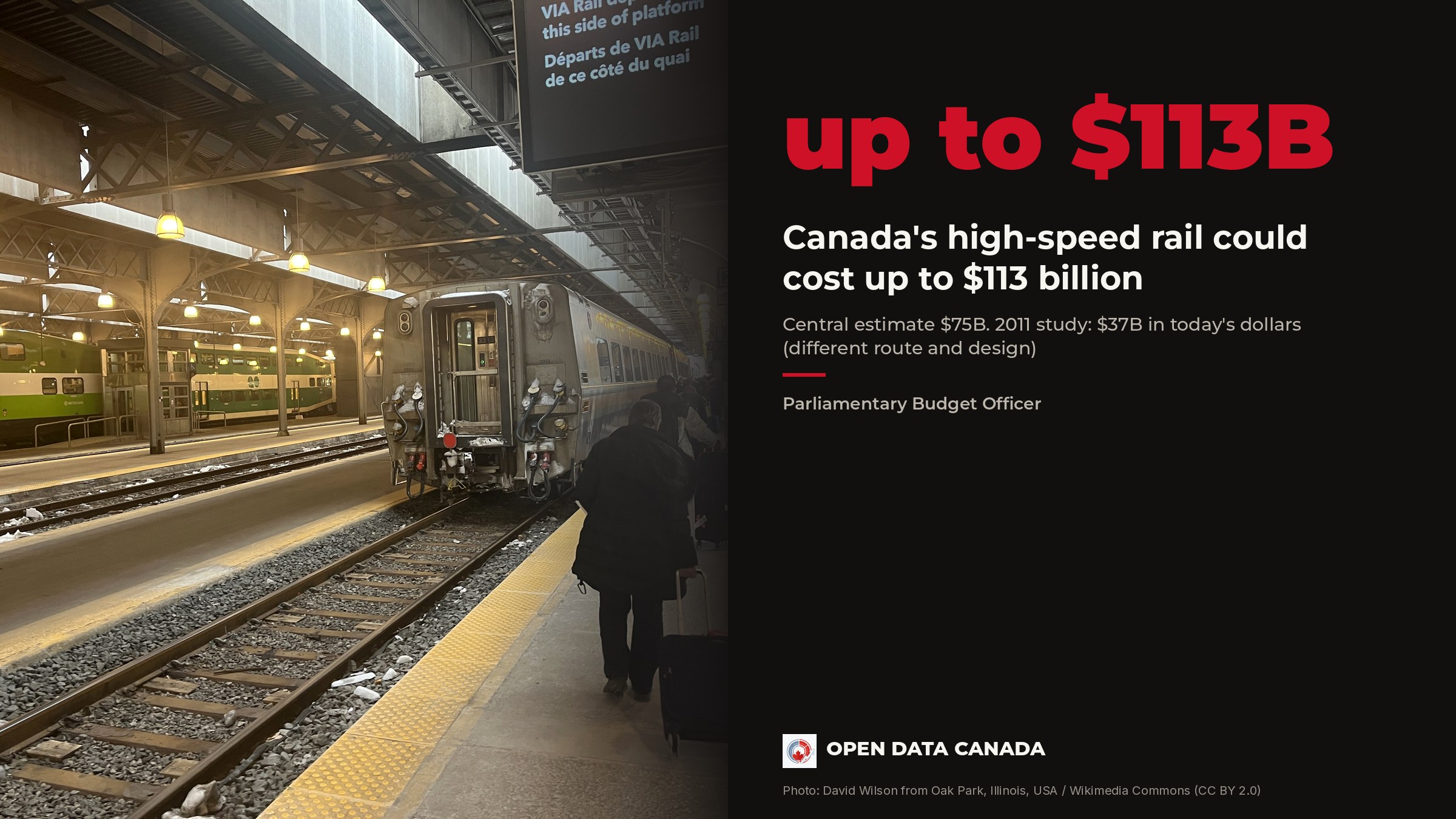
Canada's Parliamentary Budget Officer estimates that the planned high-speed rail line from Toronto to Québec City could cost about $75 billion, with an upper estimate of $113 billion for the baseline route. The estimate excludes a possible route change through Kingston. A 2011 study, for a different route and design, came to $37 billion in today's dollars.
The Parliamentary Budget Officer (PBO) is an independent office that provides financial and economic analysis to Parliament. The line is being planned by Alto, a federal Crown corporation.
The comparison with the old $37 billion figure needs a qualification: these aren't estimates for exactly the same project. The 2011 study covered Windsor to Québec City with a different design, and some of its track was to be shared with existing commuter lines. The $37 billion is that study's estimate restated by the PBO in 2024 dollars. The PBO is not revising that estimate. It is estimating a different project with a different method. The PBO says the wide spread between past estimates mostly reflects differences in what each study planned to build.
So why is the new estimate so much higher? And how does it compare with high-speed rail elsewhere in the world?
The government's own estimate is $60–90 billion. All figures are expressed in 2024 dollars, so they don't include the effect of future inflation.
Why we measure cost per kilometre
Rail lines come in very different lengths. A total price tells you little on its own. Dividing the cost by the length of track gives the cost of each kilometre. That lets us compare lines of any size, in Canada or abroad.
The PBO assumes the new high-speed track will be no longer than 850 km.
- PBO's estimate: about $88 million per km, with an upper estimate of $133 million per km.
- Government's estimate: $71–106 million per km, on the same 850 km.
What earlier studies said
Canada has studied high-speed rail in this corridor for more than 30 years. Three older studies had much lower estimated costs, even when converted to cost per kilometre:
- 1995 study (Windsor–Québec City): $21 billion in total. That is no more than about $20 million per km.
- 2011 study (Windsor–Québec City): $37 billion in total. That is no more than about $35 million per km.
- 2021 study (Toronto–Montréal only): $14 billion in total. That is no more than about $28 million per km.
The PBO's table shows these totals in 2024 dollars. The per-km figures are our own calculations, not published numbers. The PBO does not give the length of each study's route, so we used the straight-line distance between the end cities (about 1,060 km for Windsor–Québec City and about 505 km for Toronto–Montréal). A real route is always longer than a straight line, so the true cost per km of route was lower than these figures.
These are not like-for-like. The PBO warns that the old studies covered different routes and designs. The 2011 study, for example, planned to share some existing tracks with commuter trains. That means less new track to build, so its cost per km of new track would be higher than its cost per km of route.
Newer estimates are closer to the PBO's. A McGill University study put the cost at $80 billion. A 2026 submission to a Senate committee by M. Schabas put it at $61 billion.
Is $133 million per km expensive?
We compared Canada's figures with 94 high-speed lines around the world. The data comes from New York University's Transit Costs Project, the same data the PBO used. All costs are converted to 2024 Canadian dollars.
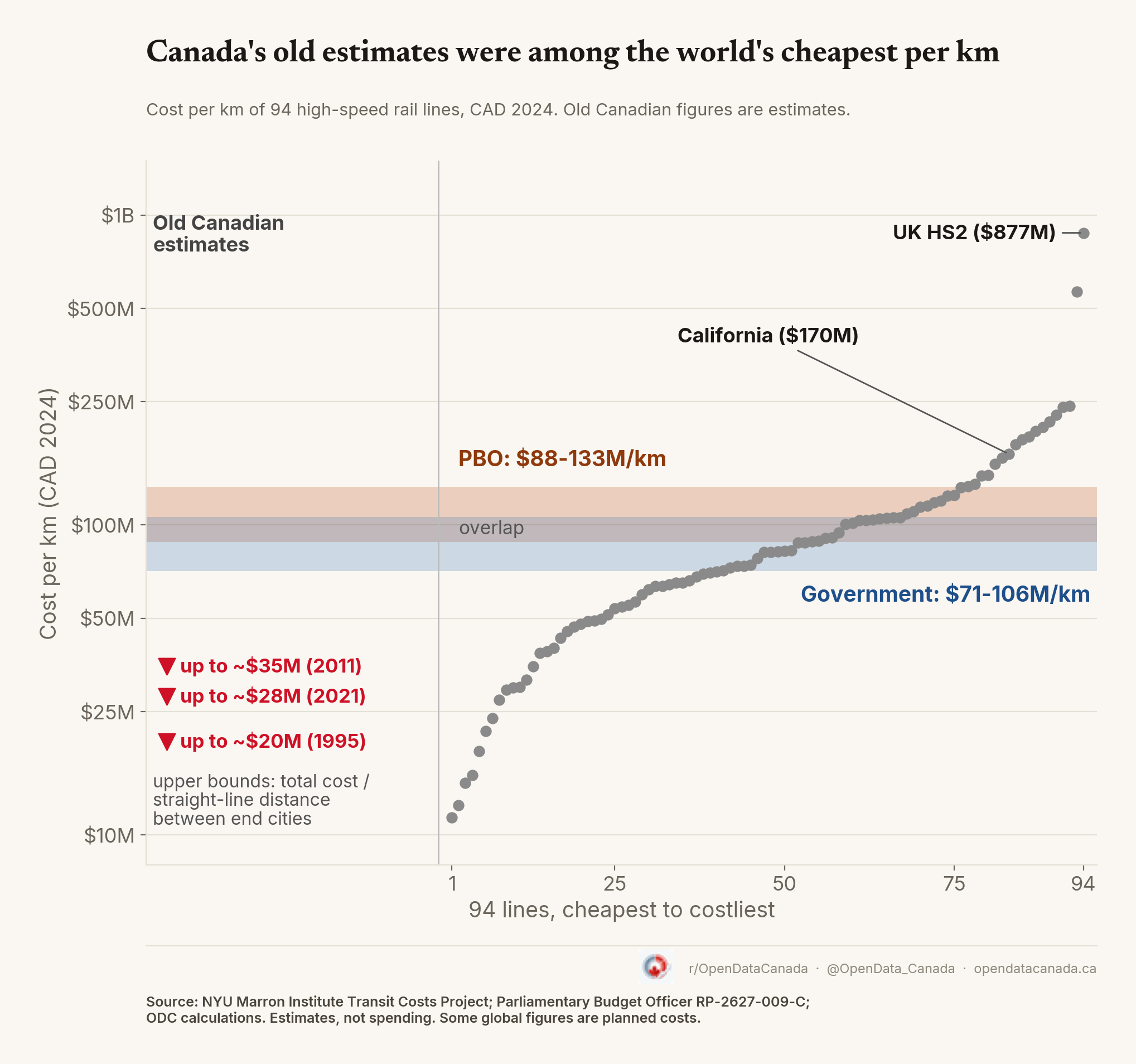
- The older Canadian estimates were among the cheapest. More than 8 in 10 lines worldwide cost more per km.
- The government's $60–90 billion sits in the middle. About 4 to 7 in every 10 lines cost less per km.
- The PBO's $75–113 billion is in the upper part of the range. About 6 to 8 in every 10 lines cost less per km. 18 of the 94 lines cost more than $133 million per km.
- The most expensive is Britain's HS2, at about $877 million per km.
The government's estimate sits near the middle of the world's lines, and the PBO's is above the middle. The older Canadian estimates were near the bottom.
The route is often described publicly as roughly 1,000 km, while the PBO assumes the new track will be no longer than 850 km. At 1,000 km, the government's $60–90 billion estimate would equal $60–90 million per km.
What pushes the cost up
Starting later. After inflation, high-speed rail construction costs have risen over time. In the PBO's model, each additional year before construction starts is associated with about $1.5 billion more in cost (range $1.1–2.0 billion). The PBO assumes building starts in 2029.
Tunnels and bridges. In the PBO's model, each extra km of tunnel adds about $169 million. Each extra km of raised track on bridges or pillars adds about $153 million. These come from comparing many past projects. They are not engineering quotes.
The PBO assumes about 15 km of tunnel between Laval and Montréal. That is under 2% of the line. Among the world's lines with tunnel data, the typical share in tunnels is about 17%.
The PBO also allows for about 130 km of hard rock (the Canadian Shield) between Ottawa and Peterborough.
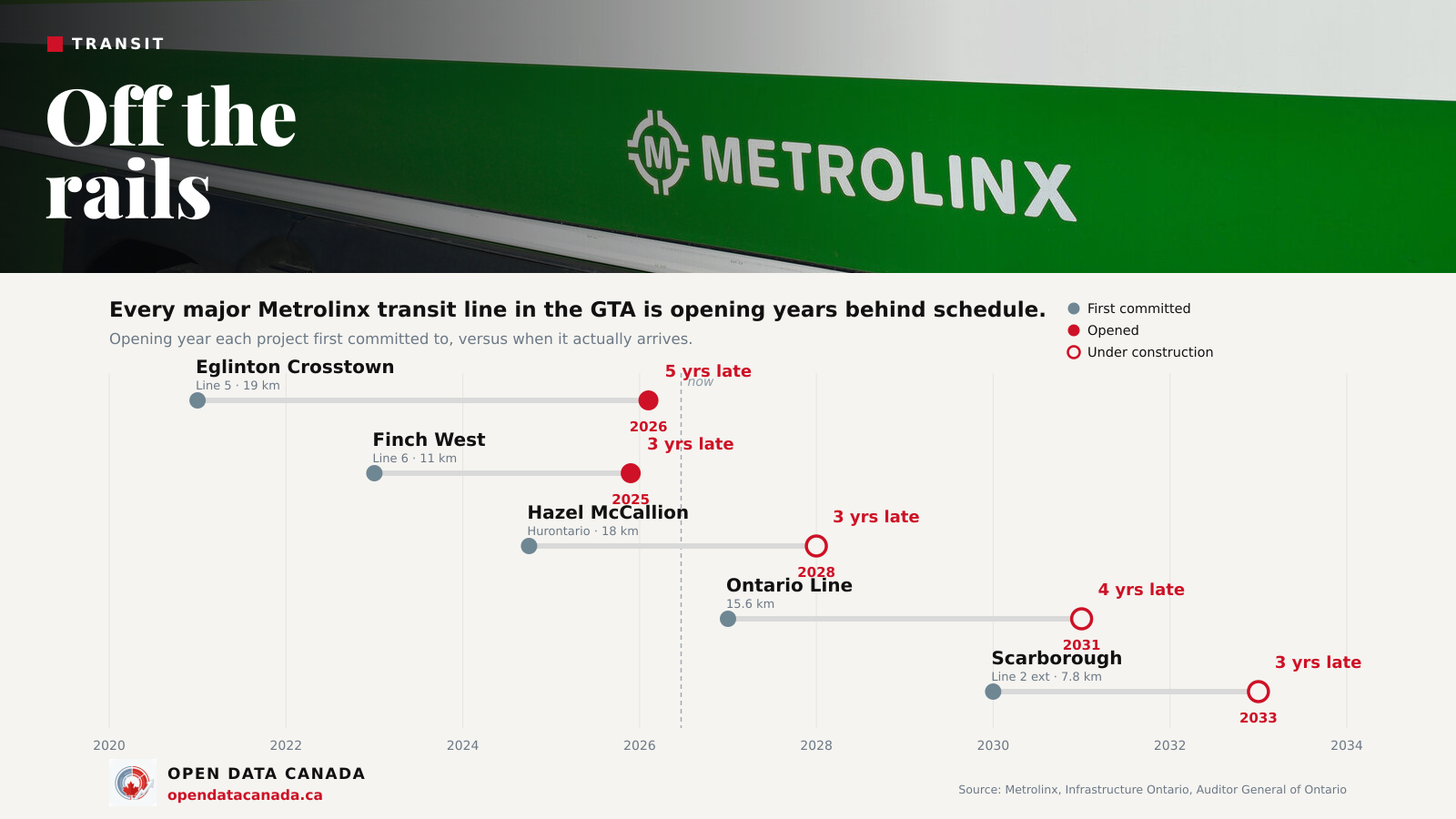
Project management. The PBO's estimates assume that approvals and permits go about as well as in past European projects. It estimates that UK and US projects have cost roughly 4.5 times as much as European projects, although that rests on only three projects. It names land purchases, permits, lawsuits and design changes as likely reasons for the higher UK and US costs. Closer to home, we found that every major Metrolinx transit line is opening years behind schedule.
The $243 billion figure
Some coverage has cited $243 billion. That is not the PBO's central estimate or its $75–113 billion range. It is a worst-case figure from the PBO's analysis of how uncertain its estimate is. Based on its model, the PBO estimates roughly a 1-in-40 chance of costs reaching $243 billion or more.
What these numbers leave out
- These are estimates of building costs, not money spent.
- They are in 2024 dollars. If spending runs from 2029 to 2045 and prices keep rising as they have, the PBO says the government's $60–90 billion would be $93–124 billion in the dollars actually paid.
- The global database includes completed projects as well as projects still under construction or nearing completion. For some lines, the cost is still a planned figure. What each line's cost includes also varies.
How we did this
Cost per km = total cost ÷ km of track. The PBO's and government's totals use the PBO's 850 km. Global costs are the Transit Costs Project's figures in 2023 US dollars (adjusted for price differences between countries), converted to 2024 Canadian dollars. Our conversion reproduces the PBO's published cost table to the nearest million dollars per km. The ranking compares each Canadian figure with all 94 lines. For older studies, we divided by the straight-line distance between end cities, as noted above, which gives the highest possible cost per km.