Transport · Map
Ottawa wants power to freeze land before Alto picks its route
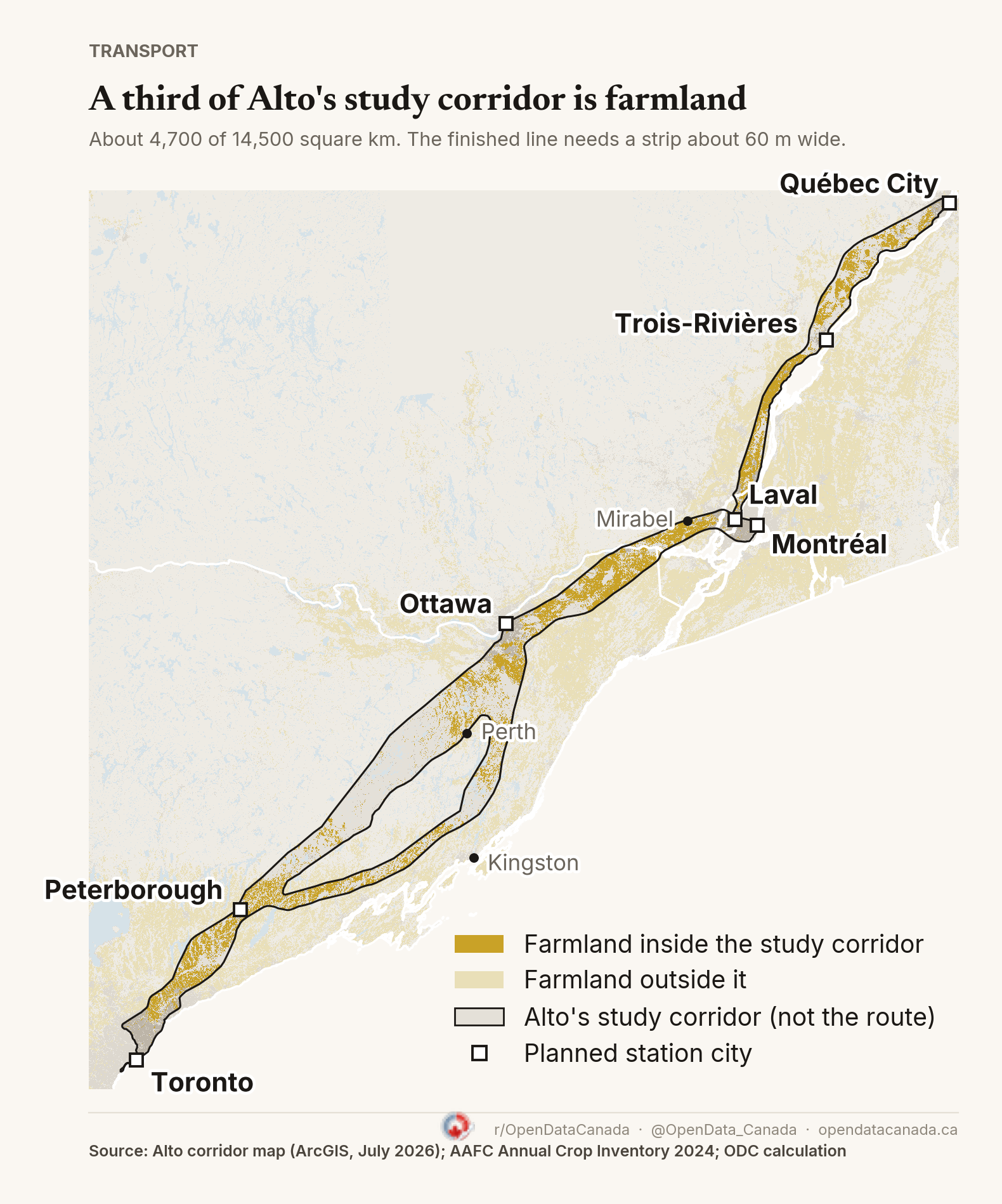
A motion posted Nov. 20 would take Alto out of the Expropriation Act entirely, widen Ottawa's power to freeze land for years and let seized property go to a private consortium. About a third of the 14,500 square km Alto is studying, roughly 4,700 square km, is farmland. The line itself will need a strip about 60 metres wide.
Ottawa wants new powers to take land for Alto, the Toronto to Québec City high-speed rail line, and it wants them before anyone knows exactly where the line will go.
The measures sit in a notice of ways and means motion posted Nov. 20, the first step toward the Budget 2026 implementation bill. The details below come from the motion text and from reporting by CBC News and The Canadian Press.
What the motion would change
Expropriation is the legal process that lets the government take private land for a public project and pay the owner. Normally that runs under the federal Expropriation Act. An owner gets a notice, has 30 days to object in writing, and an objection triggers a public hearing. Compensation is based on market value.
Parliament already loosened those rules for Alto earlier this year, when the High-Speed Rail Network Act passed as part of Bill C-15. That law let Alto skip upfront purchase talks and replaced public hearings with written objections, while keeping the project inside the Expropriation Act.
The new motion would go further. Under the motion, the government could:
- Exempt Alto from the whole Expropriation Act, plus the Railway Relocation and Crossing Act and key parts of the Railway Safety Act and Impact Assessment Act.
- Widen the power to freeze property. Parts of this came in with the earlier law. The Crown can hold a right of first refusal for up to eight years, meaning it can match any offer a buyer makes, before deciding whether it needs the land at all. The motion lets the minister weigh "any factor … including the public interest" before registering a work ban. A notice can be registered on any land Alto believes it "may require".
- Keep four-year work bans. During a ban, an owner needs the transport minister's permission to build, add on, dig or make big improvements. Under the motion, value added by work done without that permission would not count toward compensation.
- Take every right if a notice is vague. If an expropriation notice doesn't say what kind of right is being taken, such as full ownership or only a right to cross, it would cover every right in that land and would not be subject to existing leases or rights held by others.
- Hand land to a private consortium. Ownership could go straight to a company other than Alto, such as the private consortium.
- Send split farms to private arbitration. When the line cuts a farm or a local road in two, disputes over crossings would go to an arbitrator, with costs split equally up to 50,000 dollars, so up to 25,000 dollars per side, on top of each side's legal fees.
Crossings matter more here than on a freight line. Trains running up to 300 km/h need a fenced corridor, so every crossing has to be a bridge or a tunnel. A farmer can't just drive a tractor over the track.
Land use lawyer Ajay Gajaria told CBC that "both in terms of dollar value and the number of private properties required, in my view, it will be the largest expropriation project in modern Canadian history." He said owners in the corridor "may have a circumstance where you cannot market or sell your property potentially for eight years, potentially longer."
Transport Minister Steven MacKinnon says "there is no removal of due process." He points to Montréal's REM light rail and Toronto's Ontario Line, which both use what he called "bespoke regimes for land acquisition." Conservative MP Michael Barrett says the motion replaces the Expropriation Act with a separate regime for high-speed rail. The Conservatives and the Bloc Québécois oppose Alto and cite the expropriations as a main reason. NDP Leader Avi Lewis called expropriation "the last resort."
Alto told CBC that "a more streamlined process does not mean reducing protections for affected property owners" and that it will pay "fair compensation." The motion also keeps a 30-day window for written objections.
Is my property in Alto's study corridor?
Nobody can say yet, and that is the problem the motion creates.
The only map Alto has published is a study corridor. Alto describes it as about 10 km wide and close to 1,000 km long; the shape it published is wider in places, averaging about 14 km. Between Peterborough and Ottawa it shows two branches, one north through the Perth area and one farther south that passes about 20 km north of Kingston. Alto says the finished line needs a right-of-way about 60 metres wide. At that width, 1,000 km of track would cover roughly 60 square km, about 0.4% of the 14,500-square-km study area. Most land in the band will never be touched.
Alto says a narrower corridor for the Ottawa to Montréal stretch will be presented in late 2026. It had not been released as of Nov. 25. In May, Alto told Radio-Canada it estimates the Montréal to Ottawa segment alone would cross about 1,700 properties, at least 500 of them farms.
That gap is where the new freeze powers bite. A right of first refusal or a work ban can land on a property before the route is settled.
Where the farmland is
About 4,700 of the corridor's 14,500 square km is farmland, crops plus hay and pasture, according to the federal agriculture department's 2024 satellite crop map. Forest covers about 5,100 square km, towns and cities about 1,850, and wetlands about 1,100.
The farmland is not spread evenly. East of Ottawa, the band crosses the farm townships of Prescott-Russell, where The Nation, Alfred and Plantagenet, Champlain and East Hawkesbury are all more than half farmland inside the corridor. Mirabel, north of Montréal, has the highest share of any municipality with more than 100 square km in the corridor: almost three-quarters of its land inside the band is farmed.
| Municipality | In corridor (sq. km) | Farmland (sq. km) | Share |
|---|---|---|---|
| Ottawa | 1,414 | 502 | 35% |
| The Nation | 427 | 253 | 59% |
| Mirabel, Que. | 231 | 168 | 73% |
| Alfred and Plantagenet | 229 | 135 | 59% |
| Trent Hills | 244 | 129 | 53% |
| Cavan Monaghan | 242 | 127 | 52% |
| Champlain | 198 | 122 | 62% |
| Kawartha Lakes | 270 | 118 | 44% |
| East Hawkesbury | 181 | 114 | 63% |
| Rideau Lakes | 497 | 114 | 23% |
| Clarington | 227 | 109 | 48% |
| Douro-Dummer | 221 | 96 | 43% |
| Scugog | 171 | 96 | 56% |
| Pickering | 183 | 94 | 51% |
| Drummond/North Elmsley | 248 | 82 | 33% |
These figures describe land inside the study area, not land that will be taken. The CSV above lists 121 municipalities; seven slivers under half a square km were left out.
Ontario holds most of the corridor, 11,000 square km with 3,300 of farmland. Quebec's 3,470 square km is more heavily farmed, at 42% against Ontario's 30%. That is where the organized opposition is loudest: Quebec's farm union, the UPA, has asked Ottawa to halt Alto's field work and has pitched upgrading existing track instead. (See the UPA's plan and Alto's reply.)
What happens next
A ways and means motion is not law. The measures still have to be written into the budget implementation bill and pass the House and Senate.
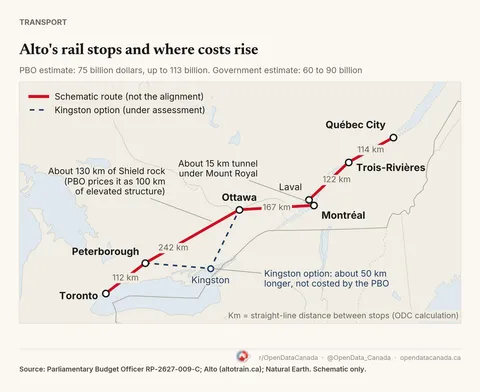
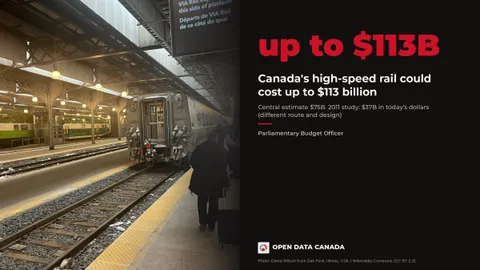
Alto has said it will try to follow existing roads, railways and power lines first, and expropriate only where it can't buy. For the route options and the stretches the Parliamentary Budget Officer flags as cost drivers, see the Alto route map and the PBO's 75 to 113 billion dollar estimate.
The government is asking for wider power to freeze land Alto may need, while the only public map is a band about 10 km wide and the line needs 60 metres. Owners will learn whether that is a fair trade only when Alto finally draws the line.