Education · Follow-up
Women earn half of Canada's PhDs, but under a third in engineering and computer science
More women than men earned doctorates in 8 of 11 fields in 2024. Engineering and math and computer science pull the total back to an almost even split.
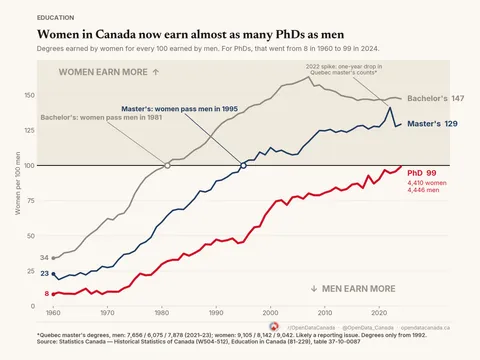
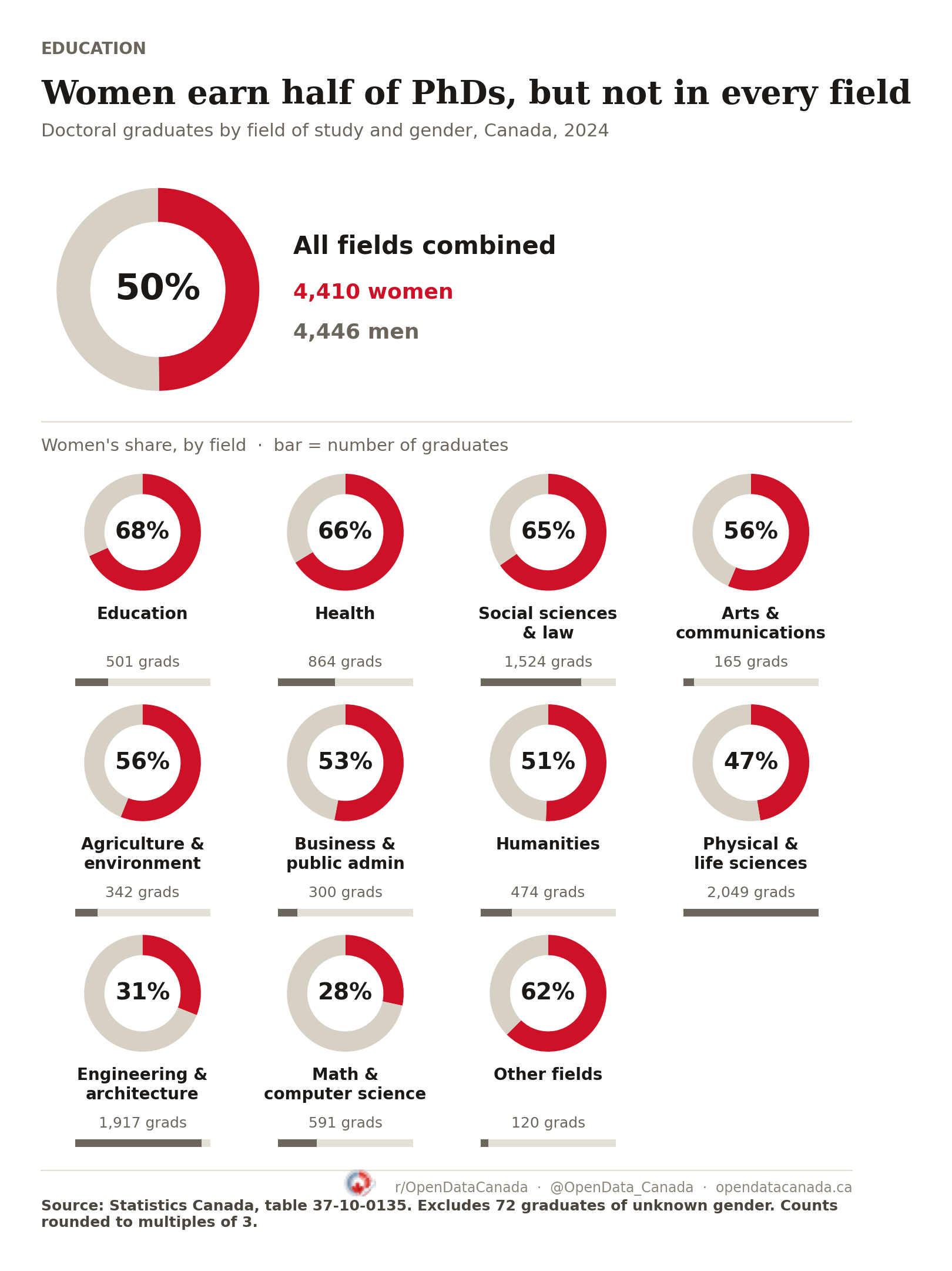
Last week's look at doctoral degrees by gender found an almost even split in 2024: 4,410 women and 4,446 men. Broken down by field of study, that even split turns out to be an average of two very different groups.
Where women account for most PhDs
Women accounted for roughly two-thirds of doctoral graduates in education (68%), health (66%), and social sciences and law (65%). In social sciences and law, the third-largest field, that was 996 women and 528 men.
Women were also the majority in agriculture, business, the arts and the humanities, though by smaller margins. Humanities came closest to even: 240 women, 234 men.
Where men outnumber women
In three fields, two of them by a wide margin. Women earned 31% of engineering and architecture doctorates (597 of 1,917) and 28% in math and computer science (168 of 591). Together those two fields produced 1,743 male PhDs and 765 female ones, a gap of 978.
Physical and life sciences, the biggest field with 2,049 graduates, leaned the same way: 1,077 men and 972 women, at 47% women. That gap of about 100 is still three times men's overall lead.
Across the other eight fields, women earned about 1,050 more doctorates than men. That advantage almost entirely offset men's lead in engineering, architecture, math, computer science, and physical and life sciences. The final difference was just 36 graduates, with men ahead.
Statistics Canada also recorded 72 graduates with gender unknown, more than the 36-graduate difference between men and women. The overall result is effectively a tie.
How the balance has changed since 1992
A lot in some fields, little in others. In 1992 women earned 11% of engineering doctorates (54 people). By 2024 it was 31% (597 people). Almost half of that gain came in the last decade: the share was 22% in 2014. Physical and life sciences went from 27% to 47%, and health from about 37% to 66%.
Progress has been less consistent in math and computer science. Women's share rose from about 14% in 1992 to 30% by 2009, but has fluctuated between 21% and 31% since then. It stood at 28% in 2024.
Engineering and architecture accounted for 888 of the additional 2,310 doctorates earned by men between 1992 and 2024, or about 38%.
Doctoral graduates are an important part of the pipeline into university teaching and research. The overall gender split is nearly even, but that doesn't mean women and men are equally represented across disciplines. In engineering and architecture, and in math and computer science, women still account for fewer than one in three doctoral graduates.
Related: Women are now earning almost as many PhDs as men in Canada · Men outnumber women until 48.