Labour
University grads still earn more in Canada, but trades are catching up
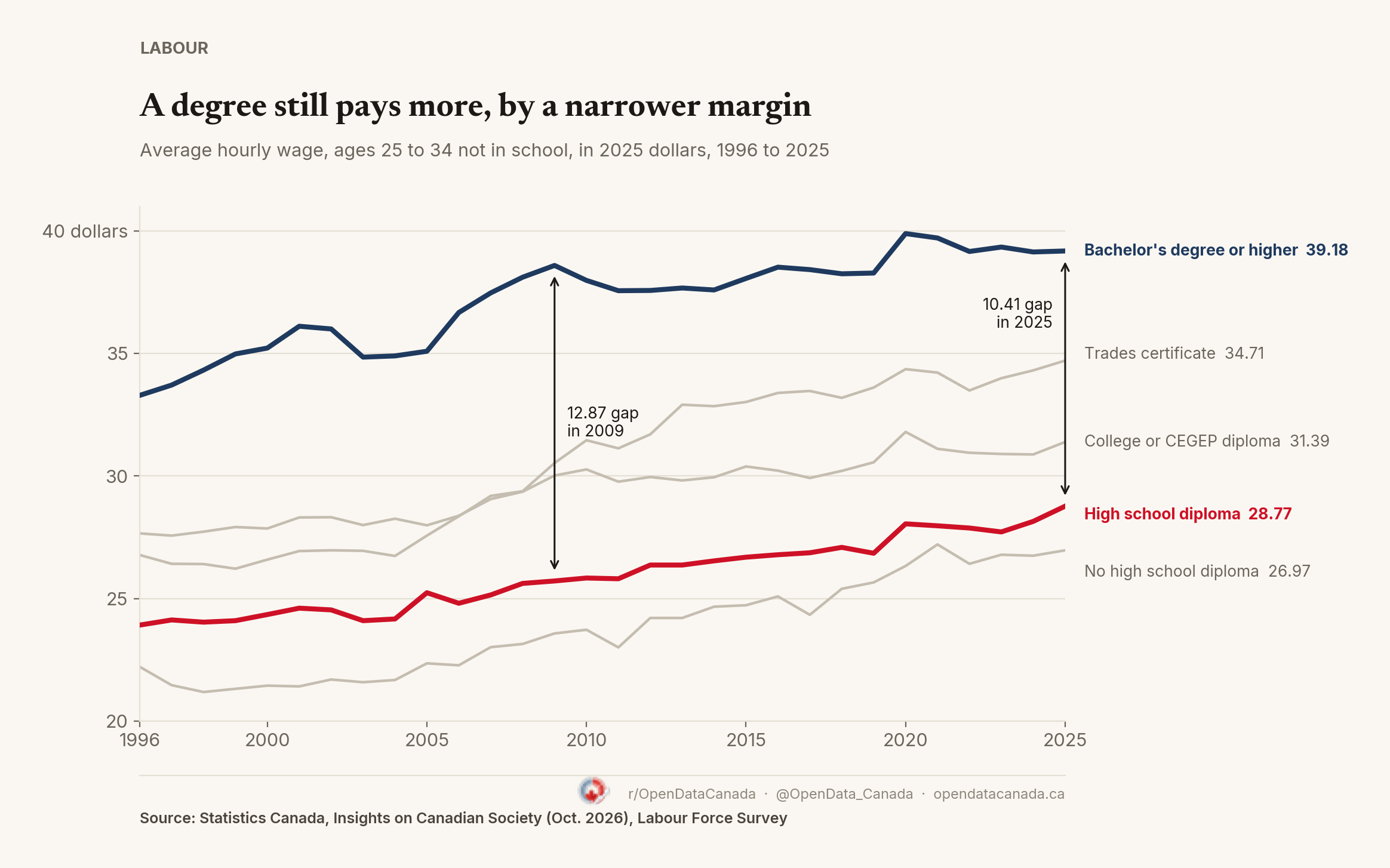
Canadians aged 25 to 34 with a bachelor's degree or higher earned 39.18 dollars an hour in 2025, more than any other education group. But their inflation-adjusted pay rose just 1.5 percent since 2009, while wages for trades certificate holders climbed 13.7 percent.
A university degree is still the best-paid credential for young Canadians. In 2025, people aged 25 to 34 whose highest credential was a bachelor's degree or higher, and who were not in school, averaged 39.18 dollars an hour. They are grouped by education, not by graduation year, so not all are recent graduates. That was 4.47 more than those with a trades certificate and 10.41 more than high school graduates. Degree holders have been the top-paid group in every year since 1996.
What has changed is the size of that lead. Statistics Canada published three decades of wage data by education on Wednesday, in a study of how young graduates are doing in the job market. It measures hourly pay and job quality, not the full return on a degree: tuition, student debt, years out of work and lifetime earnings are outside its scope. Every figure below is adjusted for inflation to 2025 dollars.
The relative edge is the smallest on record
In 2009, a young degree holder earned 1.50 times as much per hour as a young high school graduate. By 2025 that ratio was 1.36, the lowest in the series, which starts in 1996 (1.39 that year). In dollars, the gap shrank from 12.87 an hour to 10.41, the smallest since 2005. It was smaller still in 1996, at 9.37, when all wages were lower.
The gap narrowed because other wages rose, not because degree pay fell. The catch-up was not even, though. From 2009 to 2025, trades and high school wages rose much faster than degree pay, while college and CEGEP diplomas grew only a little faster:
| Education, ages 25 to 34 | 2009 | 2025 | Change |
|---|---|---|---|
| No high school diploma | 23.58 | 26.97 | +14.4% |
| Trades certificate | 30.53 | 34.71 | +13.7% |
| High school diploma | 25.72 | 28.77 | +11.9% |
| College or CEGEP diploma | 30.02 | 31.39 | +4.6% |
| Bachelor's degree or higher | 38.59 | 39.18 | +1.5% |
The pattern holds over shorter windows. Since 2019, the last year before the pandemic, degree holders' pay rose 2.4%, the smallest increase of the five groups. High school graduates gained 7.2%. Over the full 1996 to 2025 period the picture is more mixed: degree pay rose 17.7%, ahead of college diplomas (13.5%) but behind trades (29.6%).
The trades gap is the narrowest of all. A young tradesperson earned 4.47 an hour less than a degree holder in 2025, the smallest difference since the series began, down from 8.06 in 2009.
One caution applies to all of these numbers. They are averages across everyone in each group, so they shift when the mix of people holding a credential changes, not only when pay changes. The study does not separate the two.
What a bachelor's degree pays depends on the field
"Bachelor's degree" covers everything from nursing to fine arts, and the wage figures above don't split them. A separate Statistics Canada table, built from graduates' tax records, does. It tracks people who finished a bachelor's degree in 2022 and reports their median employment income in 2024, two years later, in 2024 constant dollars (adjusted for inflation). It covers graduates who reported employment income, of all ages, including international students. That is a different population, period and type of income from the hourly wages above, so the two sets of numbers shouldn't be compared directly.
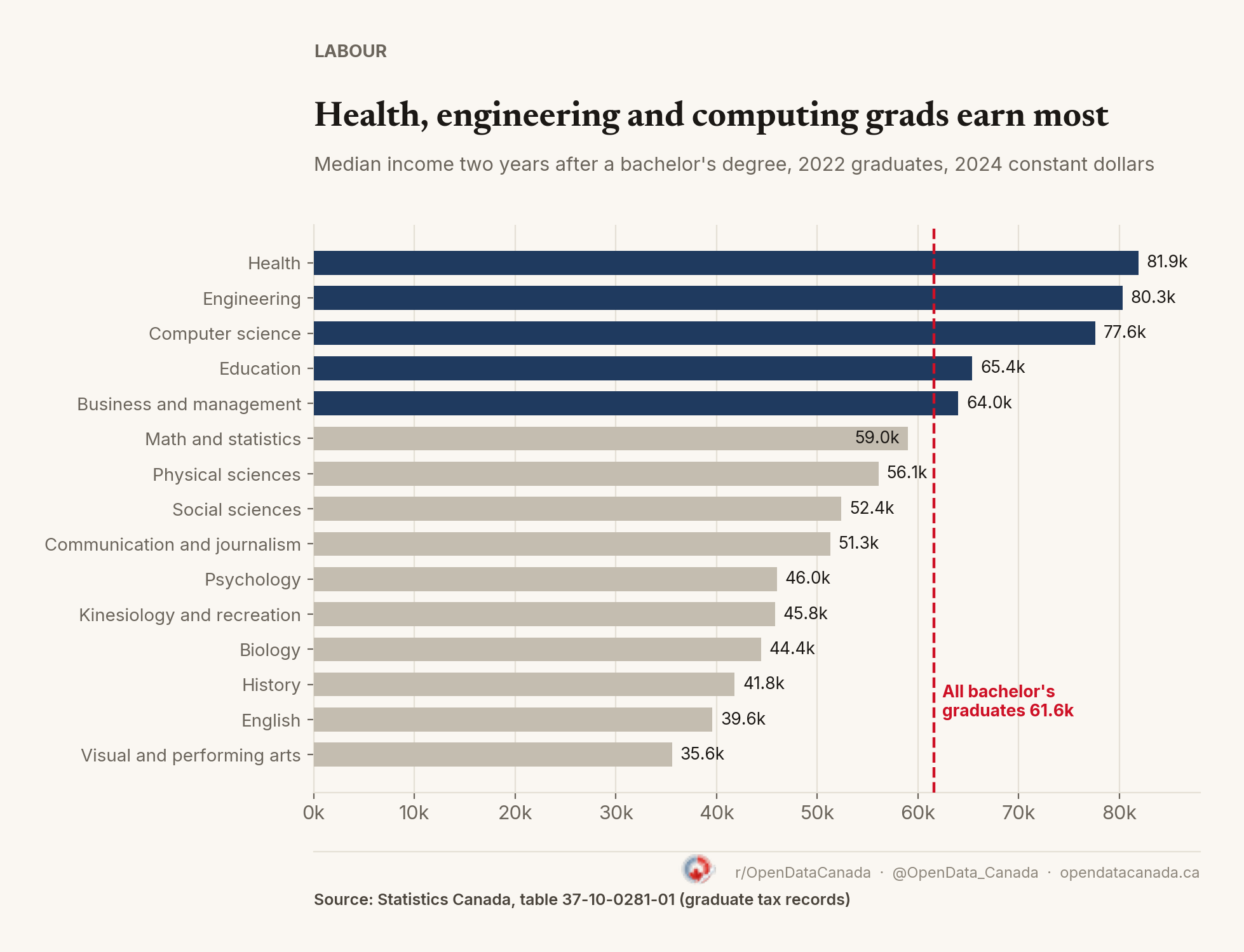
The spread is wide. Among graduates who reported employment income, those in health-related bachelor's programs, which include nursing and pharmacy, had a median employment income of 81,900 dollars two years after graduation. Engineers had 80,300 and computer science graduates 77,600. Business, the most common field with about 36,000 graduates, sat near the middle at 64,000, against 61,600 for all bachelor's graduates. Psychology, biology, history and English graduates earned between 39,600 and 46,000, and visual and performing arts graduates 35,600.
Two years out is early. Many graduates are still in entry-level jobs, and the gaps between fields can change over a career.
Steady jobs: degree holders hold their ground
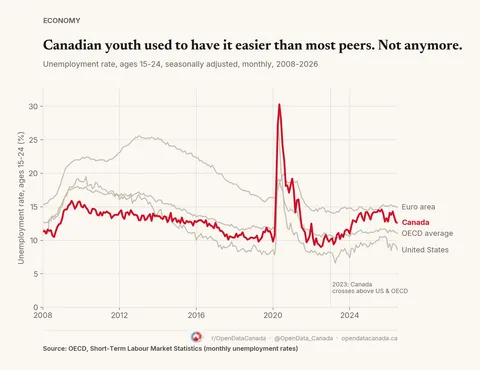
Pay is one measure. Job security is another, and here the degree still performs well. In 2025, 69% of young degree holders worked in a permanent, full-time job. That is down from 71% in 2022, when the labour market was unusually tight, but above the 66% average since 1997. Unemployment among Canadians aged 15 to 24 has risen sharply since 2023, but the people in this study are older.
Trades certificate holders did slightly better, at 71%, as they have in most years since 2018. College graduates were at 66%, high school graduates at 56%, and those without a high school diploma at 43%.
Other measures of job quality have held steady since 2020, the first year the survey tracked them all. About 15% of young male graduates and 14% of young women were overqualified in 2025, meaning they worked in jobs that usually need a high school diploma or less. Workplace pension coverage rose slightly, to 56% of men and 60% of women.
Women's pay gap hasn't moved, but mothers' job gap has halved
Young women with a degree earned 37.61 an hour in 2025, against 41.07 for men, or about 92 cents on the dollar. That ratio is almost exactly the average since 1997. It has not narrowed.
The gap between university-educated mothers and fathers in permanent, full-time work has narrowed. Among young graduates with a child aged 6 or younger at home, 76% of fathers and 62% of mothers held a permanent, full-time job in 2025. In 2007 the figures were 77% and 51%, a 26-point gap that is now 14 points. Almost all of the change came from mothers. In Quebec, university-educated women with and without young children were both at about 67%. Statistics Canada points to Quebec's low-cost child care as one possible reason, without claiming it is the only one.
What it adds up to
On the main earnings and employment measures, degree holders continue to outperform high school graduates. What the data no longer shows is the degree pulling further ahead. For the past 16 years, real pay for young degree holders has held steady while pay for trades and high school graduates has risen faster, and the trades have come within about four and a half dollars an hour. Whether a given degree is worth its cost depends on the program and the debt, which these averages cannot show.