Economy · Bank of Canada consumer survey
Why Young Canadians Still Think Inflation Is 8%
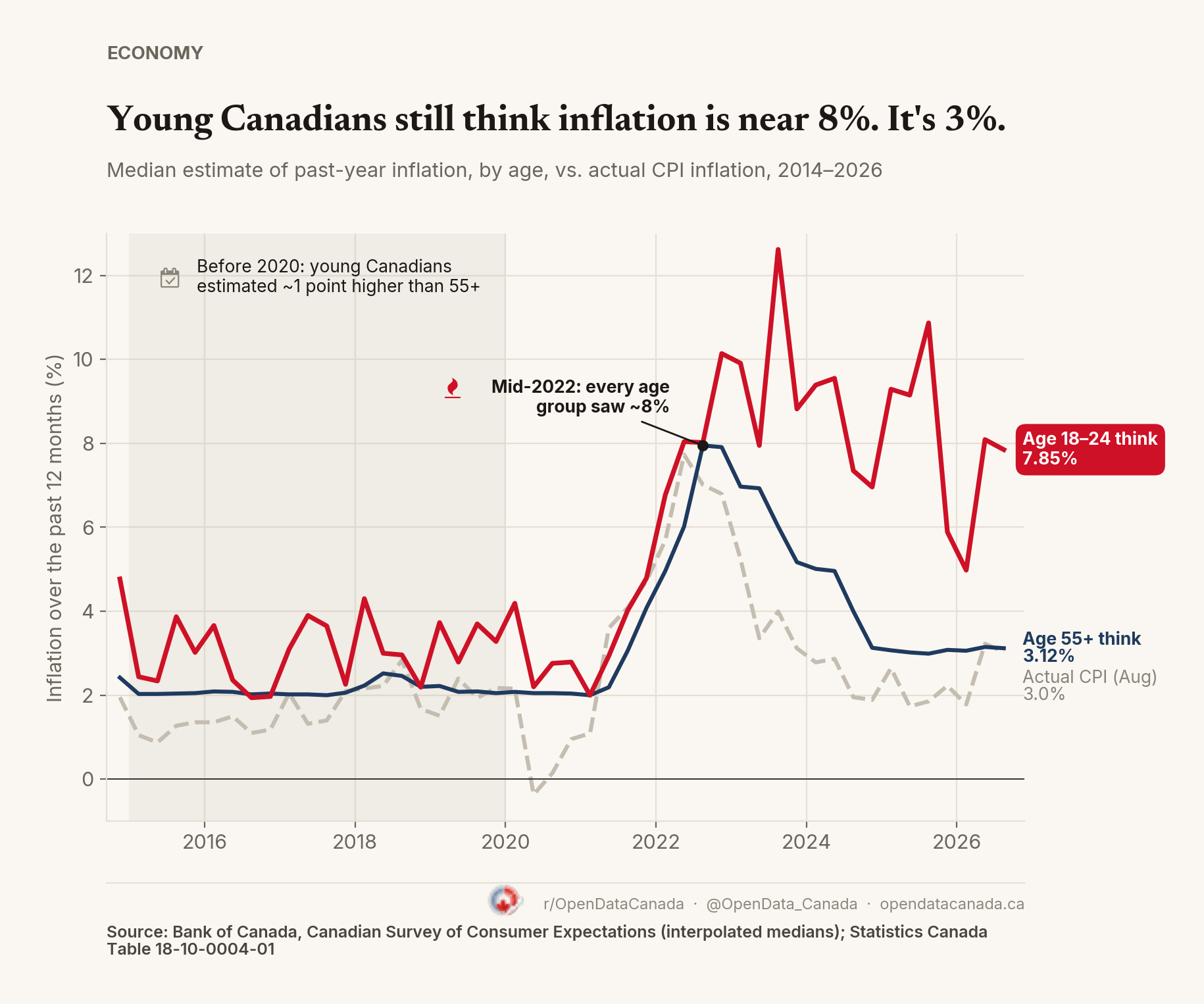
In the Bank of Canada's August survey, the median Canadian aged 18 to 24 put inflation over the past year at 7.85%. The official rate for August was 3.0%. Before 2020, younger and older respondents were about a point apart.
People 55 and over put past-year inflation at 3.12%. Statistics Canada's consumer price index (CPI), the official measure, rose 3.0% in the 12 months to August 2026, the month the survey was in the field. The September figure, out on October 19, was 3.1%. For the youngest adults, inflation feels more than twice as high as reported. The survey asks for a best guess at the overall inflation rate over the last 12 months. It doesn't measure what respondents themselves paid.
The answers come from the Bank of Canada's Canadian Survey of Consumer Expectations, a quarterly online survey of about 2,000 heads of household. The third-quarter results came out the same day as the September CPI. The Bank's report led with long-run expectations: the typical consumer now expects inflation of 3.91% five years out, up from 3.39% last quarter. The split by age is in the survey's demographic data files, which go back to the end of 2014.
Did young Canadians always guess high?
They did, by about a point. From 2015 through 2019, the median 18-to-24-year-old put past-year inflation at 3.0% on average, against 2.1% for people 55 and over. Actual CPI inflation averaged 1.7%. The youngest group's median never went above 4.3% in any quarter of those five years.
In the third quarter of 2022 the groups met. CPI inflation reached 7.0% in August 2022, and the median answer was close to 8% at every age: 8.02% for 18 to 24, 7.93% for 25 to 54 and 7.95% for 55 and over.
Then the groups split. As CPI inflation fell back toward 2% in 2024 and 2025, the answers from people 55 and over came down with it. Their median has stayed between 2.99% and 3.15% for eight straight quarters. The 18-to-24 median never came back. It hasn't dropped below 4.98% in any quarter since the start of 2023.
Averaged over the last eight quarters, the gap between the youngest and oldest groups is 4.8 points. Before 2020 it was 0.9 points.
Is it renters and low incomes?
Groups that spend more of their budget on rent and essentials also guess high. Over the same eight quarters, renters averaged 4.9% and homeowners 3.3%. Households earning under 40,000 dollars a year averaged 4.7%, against 3.3% for those above 100,000 dollars. Newcomers to Canada averaged 5.9%.
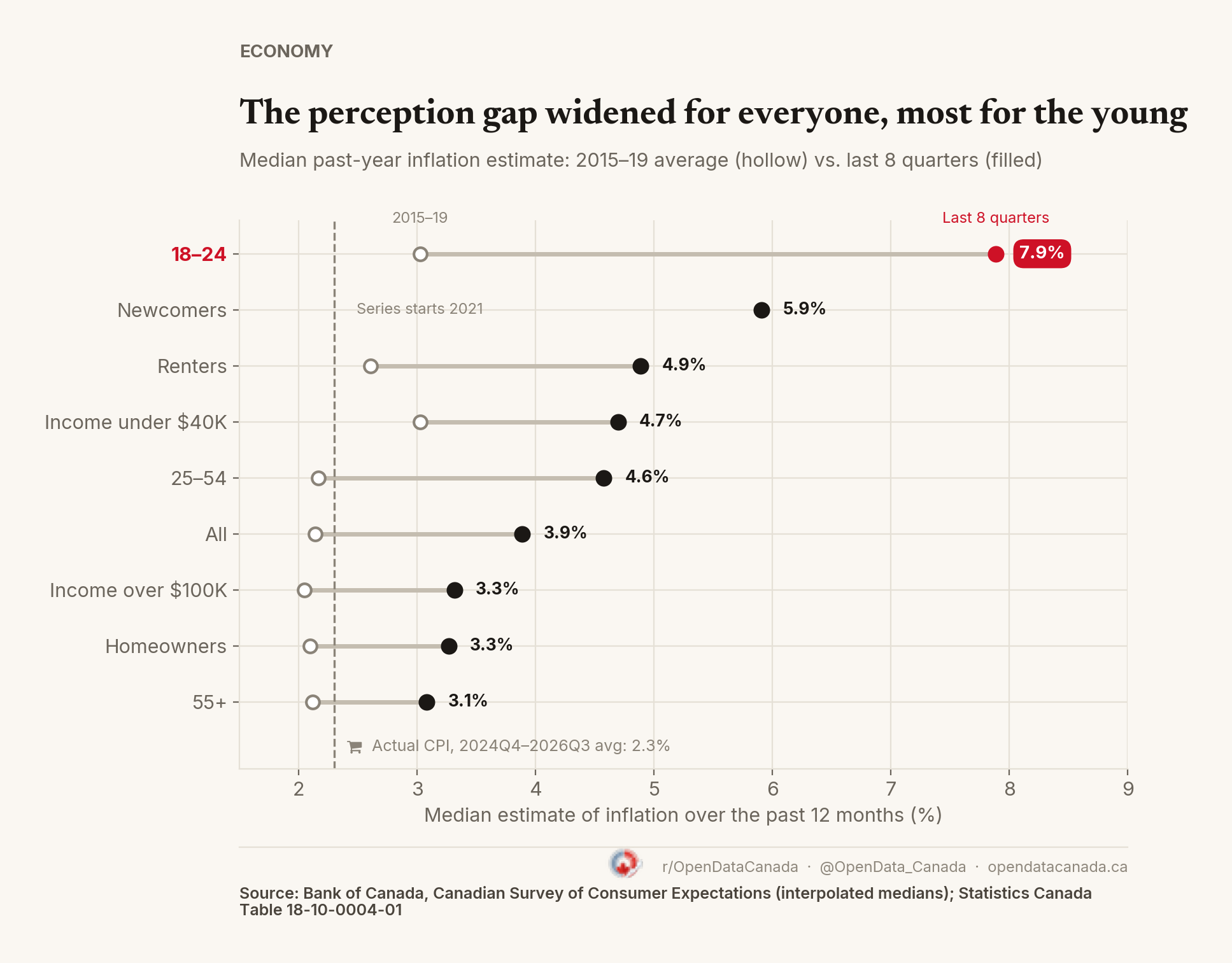
None of those groups comes close to the young. The survey also scores respondents on five basic math questions, and those who got fewer than four right put inflation at 5.95% this quarter, still well under the 18-to-24 figure.
More than half of Canadians aged 18 to 29 (55% in 2024) lived with a parent, according to Statistics Canada's Canadian Housing Survey, but living at home doesn't necessarily shield someone from housing costs. The public files don't cross age with income or housing, so the overlap between these groups can't be untangled here.
Why would the young see more inflation?
One explanation comes from research on how people learn about inflation. In a 2016 paper, "Learning from Inflation Experiences," economists Ulrike Malmendier and Stefan Nagel used 57 years of United States survey data and found that people's inflation expectations follow the inflation they have lived through. Young people update more strongly after a surprise, because recent years make up a bigger share of their lives.
For someone who is 22 in 2026, the price surge of 2021 to 2023 is the only inflation episode of their adult life. That fits the timing in the Canadian data: the age gap was small before 2021 and wide after it. The paper studies forecasts of future inflation rather than estimates of the past year, and the survey can't show that this is the cause.
What do they think is happening to their pay?
The same survey asks about wages. The median 18-to-24-year-old says their pay rose 4.94% over the past year, against prices up 7.85%, which works out to a felt pay cut of about three points. People 55 and over put their wage growth at 1.93% and prices at 3.12%. Looking ahead, the youngest group expects pay to rise 6.72% over the next 12 months.
The Bank of Canada follows these beliefs because they can feed into the raises people ask for and how fast they spend. The survey doesn't show whether young workers bargain on their estimates.
A caution on the numbers: these are estimates, and the median for a small age group moves a lot from one quarter to the next (10.87% to 4.98% within two quarters). That is why the comparisons above use eight-quarter averages. The pattern also shows up in every quarter since 2023.
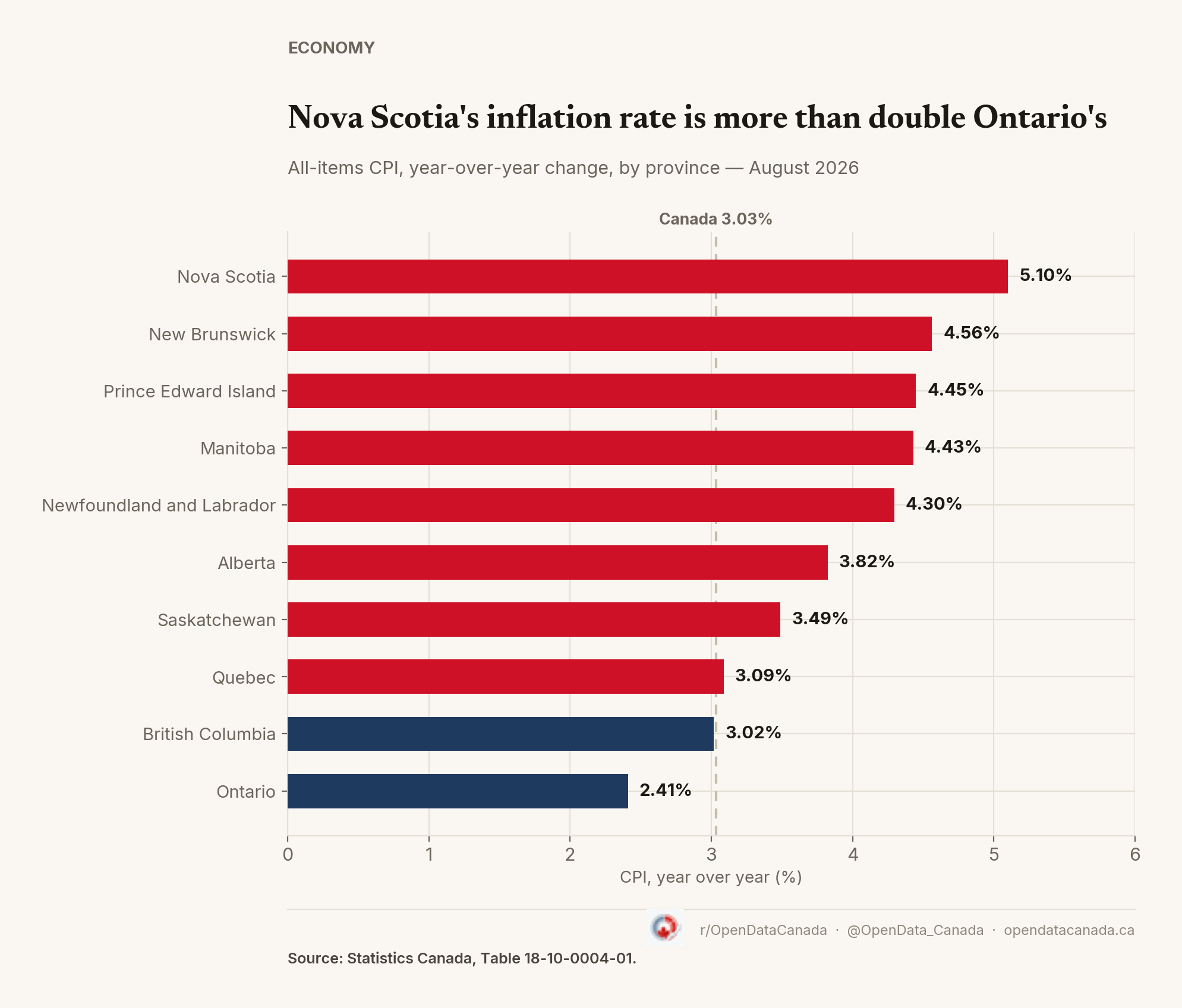
For the official figures, the Canada inflation tracker updates after every CPI release, and the August CPI breakdown by province shows where prices actually rose fastest.
Inflation came back down in 2024. For Canadians under 25, going by their own answers, it never did.