Ontario politics · Polls
Bains wins Ontario Liberal race. Polls put Ford three seats ahead of a majority
The Progressive Conservatives lead the Liberals by about 7 points, down from 13 at the 2025 election. Applied to the 2025 riding results, the latest polls leave the PCs with about 66 of 124 seats, three above a majority. New Liberal leader Navdeep Bains would need a lead of more than 3 points to win the most seats, and about 9 for a majority.
Navdeep Bains won the Ontario Liberal leadership on Nov. 21 with 50.29 per cent of the points to Lee Fairclough's 49.71. Each of the 124 riding associations got 100 points however many members voted there, with smaller allocations for student and women's clubs. He takes over the third party in the legislature. The NDP is the Official Opposition: it won 27 seats in 2025 to the Liberals' 14.
Since that election, Doug Ford's Progressive Conservatives (PCs) have lost about 4 points. The Liberals have picked up less than 2 of them. Most of the rest went to the NDP.
The newest poll, from Abacus Data, was published Nov. 18 but taken Oct. 30 to Nov. 4. No poll yet measures how voters respond to Bains, so the numbers below are his starting line.
Who leads the Ontario polls?
The PCs, by about 7 points. The Open Data Canada poll average, built from 50 polls by nine firms and weighted toward the newest, puts them at 38.7 per cent, the Liberals at 31.6 and the NDP at 21.0. At the 2025 election it was PC 43.0, Liberal 30.0, NDP 18.5.
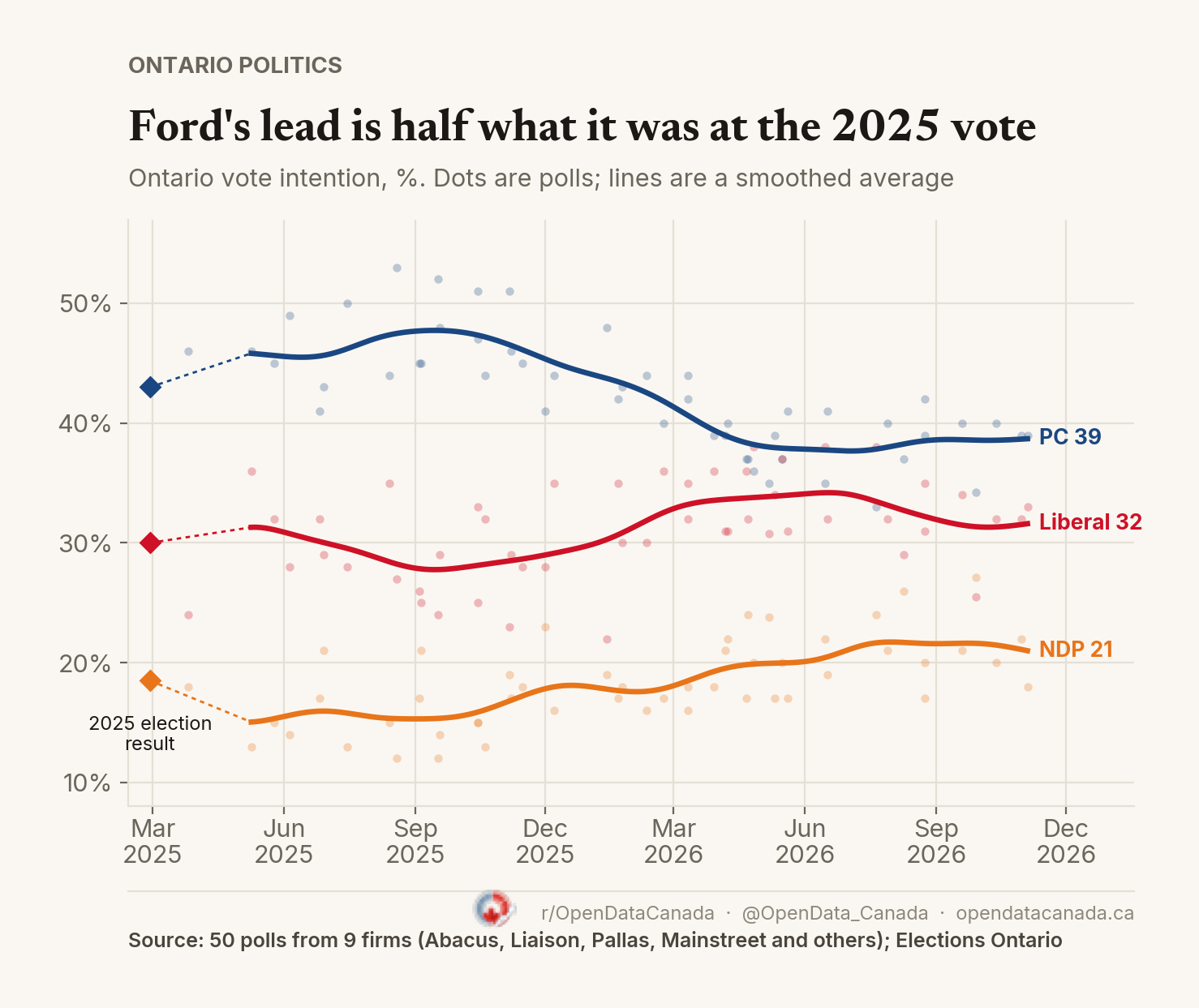
The PCs peaked in September 2025 at about 48 per cent in the average. Then they slid through the winter. By June 2026 their lead was down to 3 to 4 points, and Liaison Strategies had the Liberals ahead in April, June and July, by as much as 38 to 33.
The gap has widened again since. The two most recent polls agree: Abacus Data had the PCs ahead 39 to 33 in early November, and Liaison had 39 to 32 at the end of October.
How would the latest polls translate into seats?
Another PC majority, narrowly. Moving every riding by the same amount each party has moved province-wide since 2025, a method called uniform swing, leaves the PCs with about 66 seats, three more than the 63 needed. The NDP would win 28 and stay the Official Opposition by one seat over the Liberals at 27. The Greens would win 2 and the Independent 1.
That's 14 seats changing hands, 13 of them to the Liberals: five in Mississauga, plus Burlington, Oakville, Eglinton-Lawrence, Willowdale, Scarborough Centre, York South-Weston, Hamilton Mountain and Peterborough-Kawartha. The NDP would take Sault Ste. Marie.
Why do the Liberals win so few seats for their votes? Because only first place counts in each riding. In 2025 they took 30 per cent of the vote and 14 seats, while the NDP took 18.5 per cent and 27 seats. Liberal votes were spread thinly across the suburbs: the party came second to the PCs in 69 ridings and won nothing for those votes. NDP votes were packed into central Toronto, Hamilton, London, Niagara, Ottawa and the North, where they win.
Ford won 80 seats in 2025. A 7-point lead costs him 14 of them and leaves him three over the majority line. That cushion is thin. The PCs would hold Newmarket-Aurora and Milton by less than a tenth of a point each, and the average leans on a handful of recent polls. A 5.5-point lead would leave them short of a majority.
How big a lead does Bains need?
More than 3 points to win the most seats, and about 9 for a majority. That assumes every new Liberal voter comes straight from the PCs and the NDP stays at 21.
| What the Liberals win | Voters out of 100 who must switch from PC to Liberal | Poll result needed |
|---|---|---|
| Most seats | about 5 | Liberals ahead by more than 3 |
| Majority (63 seats) | about 8 | Liberals ahead by about 9 |
Source: Elections Ontario 2025 results by riding; poll average as above.
With a Liberal lead of 2 to 3 points, the two parties would tie at 46 seats each. Below 2 points, the PCs stay the largest party.
Why Brampton is harder for the Liberals
Bains grew up in Brampton. But all five Brampton seats are PC, and none of them flips under the uniform-swing scenario.
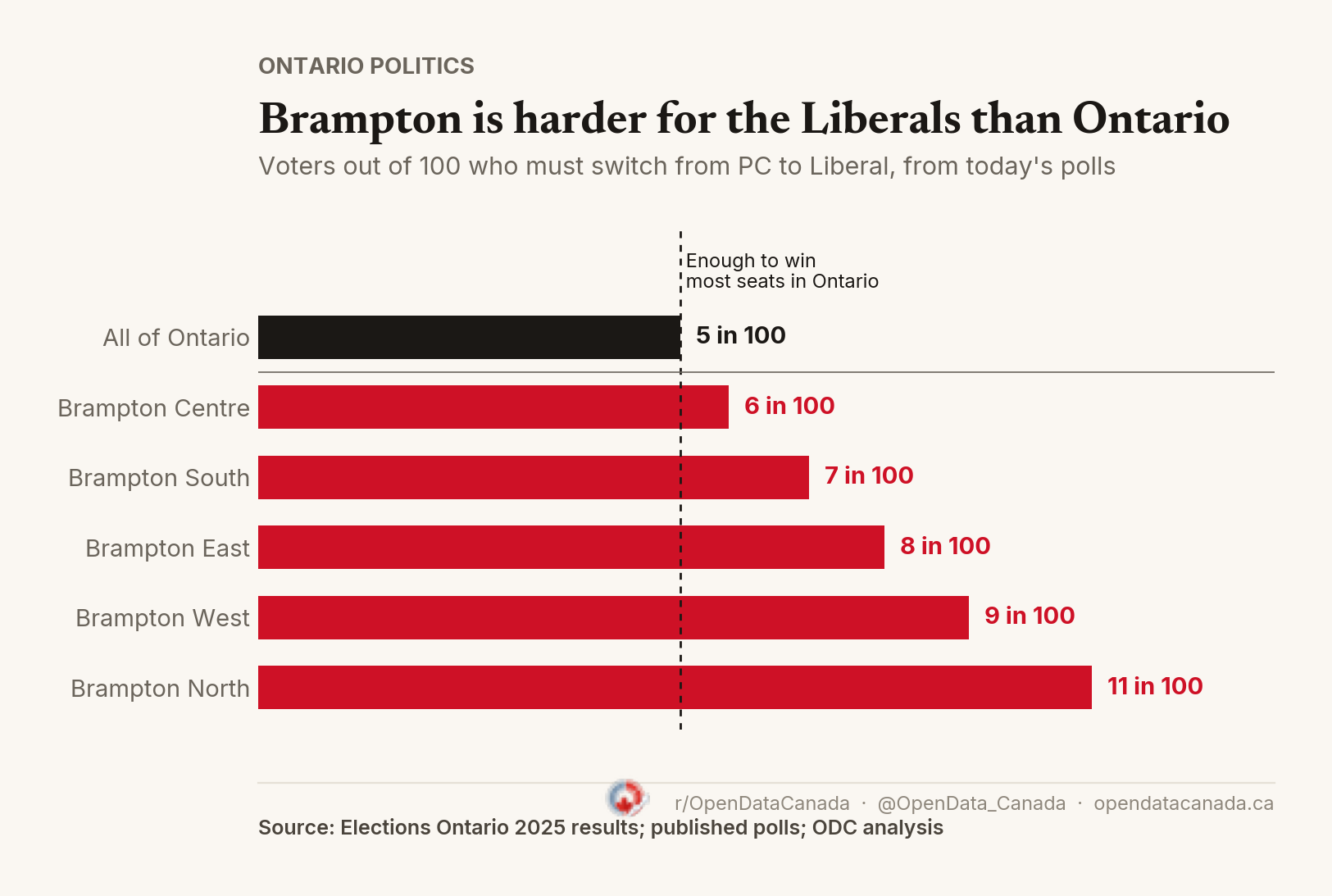
Every Brampton riding needs a bigger switch than the one that would make the Liberals the largest party. Brampton Centre is closest, at 6 voters in 100. Brampton North needs 11, twice the switch needed province-wide.
Brampton alone won't get the Liberals there. Under this scenario, their biggest gains would have to come in Mississauga, Oakville and the other Toronto suburbs first. Brampton matters for a majority: at the switch a majority takes, Brampton Centre, South and East would just flip, so a Liberal majority would need three of the five Brampton seats.
When is the next Ontario election?
There is no longer a fixed date. Ontario repealed its four-year election schedule in 2025, so the premier can call a vote whenever he likes. The legislature can't run longer than five years, which means an election by early 2030 at the latest.