Housing
Missed mortgage payments are rising fastest in Ontario cities
Toronto, London and Windsor had the biggest yearly increases in mortgages 90 or more days behind. Seven of the eight largest increases were in Ontario, while late payments fell in several Prairie cities.
The Bank of Canada raised its key interest rate on Wednesday for the first time since 2023 (how that hits the last pandemic-era mortgages up for renewal). Mortgage stress was already rising before the decision, particularly in Ontario, where more borrowers are falling behind on payments than a year ago. The figures below all predate the hike.
Canada Mortgage and Housing Corporation's (CMHC) fall mortgage report, based on credit bureau data from Equifax, tracks mortgages 90 or more days behind on payments in 18 large cities. Between mid-2025 and mid-2026, Toronto, London and Windsor recorded the country's largest increases, each rising by 0.09 percentage points. Oshawa, St. Catharines-Niagara, Hamilton and Kitchener-Cambridge-Waterloo followed. Seven of the eight largest increases were in Ontario; the exception was Vancouver.
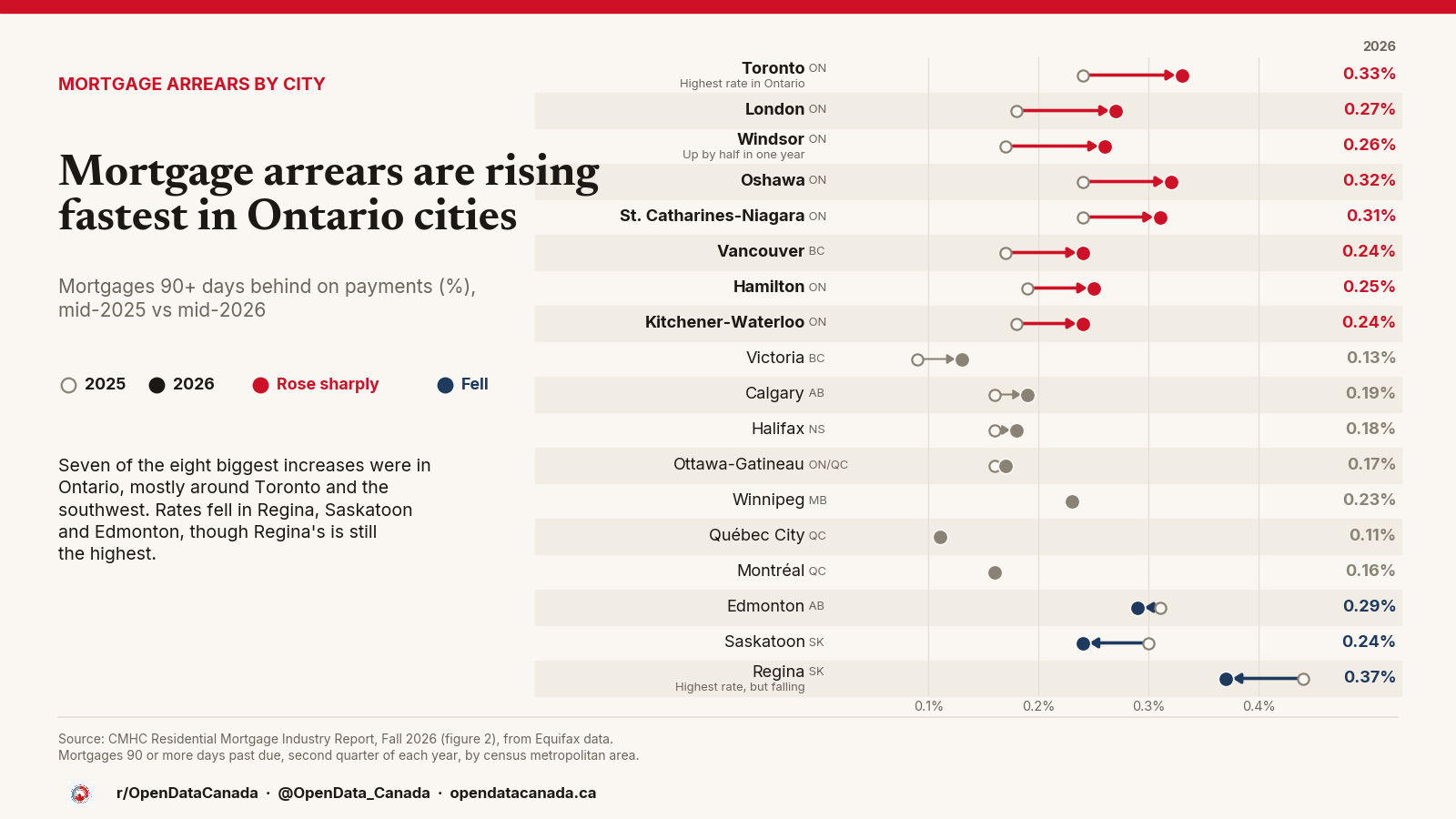
Windsor's rate went from 0.17% to 0.26%, up by half in a single year. London's rose the same amount.
The Prairies show the opposite. Regina still has the highest rate of the 18 cities, at 0.37%, but it was 0.44% a year earlier. Saskatoon and Edmonton also fell. Montréal, Québec City and Winnipeg didn't move.
Ontario's arrears rate has overtaken Alberta's
For provinces, the numbers come from a different source: the Canadian Bankers Association's count of mortgages 90 or more days in arrears, which goes back to 1995. It isn't directly comparable to the city figures above. Ontario's rate was 0.32% in the second quarter of 2026, up from 0.21% a year earlier and from a low of 0.06% in 2021 and 2022. That's Ontario's highest rate since the second quarter of 2011.
Alberta's was 0.27%. In the bankers' monthly figures, Ontario's rate has been above Alberta's every month since October 2025. Before that, the last time was August 2008.
The numbers are still small. Ontario reached 0.43% after the 2008 financial crisis and more than 0.6% in the mid-1990s. CMHC calls the national picture "contained." The concern is the direction, and where it is concentrated.
Why Ontario
CMHC points to three things. Unemployment is rising, and Ontario is more exposed to U.S. tariffs, with trade tensions felt most around Toronto and in the southwest. Home prices have softened, so a homeowner who falls behind has less room to sell or refinance. And the Greater Toronto and Hamilton Area (GTHA) has a high share of investors and stretched buyers. CMHC singles out highly indebted households that bought houses in suburbs such as Brampton and Oshawa during the pandemic, not just Toronto condo investors.
The clearest signs of stress among lenders are at mortgage investment entities (MIEs), private lenders that often serve borrowers who can't qualify at a bank. In the GTHA, 11.1% of their loan balances were 90 or more days behind in early 2026, up from 3.0% in late 2023 and nearly three times the 3.8% rate in the rest of Canada. MIEs held only 1.8% of outstanding mortgage balances in the first quarter of 2026, which limits their weight in the overall market. Their rising arrears still point to serious stress among the borrowers they serve. Their GTHA borrowers, a small group and not typical of Ontario homeowners, show how stretched the most fragile buyers have become:
| GTHA private-lender mortgages (share) | Early 2024 | Early 2026 |
|---|---|---|
| Interest-only loans (no principal paid down) | 61.0% | 69.7% |
| Uninsured, owe more than 80% of the home's value | 1.6% | 9.2% |
| Spend over 60% of income on debt payments | 10.4% | 29.0% |
Other bills are slipping too
Missed payments on other debts can be an early sign of money trouble at home. CMHC reports that payments 90 or more days late on credit cards, car loans and lines of credit have kept rising alongside mortgage arrears. Among people with a mortgage, the rate of new bankruptcies rose 25% in the year to mid-2026, compared with 5% for people without one.
CMHC projects Ontario's monthly mortgage arrears rate will rise from 0.33% in June 2026 to 0.44% by June 2027, the largest projected increase among the regions it tracks. It expects smaller increases in British Columbia and Atlantic Canada and little change elsewhere. The forecast predates Wednesday's rate hike, so it doesn't account for it.