Health · Chart note
Construction Workers' Opioid Death Rate Is Now Far Ahead of Every Major Ontario Sector
A new study using linked Ontario health records tracked opioid toxicity deaths across the province's workforce from 2018 to 2024. Construction and trades workers now die from opioids at more than 6 times the rate of Hospitality, the next-largest sector, and the gap has grown sharply since 2018.
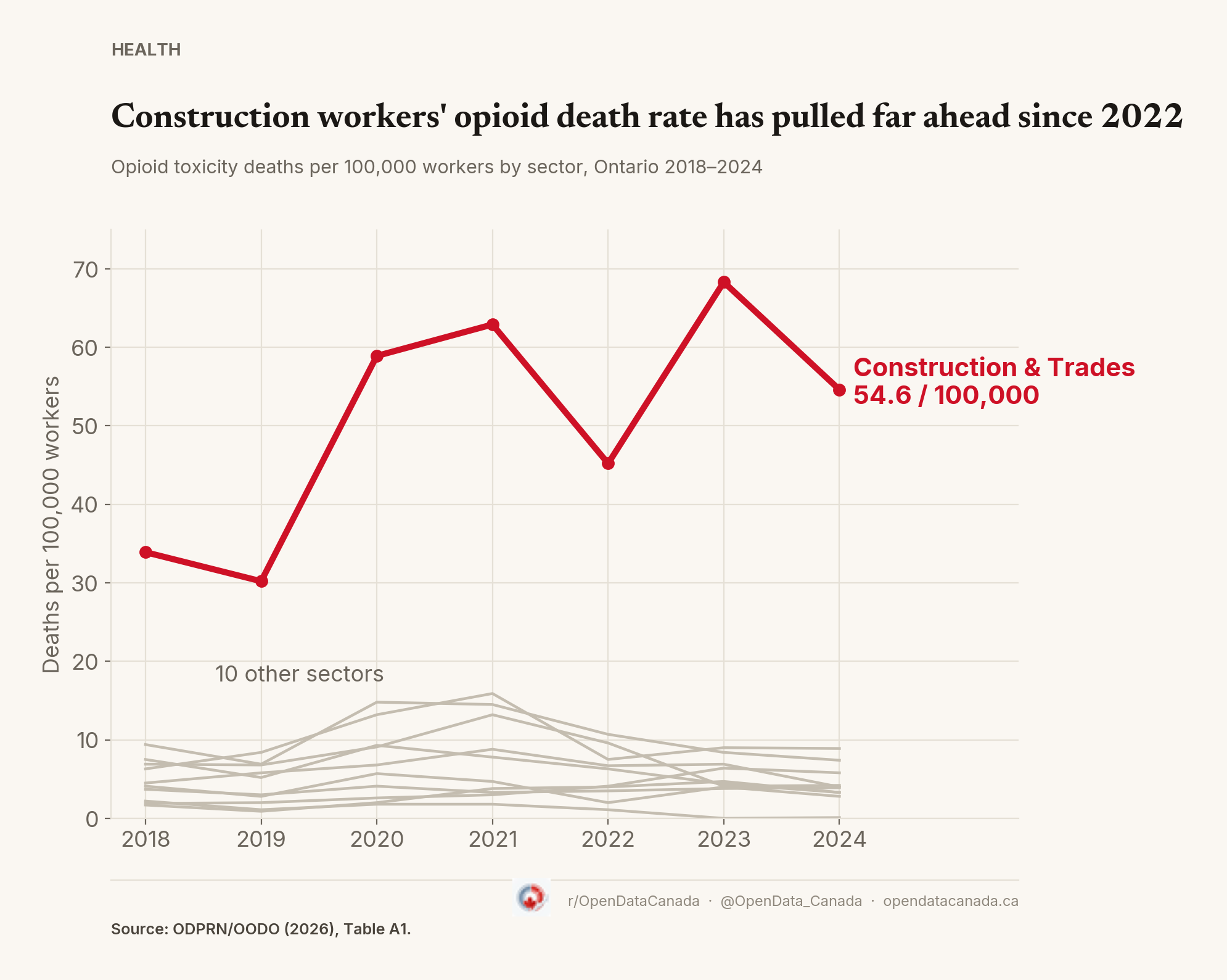
The Ontario Drug Policy Research Network (ODPRN) and the Ontario Opioid Drug Observatory (OODO) used data from ICES, an Ontario institute that holds linked health records for nearly every resident of the province, to study opioid toxicity deaths in Ontario from 2018 through 2024, linking each death to an occupational sector where coroner records held enough employment information to do so. Of 15,952 deaths in the period, only 3,534 (22.2 percent) could be matched to a known occupational sector: 54.5 percent of all deaths had missing or unknown employment information entirely, and another 23.4 percent were recorded as unemployed with no occupation on file. Among the sector-linked deaths, one sector stands apart: construction and trades.
In 2024, construction's rate was 54.6 deaths per 100,000 workers, more than 6 times Hospitality's 8.9, the next-highest rate among sectors with a large, stable workforce. That gap has not been constant. Since 2022, construction's rate has run ahead of every comparably sized sector by a factor of 4.2 to 7.6, depending on the year. Before that, from 2018 through 2021, Natural Resources & Agriculture actually posted a higher rate than construction did, in some years by a wide margin.
The raw numbers tell a related story. Construction and trades accounted for 222 of the 512 sector-identified opioid deaths in 2024, or 43 percent, up from 30 percent (120 of 400) in 2018. That 13-point rise in its share is bigger than the combined gain of every other sector whose share grew over the same period, retail, hospitality, civic and government services, and information technology and legal, roughly 9 points combined. Construction's death count itself rose 85 percent, from 120 to 222, while most other sectors' counts fell.
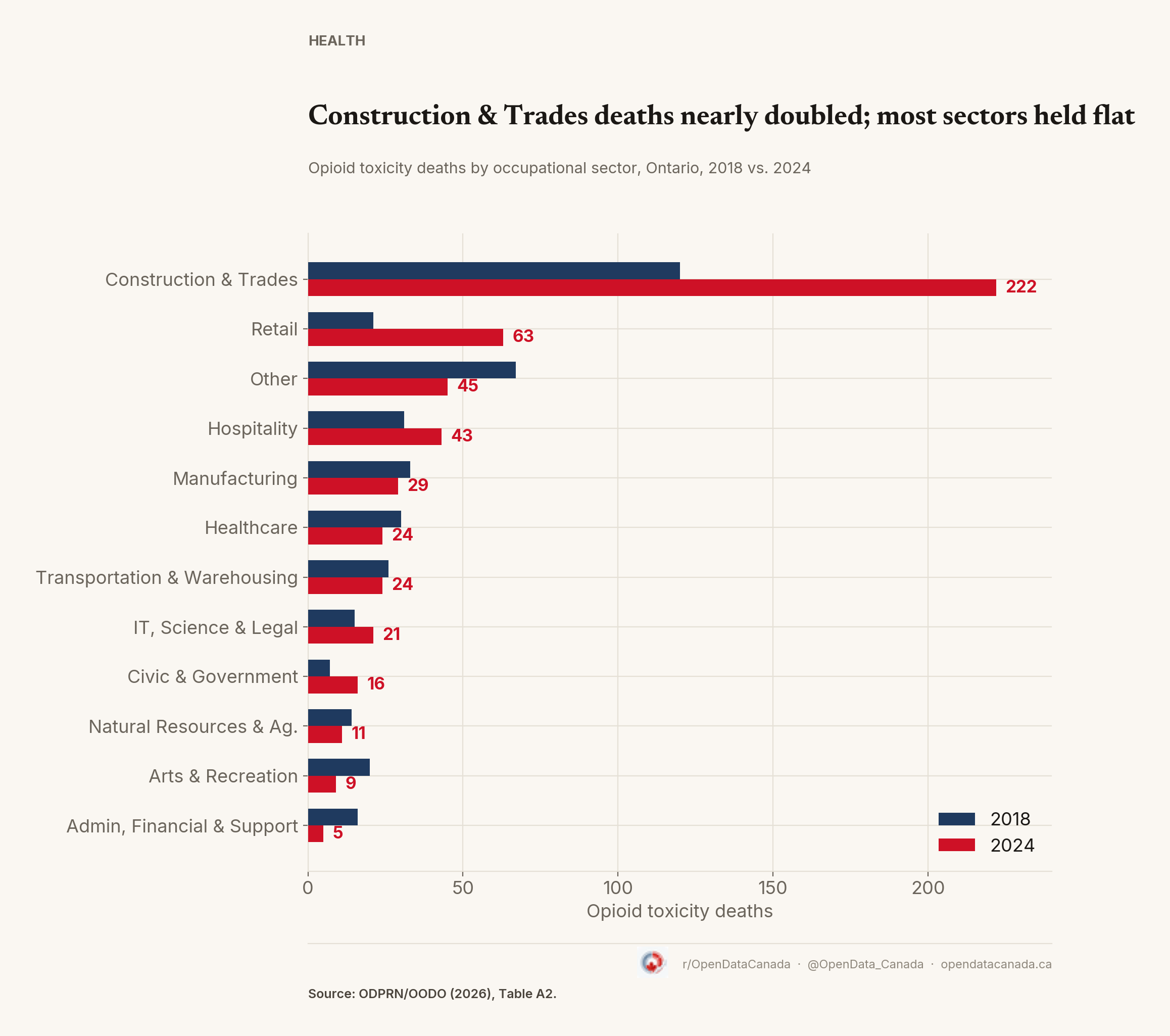
Retail is the other clear mover: its death count tripled, from 21 to 63, and its rate climbed from 1.9 to 5.8 per 100,000. Hospitality and civic and government services also grew, though more modestly, from 31 to 43 deaths and 7 to 16 deaths respectively. None of them came close to construction's scale.
One sector is deliberately left off the rate chart: Natural Resources & Agriculture, which the study's own authors identify alongside Construction & Trades as the two sectors with the highest overall burden. Its rate actually ran higher than construction's for four straight years, 2018 through 2021, peaking at 86 per 100,000 in 2021. But that rate rests on a tiny base, just 14 sector-identified deaths in 2018 and 11 in 2024, in a small workforce, and it swung from 26 to 86 per 100,000 in successive years, volatility construction's tenfold-larger death count doesn't share. It is left off the chart because including it would swamp every other line without adding a reliable signal, not because its own numbers or its standing in the study are low.
What stands out is not just the size of construction's rate but its direction. Since 2022, the gap between construction and every comparably sized sector has stayed above 4 times, even as it narrowed slightly between 2023 and 2024, from a 59-point gap to a 46-point one. Retail and civic services grew too, from a much smaller base. Everything else fell.