Population · Chart note
Does Canada Have Too Much Immigration? Polls Since 1977
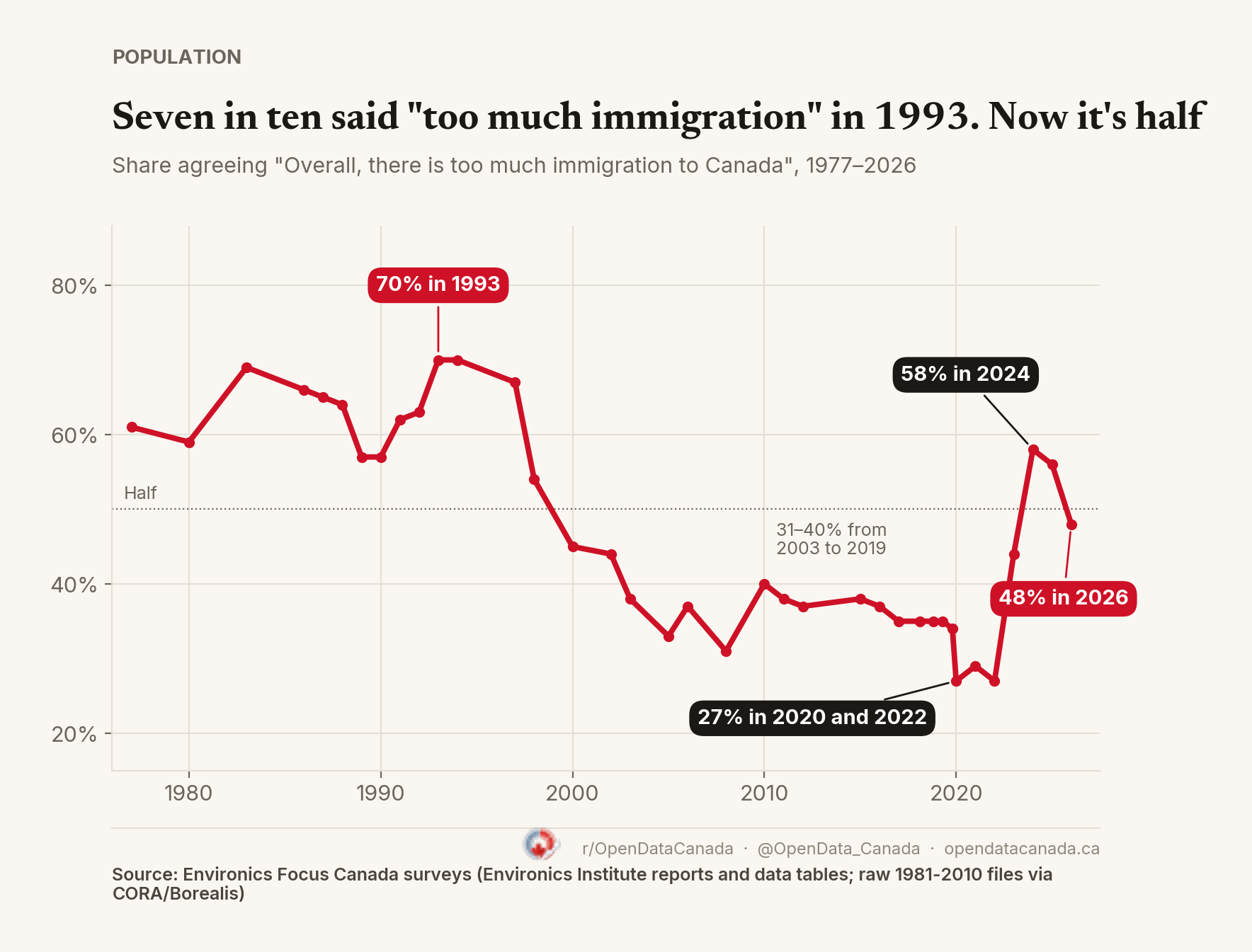
In 1993, seven in ten Canadians said there was too much immigration. In 2026, opinion is evenly split. What has changed is who says it: Conservative and Liberal voters gave similar answers for decades and are now 44 points apart.
Since 1977, the polling firm Environics has regularly asked Canadians whether they agree or disagree that "overall, there is too much immigration to Canada." The question asks about the number of newcomers rather than views of immigrants.
In 2026, opinion is evenly split: 48 percent agree and 48 percent disagree. That's down from 58 percent in 2024, the highest reading since the late 1990s.
Larger majorities agreed through most of the 1980s and 1990s. The bigger change is in who agrees.
The 1990s were the high point
From the late 1970s through the 1980s, between 57 and 69 percent agreed there was too much immigration. The peak came in 1993 and 1994, when 70 percent agreed. By 2000 fewer than half agreed, and from 2003 to 2019 it stayed between 31 and 40 percent. It hit 27 percent in 2020 and again in 2022, the lowest readings on record.
It then doubled in two years, to 58 percent in 2024, close to where it sat for much of the 1980s and 1990s. The 2026 reading of 48 percent is lower than any reading from the 1970s, 1980s or 1990s.
For decades, Conservative and Liberal voters gave similar answers
The surveys also ask people how they would vote. Until about 2010, Conservative and Liberal voters gave similar answers.
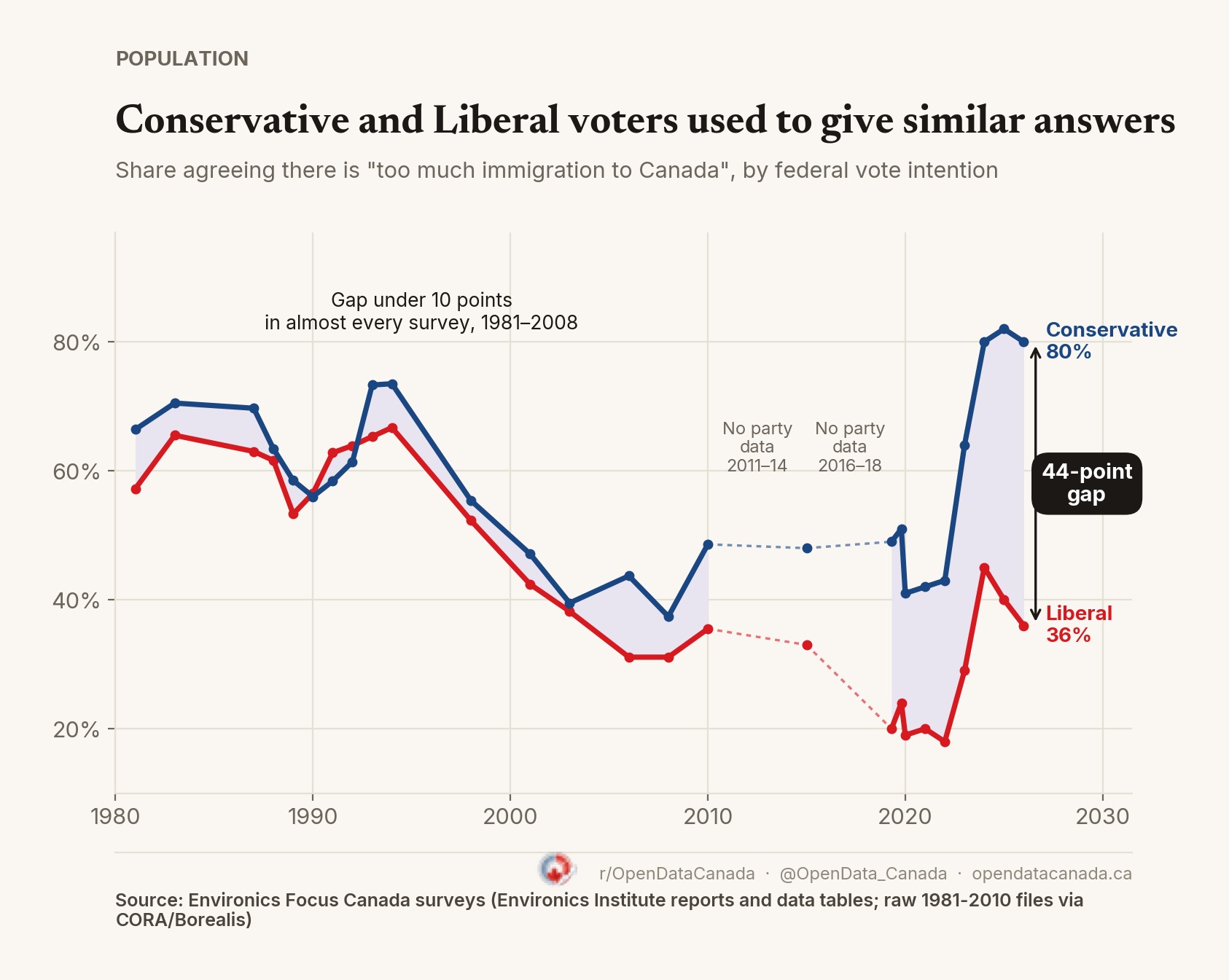
In 1981, 66 percent of Progressive Conservative voters and 57 percent of Liberal voters said there was too much immigration. In 1990 the two groups were within a point of each other, at about 56 percent. In 1991 and 1992, Liberal voters were slightly more likely to agree than Progressive Conservative voters. The strongest views sat with the Reform Party: 81 percent of its voters agreed in 1993. That year, 65 percent of Liberal voters agreed.
From 1981 to 2008, the gap between the two groups was under 10 points in every survey except 2006, when it was 13. It was 13 points again in 2010, 15 in 2015 and 27 by the fall of 2019. In 2026, 80 percent of Conservative voters say there is too much immigration, compared with 36 percent of Liberal voters and 20 percent of New Democrat voters.
The gap widened as Conservative agreement grew
Liberal voters today answer much as they did in 2008 and 2010, when about a third agreed. Conservative voters have gone from 49 percent in 2010 to 80 percent now, and have stayed near 80 percent since 2024 while other groups eased.
The widening started before the recent rise. In the fall of 2019, when 34 percent of Canadians said there was too much immigration, 51 percent of Conservative voters did, compared with 24 percent of Liberal voters. Both groups rose between 2022 and 2024. Since then, Liberal agreement has fallen to 36 percent, while Conservative agreement has not moved.
The 48 percent national figure sits between 80 percent of Conservative voters and 36 percent of Liberal voters.
See also: Canada immigration in 2026: fewer students, fewer workers, more protected persons.