Environment
Canada promised to stop shipping coal overseas. Then it quietly stopped trying.
Ottawa pledged in 2021 to ban thermal coal exports by 2030. Work on the ban stopped in 2024, reportedly on a verbal order. The commitment remains in place, but coal continues to flow through British Columbia ports to power plants overseas.
Canada has sharply reduced coal-fired electricity emissions at home. They fell from 58 megatonnes (million tonnes) in 2016 to 14 megatonnes in 2024, a drop of about 76%, according to the federal environment commissioner's audit tabled on October 29.
Over the same years, the coal Canada ships to other countries went the other way. The auditors estimate that burning the thermal coal shipped from Canada produced 42 megatonnes of greenhouse gas abroad in 2024, up from 20 megatonnes in 2016. That is more than double, and three times what coal power now emits inside Canada. These are emissions measured in carbon dioxide equivalent (CO₂e), a common unit that counts all greenhouse gases by how much warming they cause compared with carbon dioxide.
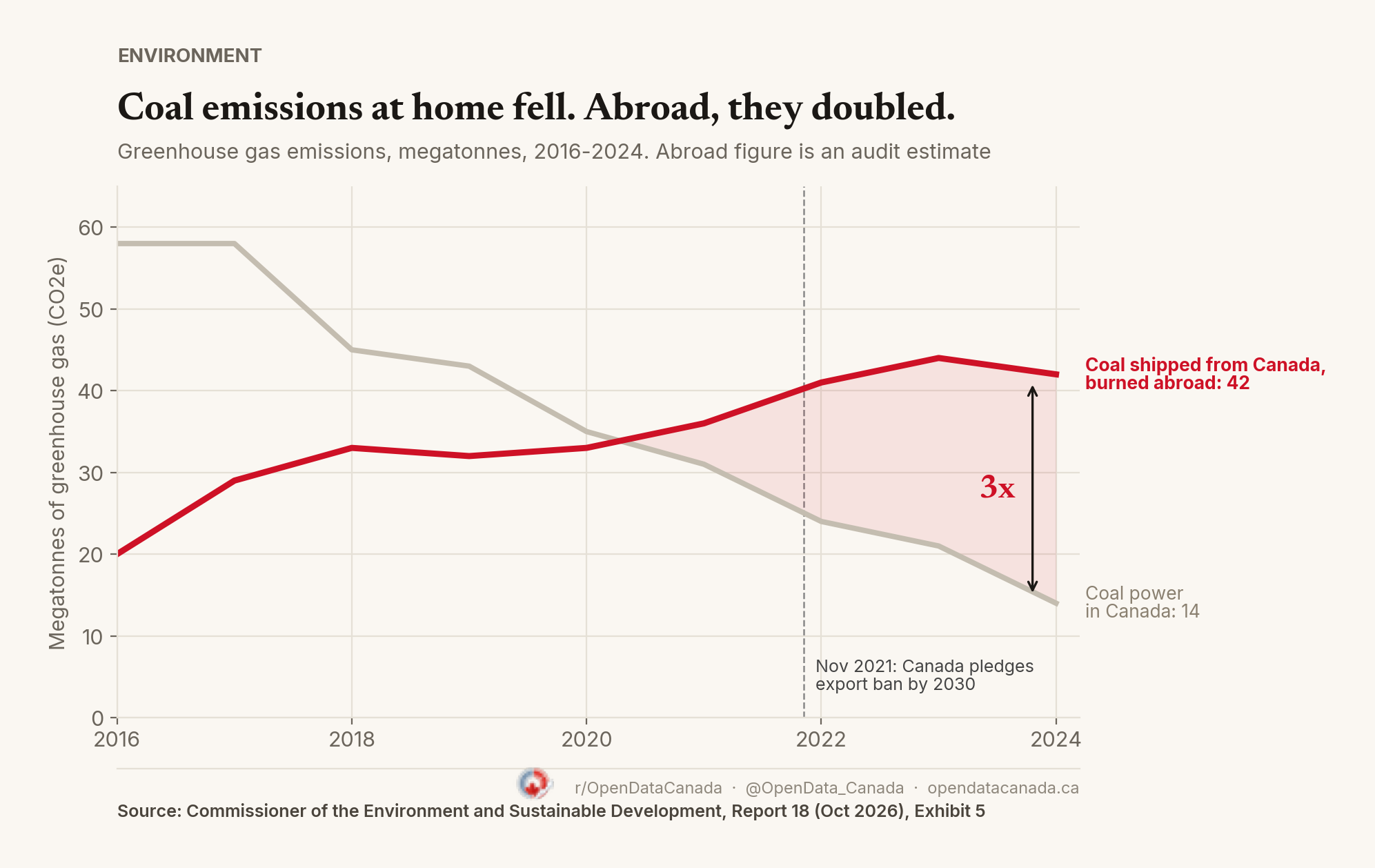
Thermal coal is the kind burned to make electricity, as opposed to the steelmaking coal BC terminals also ship. In November 2021, the federal government committed to ban thermal coal exports from and through Canada by 2030. As of the audit, that commitment had never been withdrawn. Nobody is working on it. Asked at committee whether the 2030 pledge still exists, officials would not say, promising clarity "in the coming months."
A promise stopped by word of mouth
Environment and Climate Change Canada spent about three years studying how a ban could work. In November 2024, the work stopped. The department "did not produce evidence of an official direction" to end it, the audit says. The department told auditors the stop was formalized in August 2025, as part of a government-wide spending review. Auditors found no clear records that the minister was given an assessment of what dropping the ban would mean.
At the House of Commons environment committee on November 19, members of Parliament (MPs) pressed department officials on who gave the order. Officials said "the decision was made by the previous government and was communicated verbally to senior officials." Who exactly made it, they could not say, as The Canadian Press first reported. "It was communicated to me via the deputy minister at the time," one senior official said. It reached the deputy minister "from political level, so I don't know who it came from at that point." Pressed on why, the official said the department had shared its analysis, "so I can only conclude that the government considered our analysis and made the decision on that basis."
Another official described the August 2025 spending approval, which asked the minister to reduce resources for the work, as "the only written trace." That approval, the official added, "wasn't the same as making a decision."
The auditors had the same trouble. The lead auditor told MPs that at different points the department "thought they had an e-mail or more information but then they wouldn't be able to produce that information." The process, she said, "was unusual."
The department did not share the decisions to stop with Global Affairs Canada, other partners or Indigenous communities, and made no public announcement. It has not reported publicly on the commitment since 2021. Neither department monitored or compiled coal export data after the end of 2024, the audit found.
Most of the coal is American, and the shipments grew
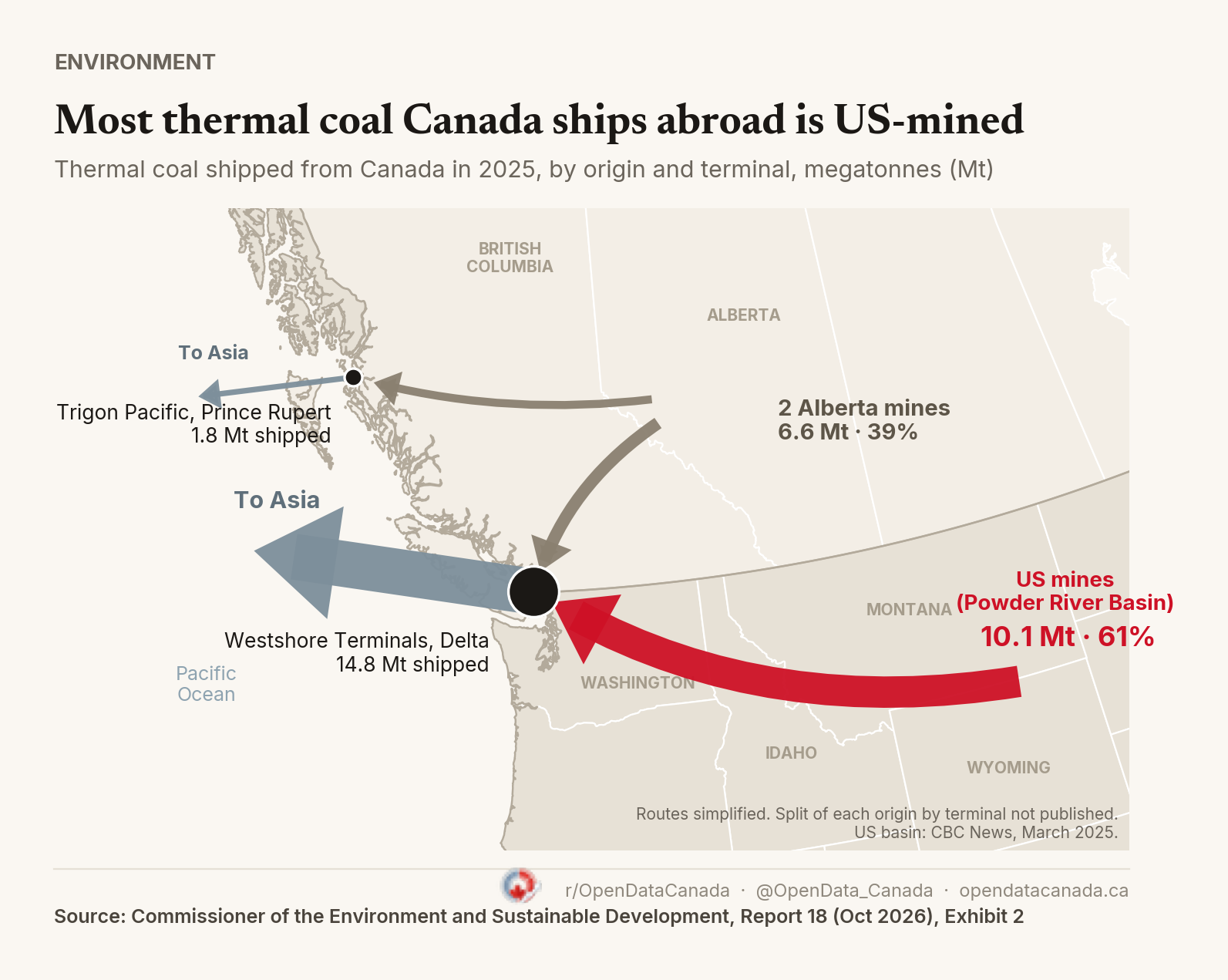
Most of the thermal coal shipped from Canada originates in the United States: about 61% of the 16.6 megatonnes shipped in 2025, the audit found. Much of it moves north by rail from the Powder River Basin in Montana and Wyoming before being exported through British Columbia. The rest comes from two Alberta mines. The audit notes that coal export projects on the US Pacific coast have faced regulatory and permit challenges.
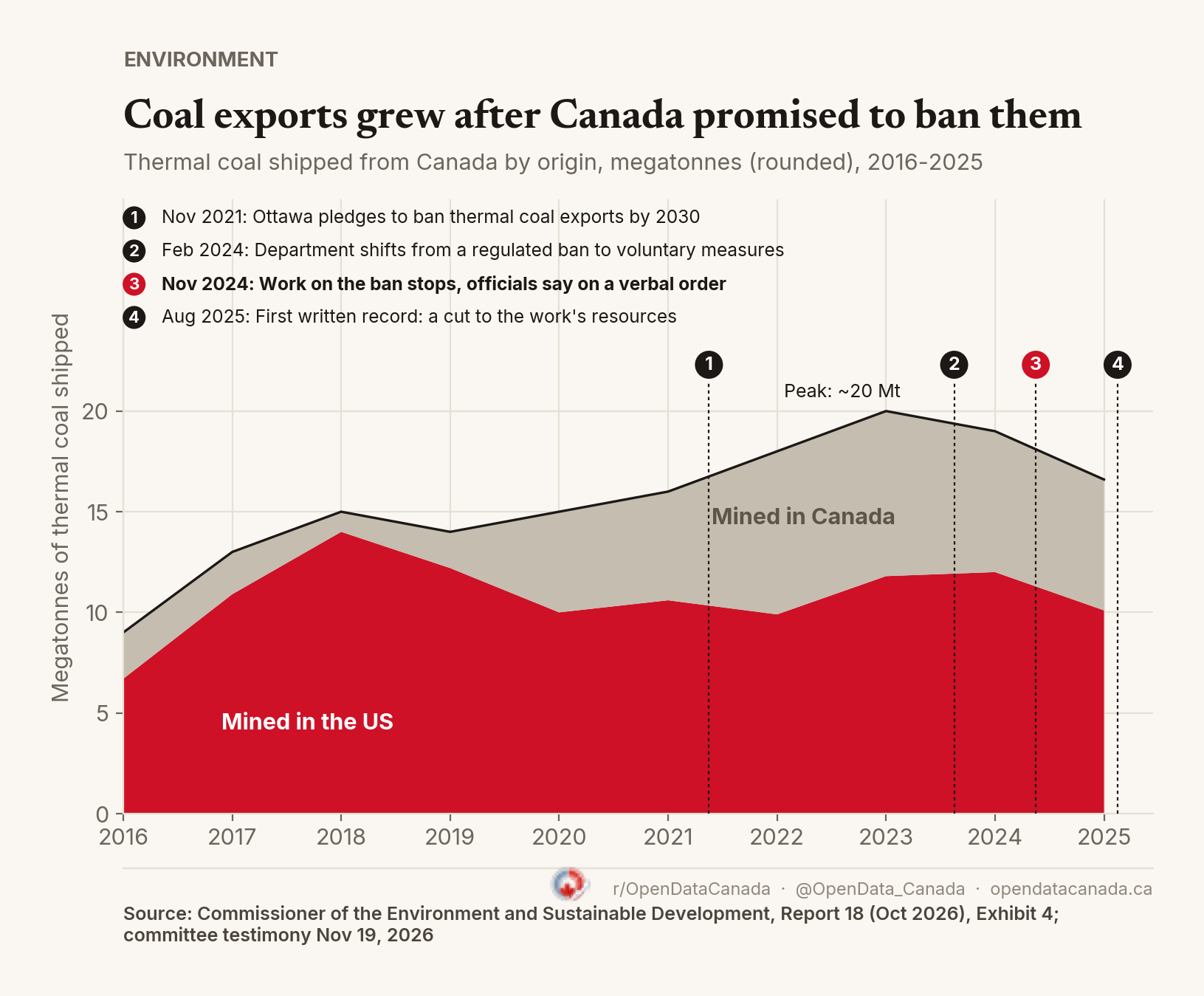
Total shipments grew from about 9 megatonnes in 2016 to a peak of about 20 megatonnes in 2023. They were still above 2021 levels in 2025, four years into a pledge to end them.
"Close to impossible" to count, except when asked
At the committee, a Conservative MP asked whether the department had calculated how much global emissions a ban would cut. "It's close to impossible to do that," an official replied, because it depends on the policies of the countries burning the coal, such as whether they capture or offset the emissions.
That is a fair point about one question. If Canada stopped shipping coal, some buyers would likely find it elsewhere. The department's 2023 analysis made that argument, and officials noted Canada handles only about 2% of global thermal coal exports. But it is a different question from how much greenhouse gas the coal Canada ships actually produces, and that number is not impossible to get. The audit says the department produced those estimates when asked, for an MP's question in 2023 and for five environmental petitions between 2021 and 2025. But it did not produce them systematically, and its analysis and briefings for the people deciding the ban's fate did not consider them. The auditors called that "important information for decision makers."
The audit also notes that two BC coal terminals, Westshore Terminals and Trigon Pacific Terminals, had registered lobbying contacts with the officials working on the ban, and with senior officials on trade and export issues, while the ban was being studied. The auditors call lobbying a legitimate part of policy development and do not say it caused anything. But they say the lack of records explaining the 2024 move away from a regulated ban "may undermine public confidence."
Canada co-chairs the Powering Past Coal Alliance, a group of more than 180 governments and organizations pushing to end coal power. It also committed 1 billion dollars to the Accelerating Coal Transition program, which helps developing countries move off coal, plus 15 million dollars to the Women-Led Coal Transition Mechanism. With most projects still at an early stage, only about 1% of the program's funding had reached projects by the end of the audit period.
At home, emissions from coal-fired electricity are down three quarters. Abroad, coal keeps leaving through Canadian ports, while the 2030 commitment stays on the books with no active work to carry it out.