Technology · 4 min read
Canada's junior coding job vacancies fell 64% since 2022
Openings for coding jobs that ask for three years of experience or less are down 64 per cent since late 2022. Openings for more senior coding jobs fell 34 per cent. Hiring of young coders began falling before ChatGPT launched.
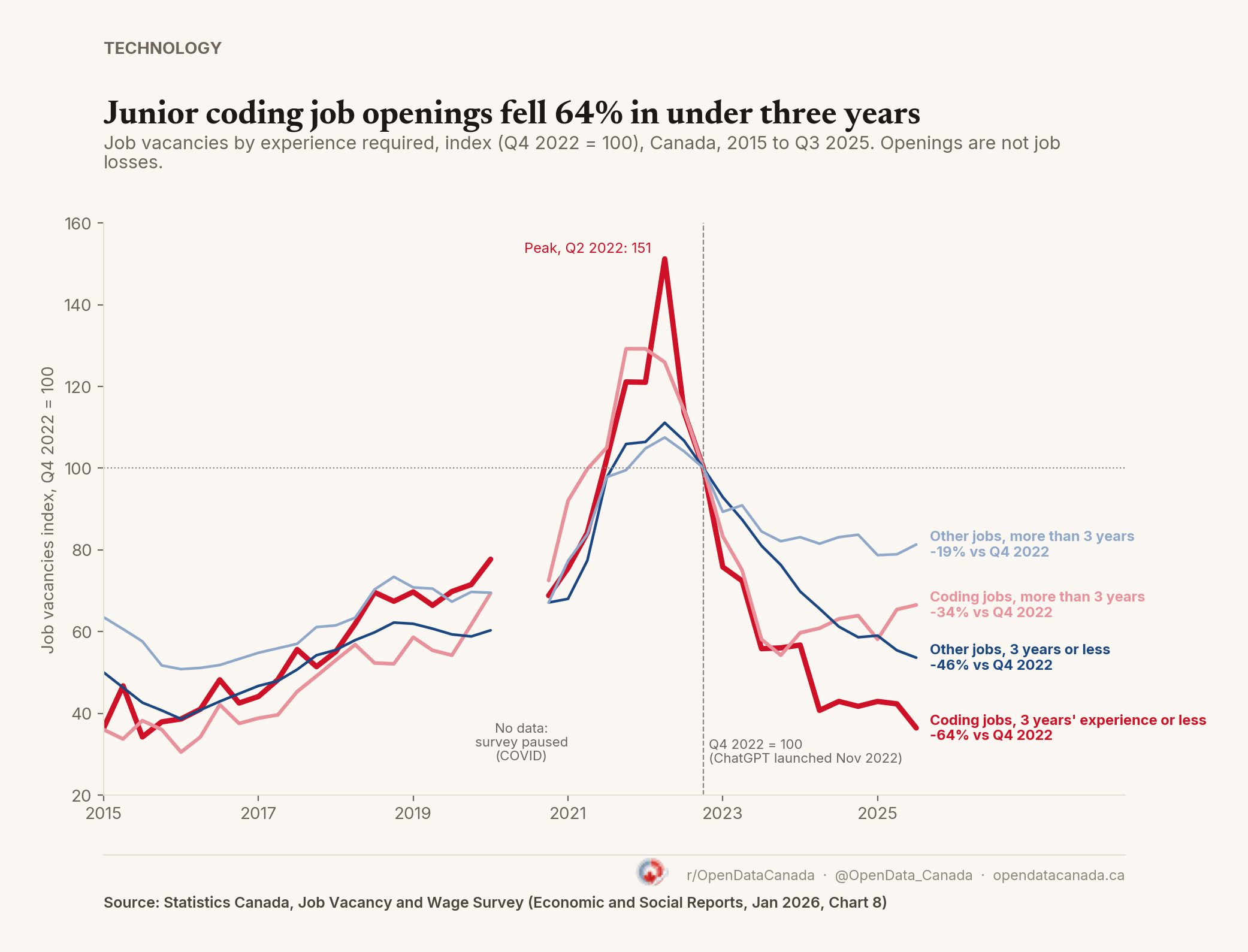
Job openings for junior coders in Canada fell 64 per cent between the fourth quarter of 2022 and the third quarter of 2025, according to Statistics Canada's job vacancy survey. "Junior" means the posting asks for three years of experience or less. Openings for coding jobs that ask for more experience fell 34 per cent.
 Download chart · Download data (CSV)
The chart sets late 2022 to 100, so every line shows change from that quarter. Junior coding openings ended at 36. That is the same level as early 2015.
Late 2022 was also a high point. Junior coding openings peaked at 151 in the second quarter of 2022, so part of the drop may be a hiring surge unwinding. Even so, the gaps between groups are wide. Junior jobs outside coding fell 46 per cent and senior jobs outside coding fell 19 per cent. Within both coding and non-coding work, Statistics Canada found junior openings fell significantly more than senior ones. Vacancies are not job losses, but they show where employers were advertising fewer openings.
The comparison with other junior jobs is the useful one. Junior openings fell everywhere, so part of the drop is a general slowdown. Junior coding openings fell about 17 percentage points further than junior openings in other occupations. Statistics Canada's tests cover junior against senior within each group. They do not report a test of junior coding against other junior jobs, so that gap is a description, not a finding.
Young coders are not gaining jobs
Employment tells a similar story. By December 2025, employment among coding-intensive workers aged 15 to 29 was about where it was in November 2022. For those aged 30 to 49, it was almost 30 per cent higher. Statistics Canada says that divergence has been statistically significant since late 2024.
The slowdown began before ChatGPT
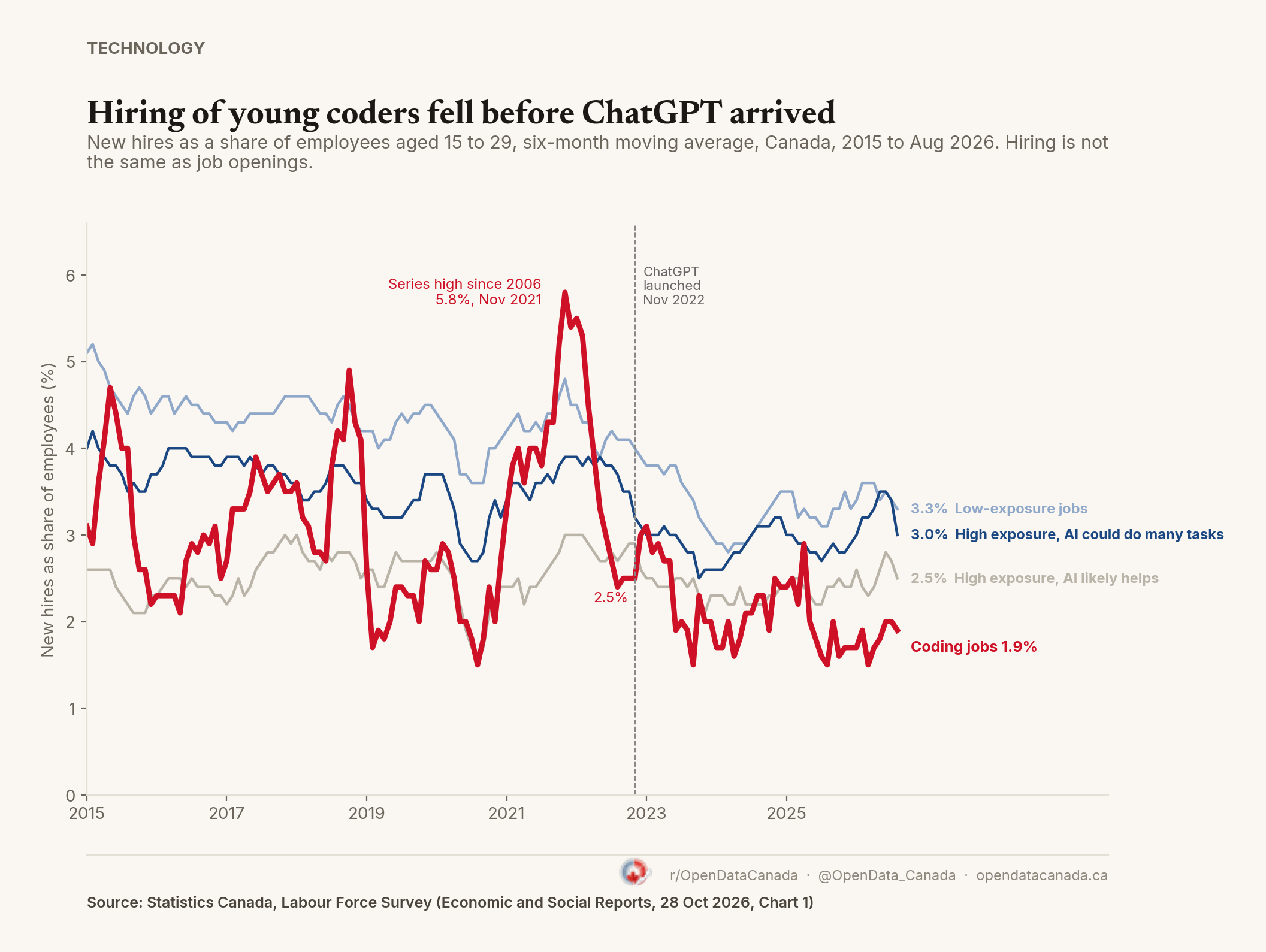
A separate Statistics Canada paper, released on 28 October 2026, looked at hiring directly. It measures new hires as a share of all employees. For coding-intensive workers aged 15 to 29, the hiring rate reached 5.8 per cent in the six months leading up to November 2021, the highest since the series began in 2006. It had fallen to 2.5 per cent in the six months leading up to November 2022, when ChatGPT launched, and to 1.9 per cent in the six months leading up to August 2026. Most of the fall came quickly: the rate was 5.5 per cent in the six months to January 2022 and 2.7 per cent to July 2022.
 Download chart · Download data (CSV)
The decline was already well underway before ChatGPT became publicly available. From 2015 to 2019 the same rate ranged between 1.7 and 4.9 per cent, so the 2021 peak was unusual and the drop is partly a return to normal. Since 2023 it has averaged about 2 per cent, well below its 2015 to 2019 average of about 3.1 per cent.
Between November 2022 and August 2026, hiring of young workers in broader groups fell by a smaller share. In occupations with high potential AI exposure and low complementarity, the broader group that includes coding, the rate edged down from 3.2 to 3.0 per cent. In occupations with low AI exposure, it fell from 4.0 to 3.3 per cent. The paper's authors found no broad evidence that AI has cut hiring so far, and describe the pattern as largely a continuation of earlier trends.
What this does and does not show
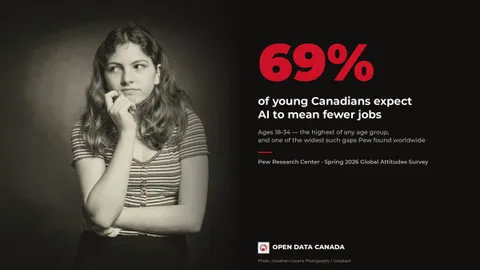
Generative AI use is already common across the economy. In March 2026, 35.9 per cent of workers aged 15 to 69 said they had used it at work in the previous 12 months. Use was 45.9 per cent in occupations with high potential AI exposure and low complementarity, the group that includes software development, and 14.2 per cent in low-exposure occupations. Those shares cover all workers, not coders specifically, and use alone does not show that employers are replacing workers. Nothing here can separate AI from the unwinding of the 2021 to 2022 hiring surge or from other economic forces. Expectations are gloomy too: 69 per cent of Canadians aged 18 to 34 expect AI to mean fewer jobs, more than any older age group in a Pew survey.
Taken together, the three measures point to pressure on the early-career coding market: employers are advertising fewer junior openings, employment among younger coding workers has stagnated, and their hiring rate has fallen. The measures track different groups, since vacancies are sorted by experience requested and the other two by age, but they point in a similar direction.
It also matters how long the pattern lasts. Hiring has averaged about 2 per cent since 2023, so this is not a single bad quarter. A cycle that turns would restore the bottom rung. A permanent change in how companies staff software teams would not.
Experienced developers were once new hires. If employers fill fewer first jobs now, where will tomorrow's experienced developers come from?