Economy · 3 min read
Canada's economy was flat in July: construction rose, factories and stores fell
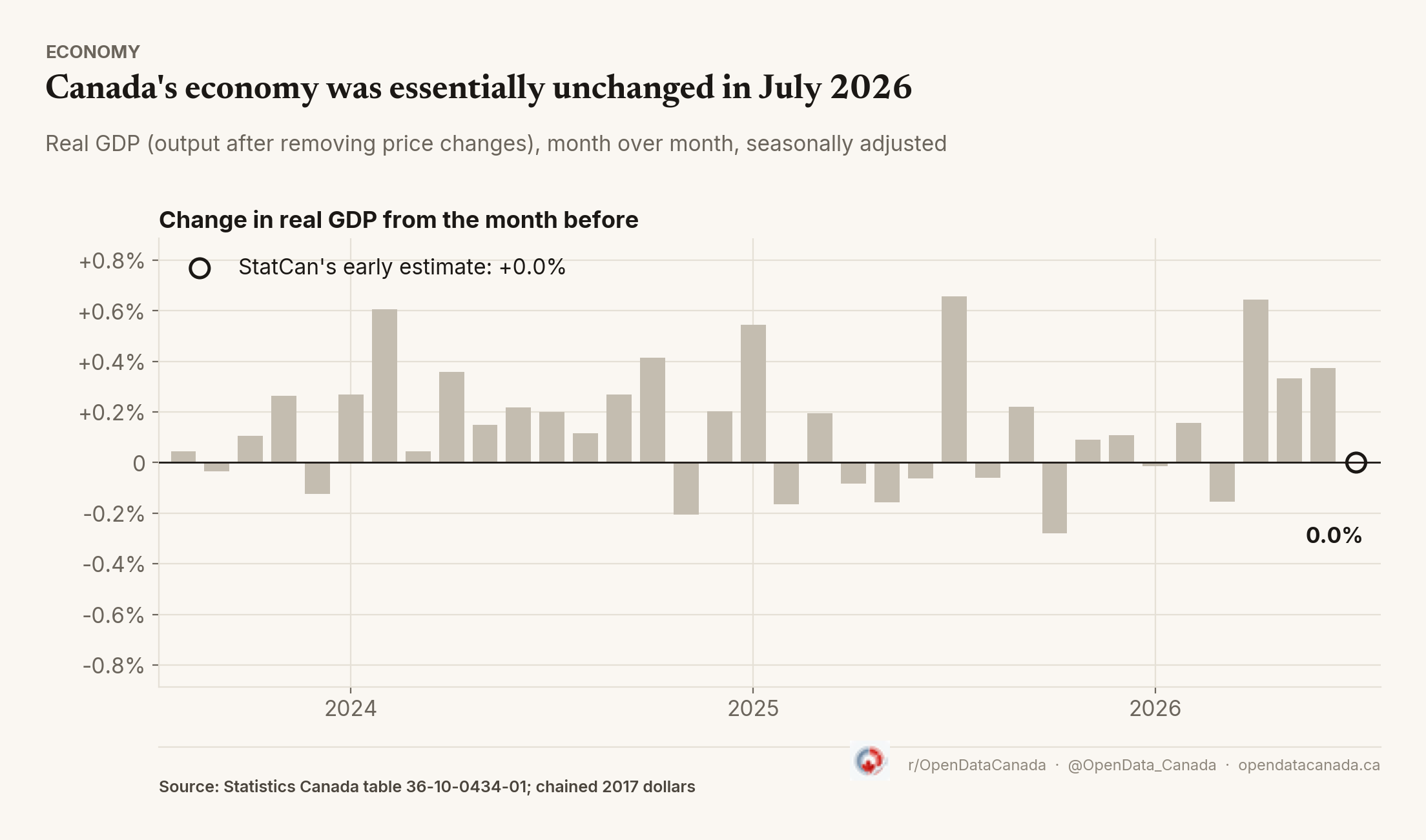
Real GDP was unchanged in July, as Statistics Canada's early estimate said. Construction and utilities grew. Manufacturing, retail and mining shrank. A first look at August points to +0.2%.
Canada's real gross domestic product (GDP) was essentially unchanged in July, according to Statistics Canada's monthly GDP by industry release of 29 September 2026. Real GDP is output after removing price changes. Statistics Canada's early estimate a month ago had said the same. It ends three straight monthly gains (April, May and June). Ten of 20 industrial sectors grew.
Where the change came from
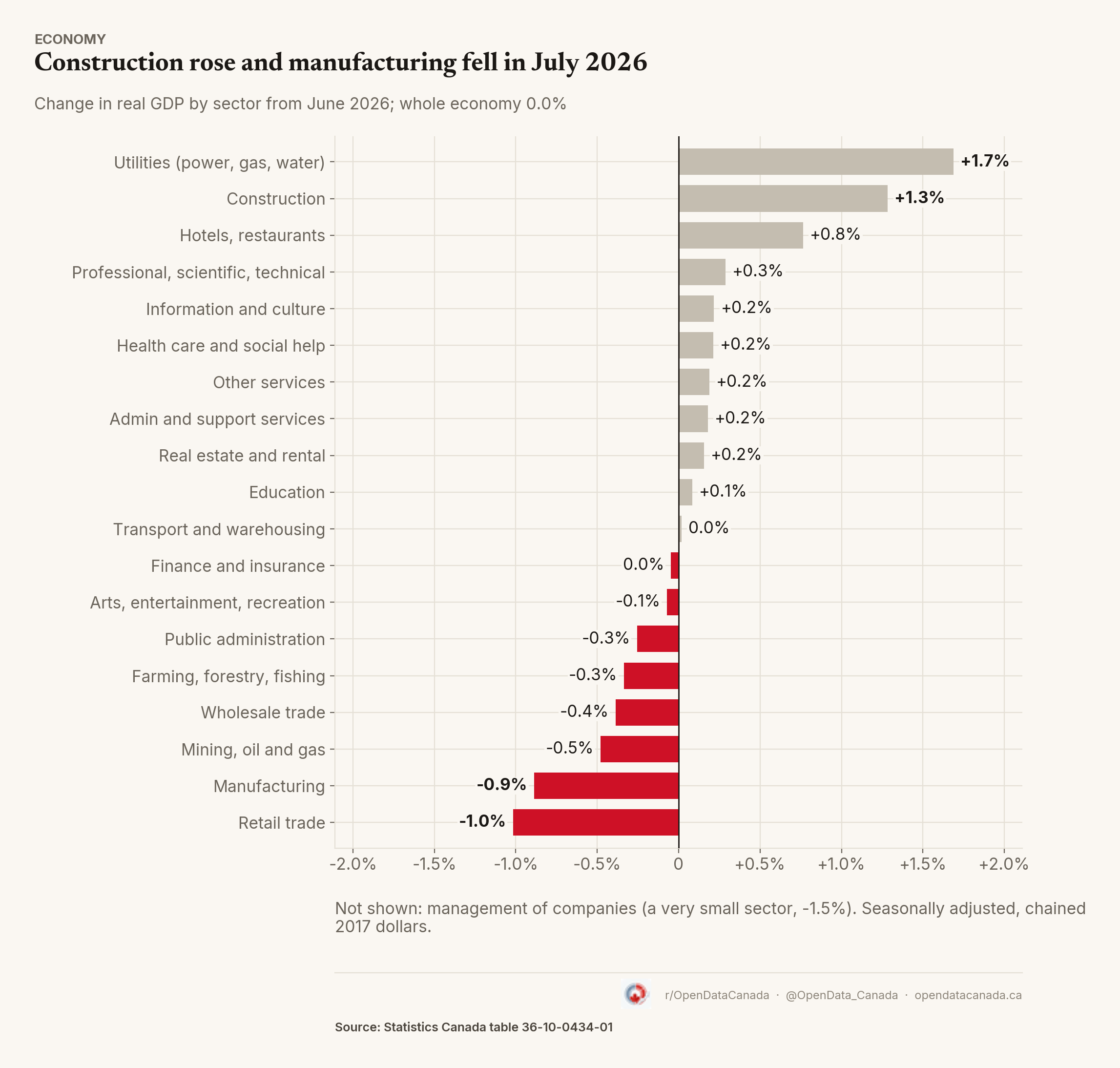
Nothing moved the total, but the sectors underneath did. Construction grew 1.3% (about +0.09 percentage points of total GDP), its fourth straight monthly increase. Non-residential building construction rose 2.9%, its biggest jump since January 2022, which Statistics Canada links to a new hospital in Ontario. Utilities grew 1.7% as a July heat wave lifted electricity demand.
Three sectors pulled the other way. Manufacturing fell 0.9% (about -0.08 points), its first drop in four months. Petroleum and coal product manufacturing fell 5.7% after unplanned downtime at a refinery in southwestern Ontario, and machinery manufacturing fell 5.1%. Retail trade fell 1.0% (about -0.05 points), with gasoline stations down 3.5% and general merchandise stores down 2.2%. Mining, quarrying and oil and gas extraction fell 0.5%, including a 6.4% drop in potash mining.
Statistics Canada's early estimate named real estate and professional services as gainers and retail and manufacturing as decliners. All four moved as predicted: real estate and rental grew 0.2%, professional, scientific and technical services 0.3%. Construction, the largest gain, was not named in the estimate. Manufacturing is now 6.0% below its January 2019 size, the only large sector still under that mark (see our August look at winners and losers since 2019).
The third quarter is already ahead of the second
July's level is 0.36% above the April-to-June average, so the third quarter starts with growth already in hand. Statistics Canada's early estimate for August is +0.2%, led by mining and quarrying and retail trade, partly offset by oil and gas extraction. If August grows 0.2% and September is flat, Open Data Canada calculates third-quarter real GDP would be about 0.5% above the second quarter, roughly 2% at an annual rate. That is an illustration, not a forecast. Over the past year, real GDP is up 1.4% from July 2025. The next test is 30 October, when the full August data replace the early estimate.
How the numbers were calculated
Figures are monthly gross domestic product at basic prices by industry (table 36-10-0434-01), seasonally adjusted at annual rates, in chained 2017 dollars, so they show real output after removing price changes. Percentage changes are calculated by Open Data Canada from the table's levels; sector contributions in percentage points are approximate because chained dollars are not additive. Statistics Canada revises earlier months with each release, back to January 2025. This time June growth went from +0.26% to +0.37%, mostly from transport and warehousing and manufacturing, and second-quarter growth now reads 0.94% instead of 0.89%. That is a modest change; before this release, only 3 of the previous 39 moved the prior month by 0.10 points or more. Industry-based GDP can diverge slightly from the expenditure-based GDP used for quarterly headlines, because the concepts and sources differ. Open Data Canada saved the table on 28 September 2026, before release, which is what makes the revision comparison possible. Ten of 20 sectors grew by Statistics Canada's count; one, transport and warehousing, rose by 0.02%, which rounds to zero.