Economy · 3 min read
Manufacturing Is the Only Major Industry Smaller Than It Was in January 2019
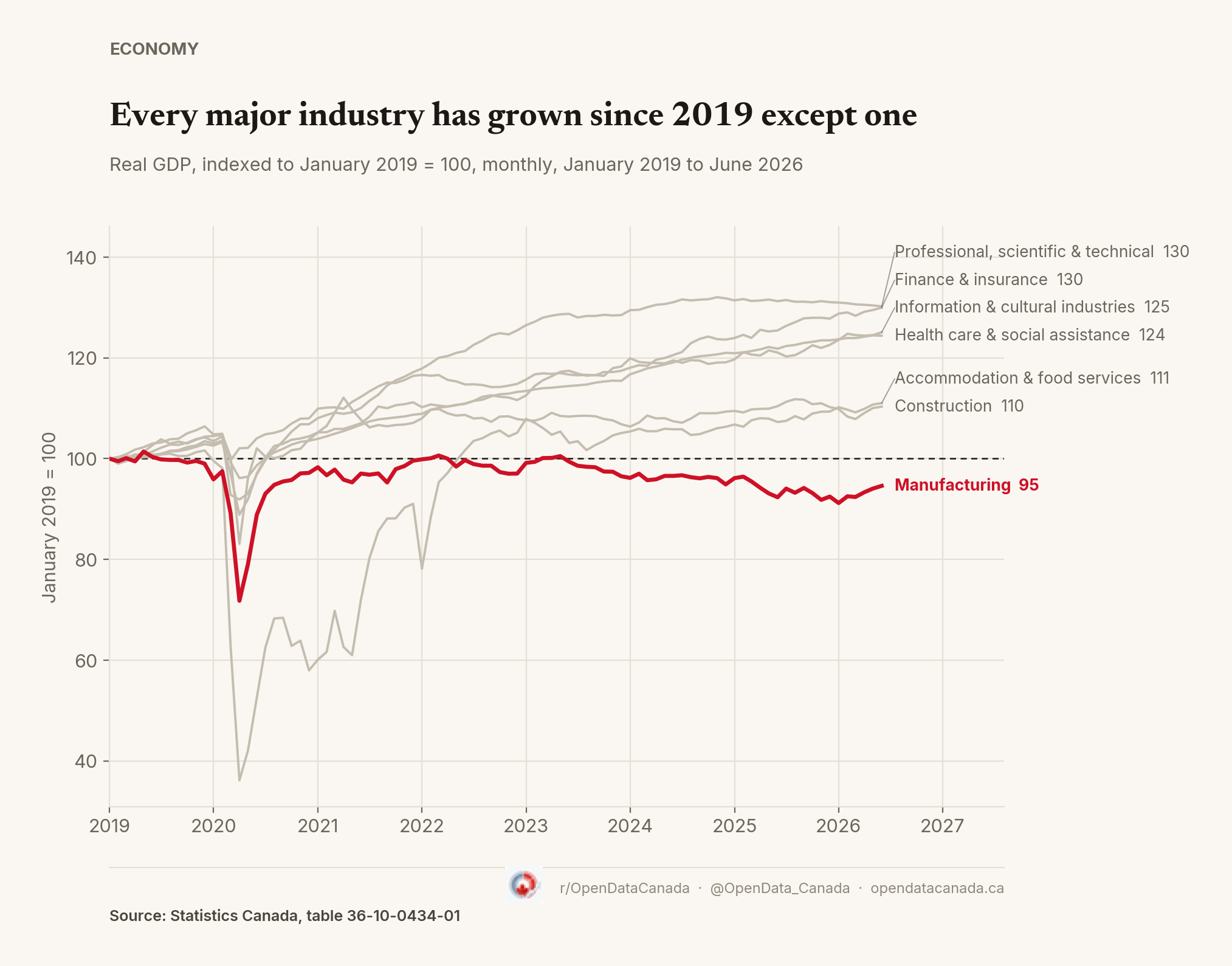
Real GDP is up 14.6% since January 2019, but the industries behind that number aren't the ones you'd guess. Finance and professional services have each grown by nearly a third; health care by about a quarter. Manufacturing is the one broad industry that still hasn't gotten back to where it started.
Statistics Canada's June figures, released today, put real GDP growth at 0.3% for the month. That's the number likely to dominate coverage. But a longer view tells a more interesting story: since January 2019, Canada's economy has grown 14.6%, and that growth has been remarkably uneven across industries.
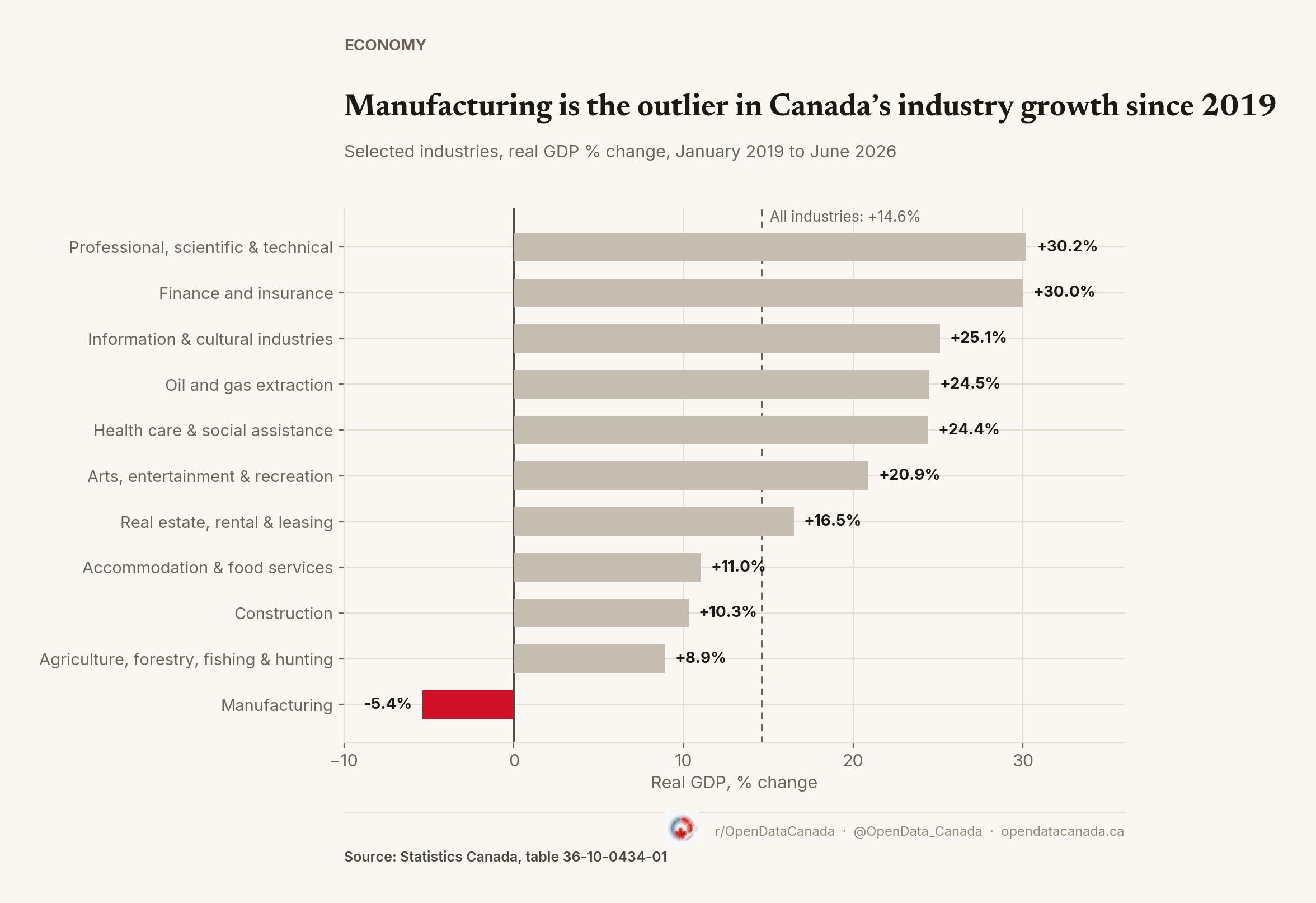
Growth split unevenly across industries. Professional, scientific and technical services and finance and insurance each grew about 30% over more than seven years — more than double the 14.6% economy-wide average. Information and cultural industries, oil and gas extraction, and health care and social assistance each grew close to a quarter, and arts, entertainment and recreation gained 20.9%. Real estate, the slowest of this group, still grew 16.5% — faster than the economy as a whole, but not by much.
At the other end, three industries grew slower than the economy as a whole but still grew: accommodation and food services (11.0%), construction (10.3%), and agriculture, forestry, fishing and hunting (8.9%). Manufacturing was the only broad industry on this list to shrink, down 5.4% from its January 2019 level.
What the monthly numbers miss
None of this shows up in a single month's GDP release. May's report drew a contrast between goods-producing industries, up 0.6%, and services-producing industries, up 0.2%. In June that pattern flipped: goods-producing output was roughly flat while services-producing output rose 0.4%, two months that look contradictory in isolation. Measured from 2019, the picture is steadier: services-producing industries have grown 17.9% and goods-producing industries 7.0%, a gap that has been building for years, not one that shows up or disappears month to month.
Manufacturing's decline is worth separating from a pandemic-recovery story. Accommodation and food services and arts and entertainment were both hit hard in 2020, and both have since grown past their 2019 levels. Manufacturing hasn't.
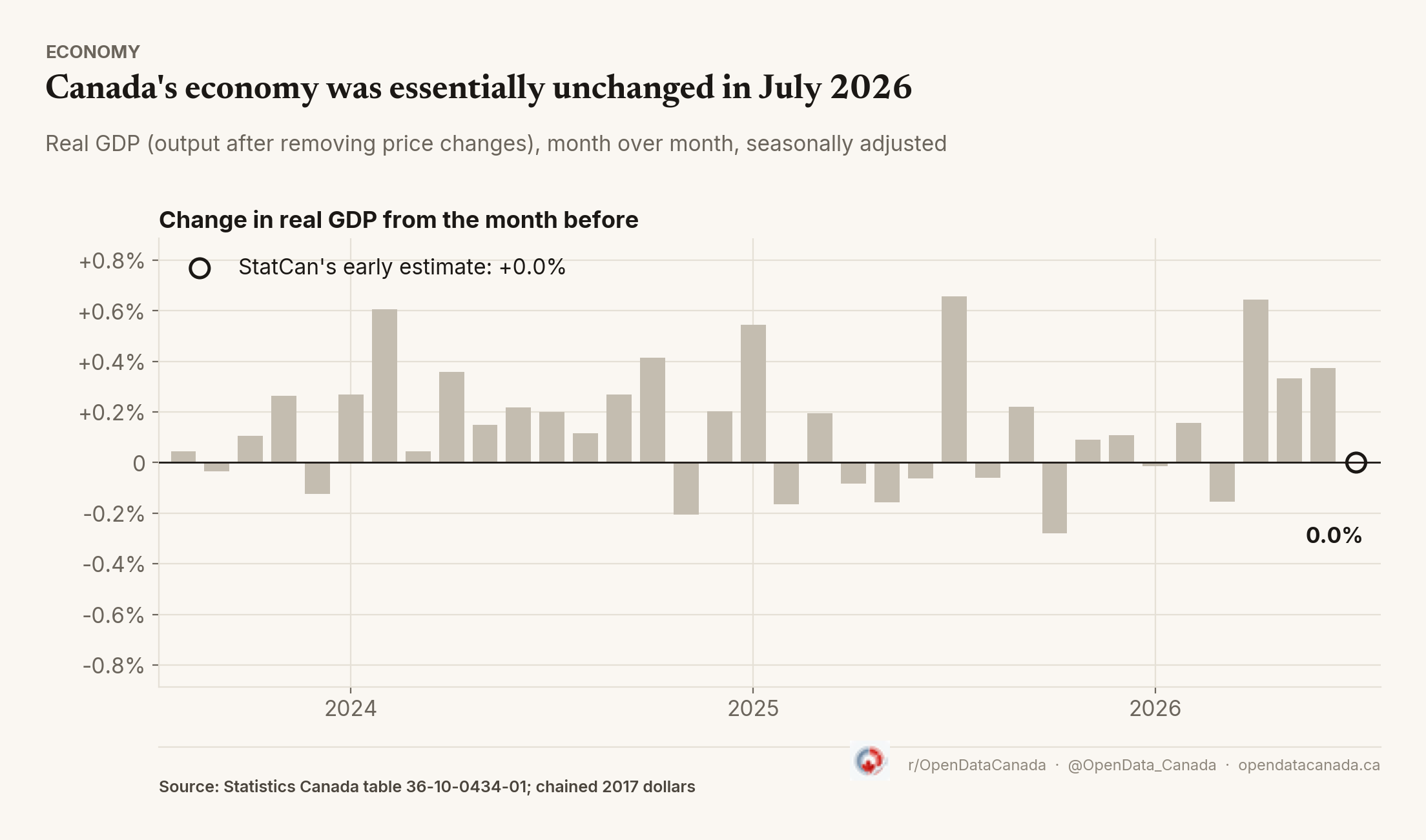
Update, 29 September: July's GDP figures came out unchanged, and manufacturing fell 0.9%, leaving it 6.0% below January 2019. See Canada's economy was flat in July.