Labour · 5 min read
Ontario EI rolls surged 24 percent since 2024 — factories are not the reason
In the two years since January 2024, Employment Insurance beneficiaries in Ontario grew by nearly 36,000 to 185,010 — a 24 percent jump at nearly double the national rate. Manufacturing and utilities occupations, the ones cited most in tariff coverage, account for none of it.

Ontario's Employment Insurance rolls grew by nearly 36,000 people between January 2024 and April 2026, reaching 185,010 beneficiaries. That is a 24 percent rise in just over two years. Canada's national EI count grew 14 percent over the same period, so Ontario added claimants at almost twice the national pace.
Where did that growth come from? Occupation-level data from Statistics Canada, released June 18, splits each province's EI total into three broad groups, and for Ontario the answer cuts against most tariff coverage. Manufacturing and utilities occupations have dominated reporting on the Canada-US trade dispute since early 2025, but they added nothing to Ontario's EI surge. The manufacturing count was 13,980 in April 2026, 410 below the 14,390 recorded in January 2024.
A mid-2025 spike that reversed
There was a manufacturing signal earlier in the series. The factory count jumped to 18,490 in June 2025, 28 percent above the January 2024 baseline, tracking the first round of US tariff escalation. It then unwound completely. By April 2026 the count of 13,980 had fallen back below where it started.
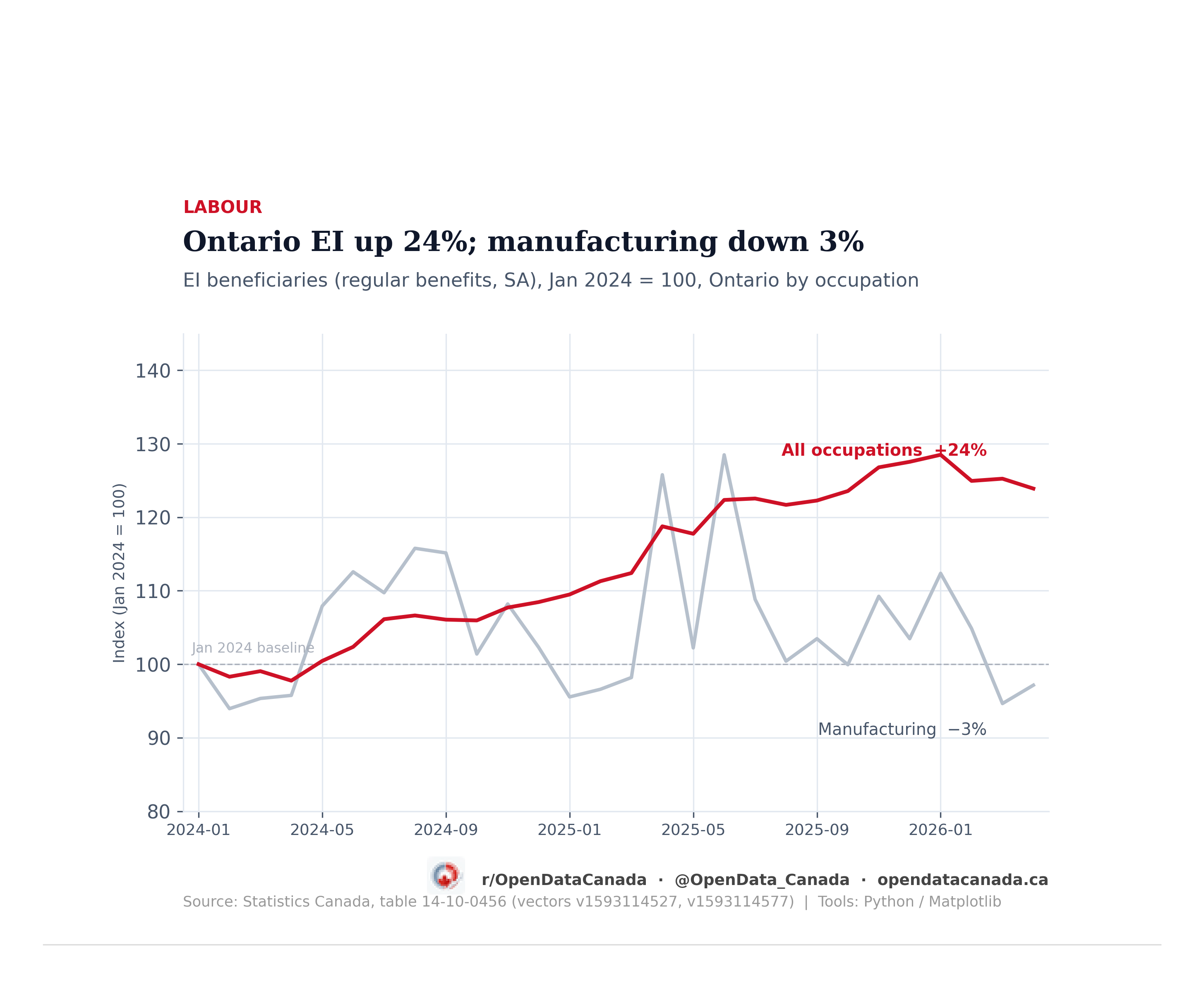
The national numbers look the same. Canada-wide manufacturing and utilities EI beneficiaries stood at 38,460 in January 2024 and 38,500 in April 2026 — essentially unchanged across two years that included the largest trade shock since NAFTA's renegotiation.
Services and office workers are filling the gap
If factories did not drive the surge, the rest of the occupation data shows what did. Trades, transport and equipment operators — skilled construction, trucking, heavy equipment — grew 16.5 percent, from 45,690 to 53,210 beneficiaries. The remaining group, everything outside manufacturing and trades, grew 32 percent, from 89,240 to 117,820 people claiming regular EI benefits.
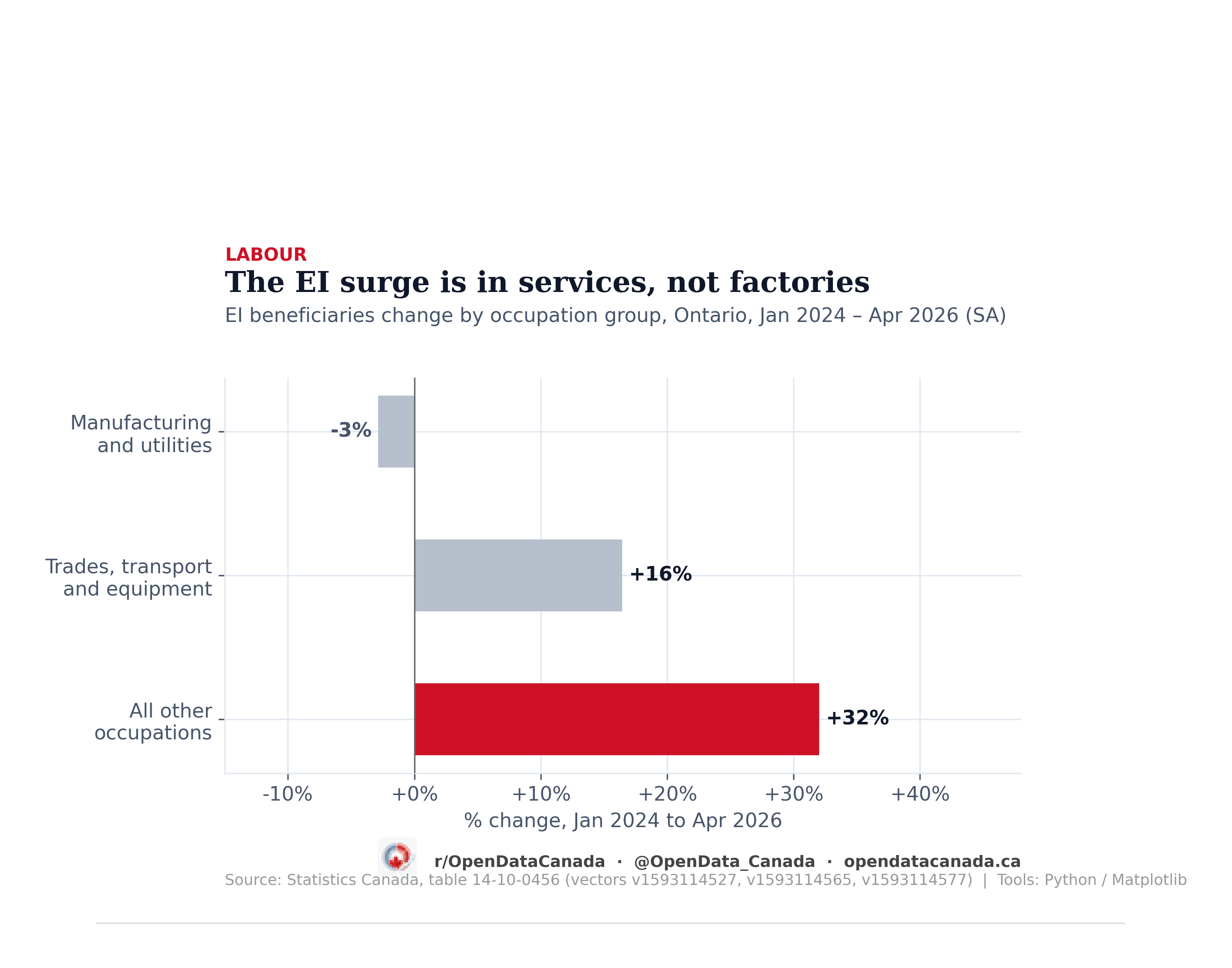
That group covers management, administration, business and finance, sales, health and social services, and information technology. The StatCan table does not break it down further by major NOC group. The occupations most exposed to tariff-related manufacturing risk have stayed flat, while Ontario's faster-than-average EI growth has built up across the service economy. Job-vacancy data shows a similar divide by education and occupation.
Ontario's rate runs at double the national average
Quebec is a useful check. Its manufacturing EI count went from 7,430 beneficiaries in January 2024 to 7,810 in April 2026, basically flat through a period of sharp tariff pressure on the province's aluminium and softwood lumber industries. Quebec's overall EI count rose 15 percent, close to the national average.
Ontario's 24 percent growth outpaces Quebec by nine percentage points and Canada by ten, and the gap is in service-sector claims rather than factories or skilled trades. What has been pushing the broader Ontario labour market onto EI at this rate, and for how long, has gone mostly unexamined in a debate fixed on tariffs.
The table runs from 2008 onward, but the occupation breakdown only appears in the most recent releases. A longer trend will be possible once StatCan extends the occupational series further back.
What the EI count doesn't include
Employment Insurance counts workers who lost a job, filed a claim and qualified under the rules. Severance packages, early retirements and short-term contracts that fall outside the qualifying period never show up in the data. Manufacturing employment could be softening through channels the count misses: reduced hours, contracts not renewed, workers who left without qualifying. Statistics Canada's Labour Force Survey tracks Ontario manufacturing employment directly and would pick up those movements.
So the EI numbers say a large factory layoff wave has not turned into new claims. They do not say nothing happened. A real manufacturing slowdown can move through voluntary exits, shorter hours, or workers who never qualify, and none of that registers here. Manufacturing is also the only major industry whose GDP is still below its pre-2019 level.
Policy is one likely reason the claims stayed low. The federal Work-Sharing program, extended through March 2027 in response to tariffs, had covered more than 54,000 workers across roughly 1,500 agreements as of March 2026, keeping an estimated 20,000 on payroll who might otherwise have filed claims. Work-Sharing participants draw partial EI for reduced hours but do not count as regular-benefit beneficiaries, so a slowdown absorbed this way would never appear in the figures above.
A second set of rules pushed the other way. Under the federal EI tariff measures — Pilot Project No. 24, extended to October 2026 — Ottawa waived the one-week waiting period and gave long-tenured workers up to 20 extra weeks of regular benefits. Those changes make claims easier to start and slower to roll off, lifting the beneficiary count across every sector rather than any one industry. The net effect is two policies working in opposite directions: Work-Sharing held the manufacturing count down, while the EI rule changes pushed the overall total up.