Health · Follow-up
Canada's Older Men Are Closing the Mortality Gap With Women
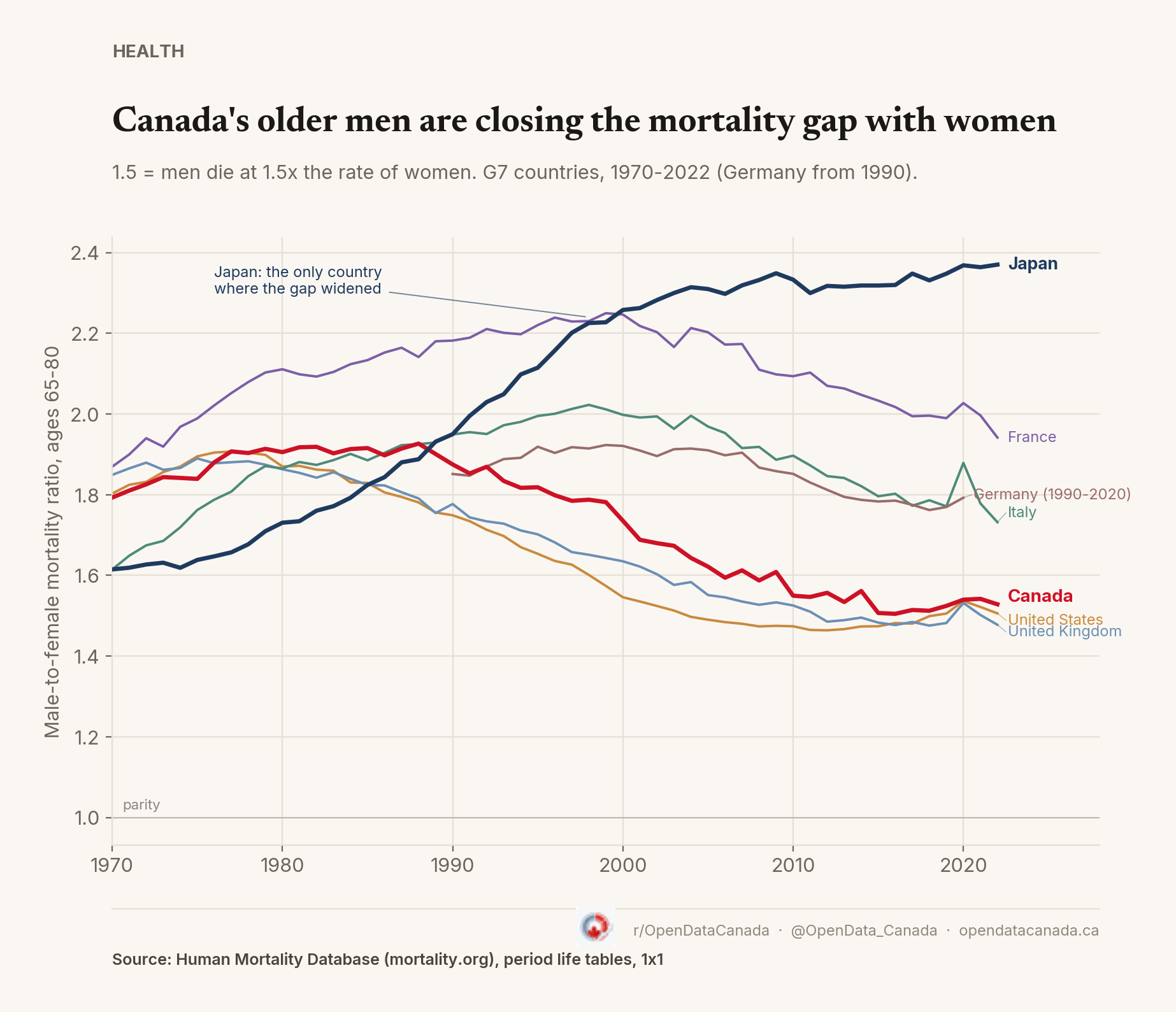
Canada's 65-80 male-to-female death rate ratio has fallen from 1.79 in 1970 to 1.53 in 2022, the lower end of a plateau it has held since the early 2010s. Most of the G7 closed a similar gap over the same period. Japan went the other way: its ratio rose from 1.61 to 2.37, the sharpest widening in the group.
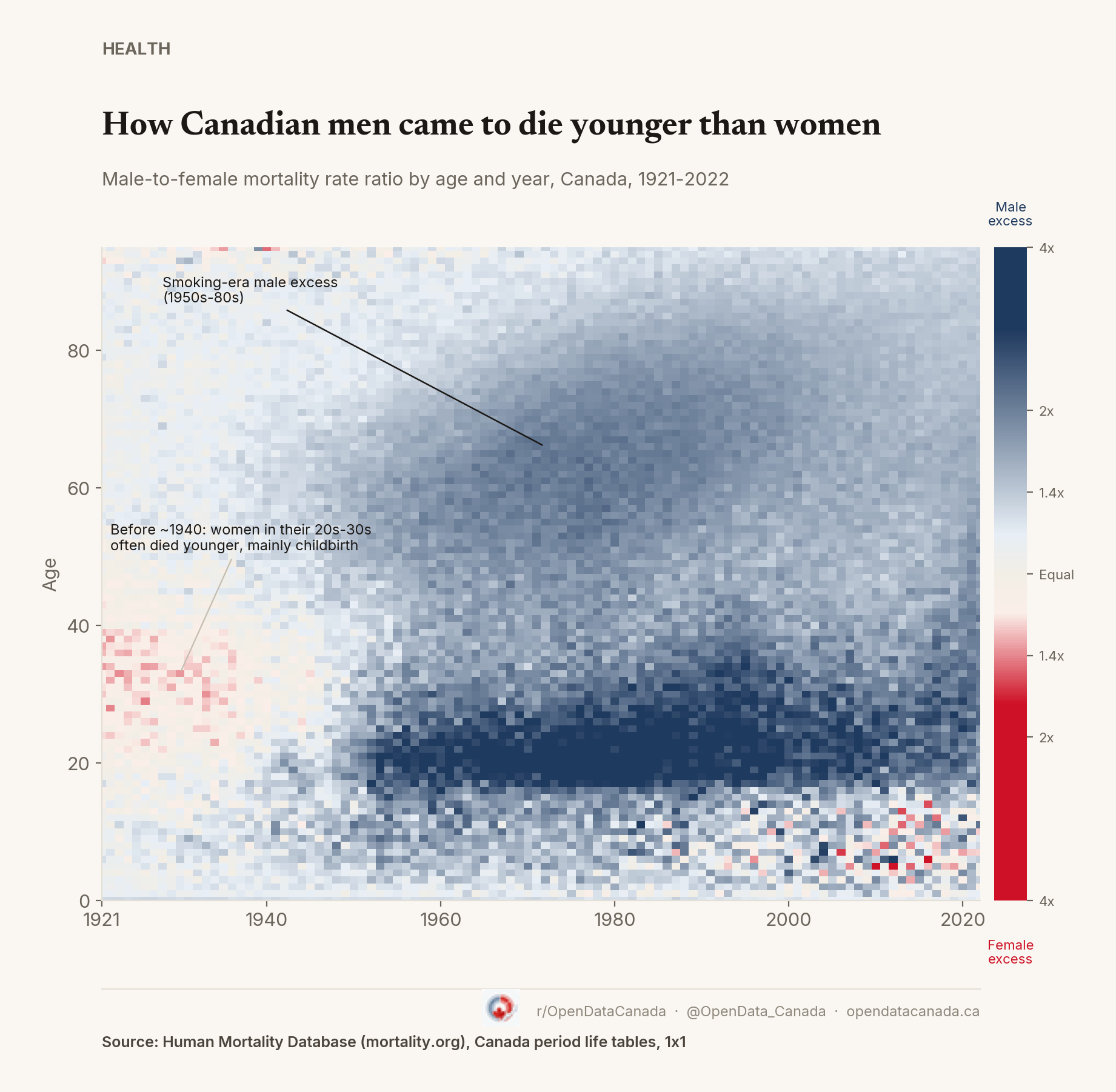
A previous piece on this site showed that Canadian men aged 65 to 80 have been closing the mortality gap with women their age since the late 1980s, a trend loosely tracked to falling smoking rates. That raises an obvious question: is this a Canadian story, or a story about every rich country getting past the worst of the tobacco era at roughly the same time? Rather than pick a handful of countries to compare against, the natural, non-arbitrary group to check is the G7 — Canada, France, Germany, Italy, Japan, the United Kingdom, and the United States.
It is mostly the second, with one sharp exception. Pulling the same age-65-80 ratio for the United States and the United Kingdom shows both narrowing more than Canada did: the UK's ratio fell 20% between 1970 and 2022, the US's 17%, against Canada's 15%. All three end up clustered within a few hundredths of each other by 2022, near 1.5. Germany's unified national series only begins in 1990 — East and West Germany were reported as separate populations before reunification — but even that shorter window narrowed slightly, ending at 1.79 in 2020.
Japan and, to a lesser extent, France and Italy break the pattern. France's ratio barely moved, drifting from 1.87 to 1.94 over the same 52 years, a country that started with one of the largest gaps in this group and still has one. Italy's ratio rose 7%, from 1.61 to 1.73. Japan is the real outlier: in 1970 its 65-80 ratio, 1.61, was tied with Italy's for the lowest in the group, well below Canada's 1.79. By 2022 it was the highest of the G7 by a wide margin, at 2.37, having overtaken every other country by around 1998 and continued climbing while the rest flattened or fell.
That is a 47% increase over the period when Canada, the US, and the UK were narrowing and Germany's shorter series was flat to slightly down. Japan's ratio didn't plateau after crossing the pack, either; it kept rising through the 2000s and 2010s, years when Canada, the US, and the UK had all leveled off.
What is driving it is not something this chart's all-cause, ages-65-to-80 ratio can answer on its own. Smoking is one commonly proposed factor in Japan's mortality patterns generally, but a search for Japan-specific historical smoking-prevalence figures and their timing relative to the United States and Europe did not turn up sourced data solid enough to attach to this specific 47% rise, so it is not asserted here. There is also a structural reason to be cautious: the figure charted here is an arithmetic average of 16 separate single-age male/female mortality ratios, not a standardized, population-weighted ratio. Japan's population within the 65-80 band has aged and shifted within that range over five decades in ways the other six countries have not matched as closely, and an unweighted average across a fixed age band can move for compositional reasons alone, not just a change in relative risk at each age. Separating a genuine widening in age-specific risk from that kind of compositional shift would need cause-specific, single-age data this comparison does not use.