Economy · 3 min read
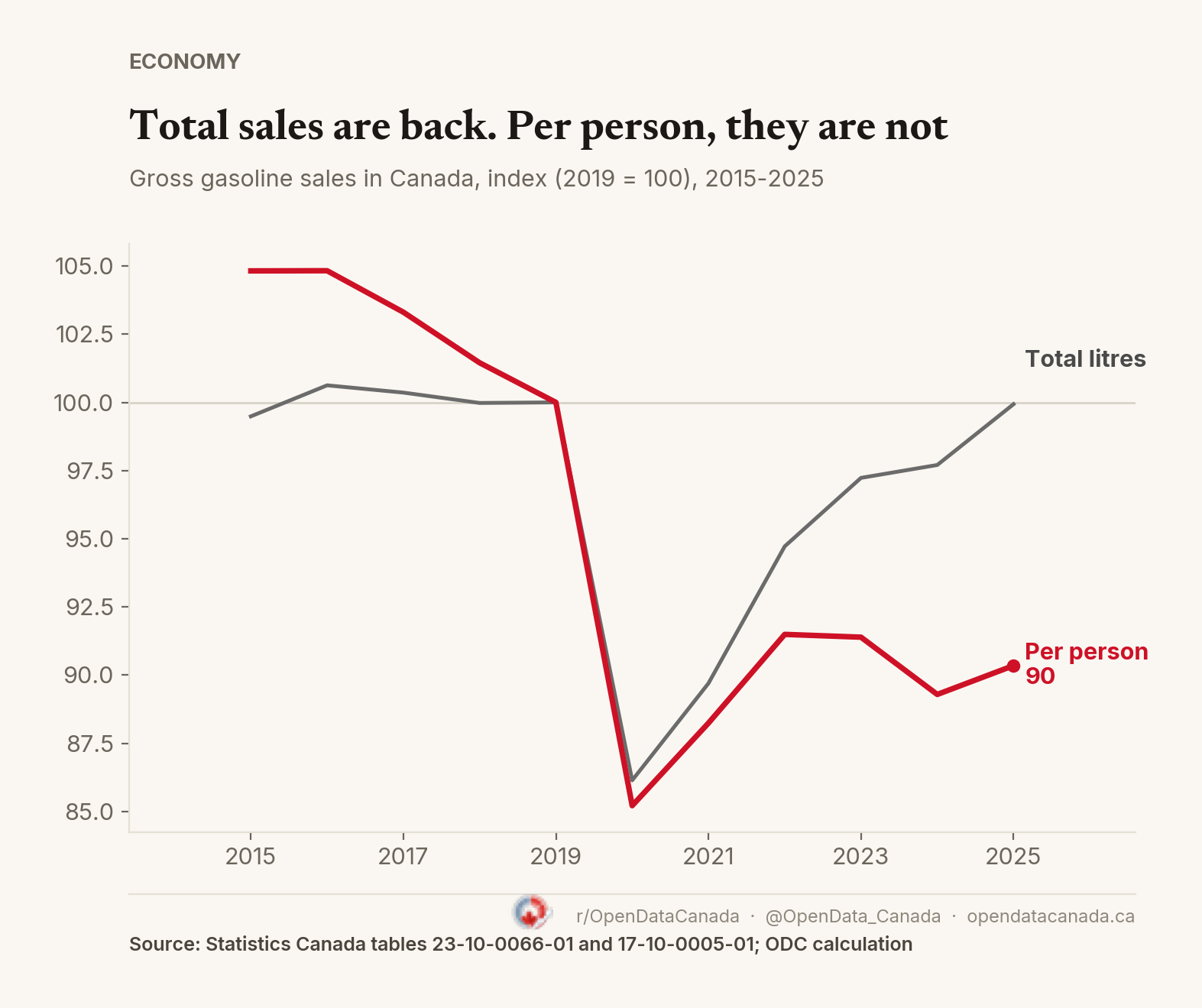
Canada's gasoline sales are back to 2019. Per person, they are down 10%.
Canadians bought 44.8 billion litres of gasoline in 2025, virtually the same as in 2019. The country has 4.0 million more people since then, so each of us bought 1,076 litres, down from 1,191. That is below every pre-pandemic year in the series, back to 1987.
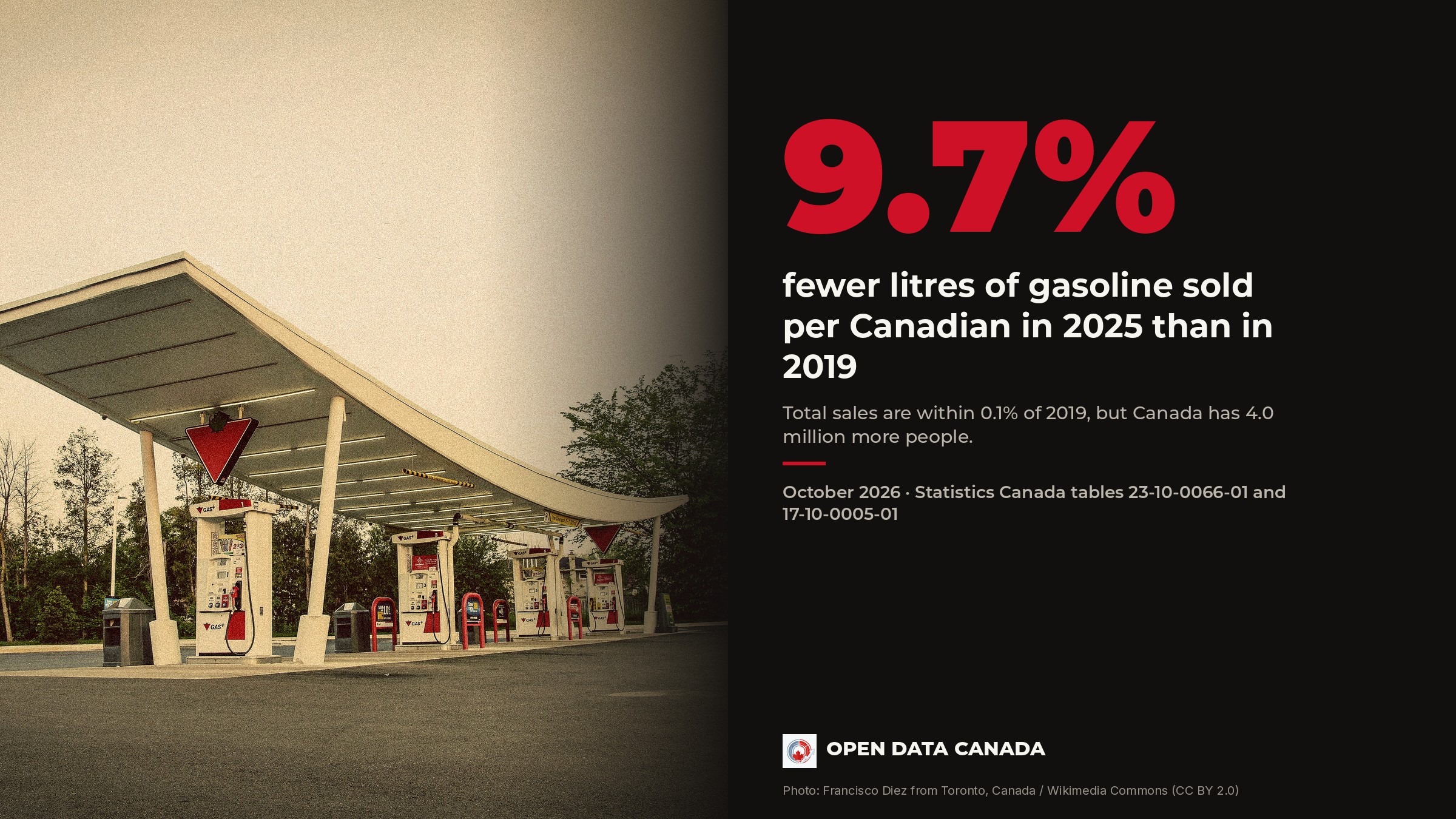
Canada sold 44.8 billion litres of gasoline in 2025. That is 2.3 percent more than in 2024 and virtually the same as in 2019, the last year before the pandemic (44.777 billion litres against 44.806 billion). Read alone, that sounds like driving has come all the way back, but the per-person figure is lower. Canada's population on July 1, 2019 was 37.6 million. On July 1, 2025 it was 41.6 million, a gain of 10.6 percent. The same fuel is spread across about four million more people, and the average Canadian bought 1,076 litres in 2025. In 2019 it was 1,191. In 2015 it was 1,248.
These are gasoline sales per resident, not gasoline used for driving. Statistics Canada's measure includes fuel sold for off-road uses such as farming, forestry, construction and mining.
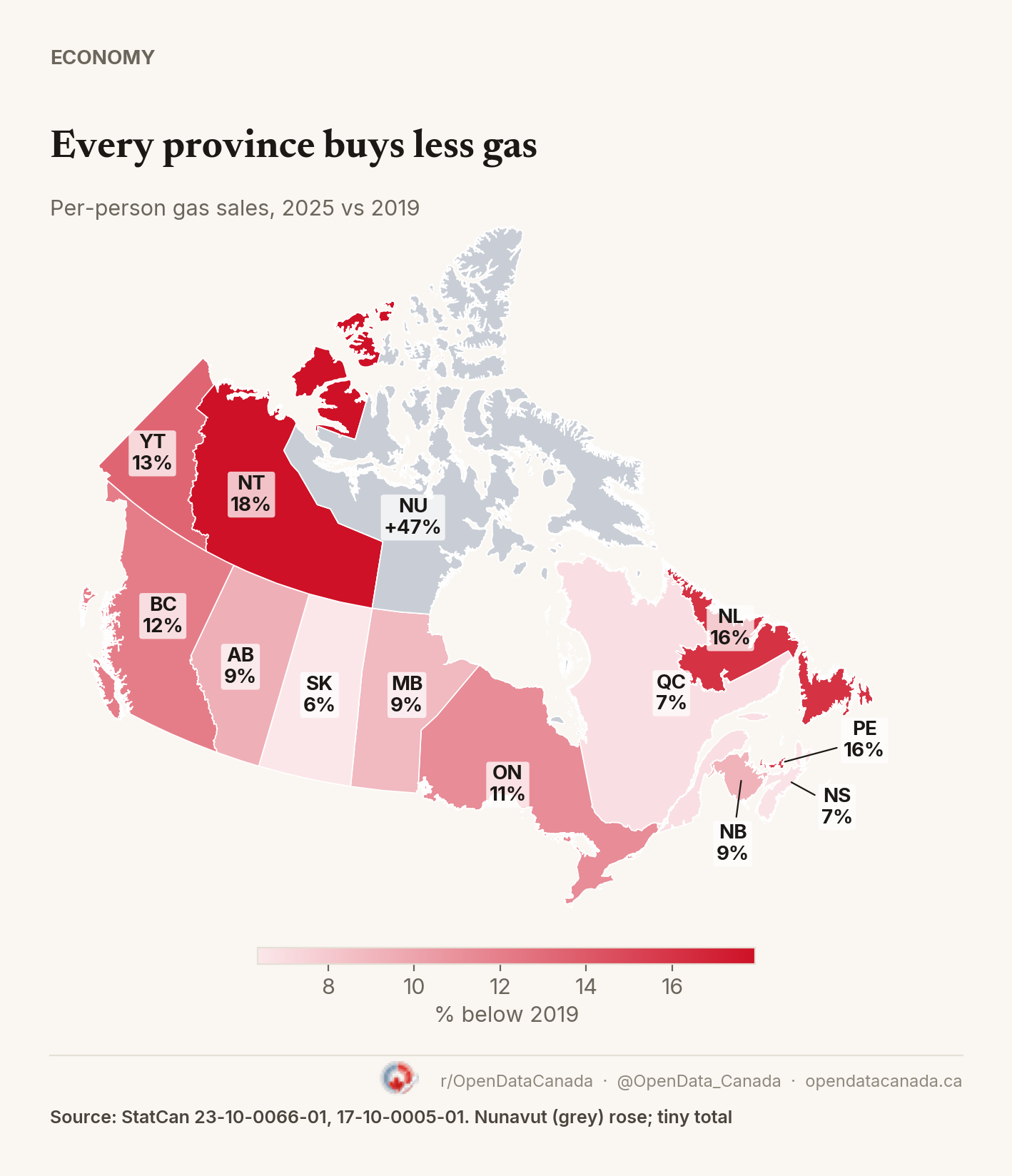
Every province is down, by 6 to 16 percent
All ten provinces bought less gasoline per person in 2025 than in 2019. Prince Edward Island (down 16.3 percent) and Newfoundland and Labrador (down 16.1 percent) fell furthest, followed by British Columbia and Ontario. Saskatchewan fell least.
| Province | 2019 | 2025 | Change |
|---|---|---|---|
| Prince Edward Island | 1,473 | 1,234 | -16.3% |
| Newfoundland and Labrador | 1,374 | 1,152 | -16.1% |
| British Columbia | 990 | 870 | -12.1% |
| Ontario | 1,178 | 1,046 | -11.2% |
| Alberta | 1,471 | 1,332 | -9.4% |
| New Brunswick | 1,498 | 1,361 | -9.2% |
| Manitoba | 1,267 | 1,155 | -8.9% |
| Quebec | 1,062 | 990 | -6.8% |
| Nova Scotia | 1,315 | 1,228 | -6.6% |
| Saskatchewan | 1,591 | 1,490 | -6.3% |
Gross gasoline sales in litres per resident.
Among the territories, Yukon (down 13.4 percent) and the Northwest Territories (down 17.9 percent) also fell. Nunavut rose 47 percent, from 401 to 590 litres per person, on a total of only 25 million litres. Statistics Canada notes that Nunavut's 2019 figure was imputed, and the territory's totals move a lot from year to year (17 million litres in 2022, 25 million in 2025), so treat this change with caution.
The long view
Per-person sales have been drifting down since 2016, and the pandemic cut them hard. They dropped to 1,015 litres in 2020 and recovered only to 1,090 by 2022. They have barely moved since: 1,089 in 2023, 1,064 in 2024, 1,076 in 2025. The 2025 uptick is 1.2 percent.
Statistics Canada's series starts in 1987. In that time, the lowest per-person figure before 2020 was 1,155 litres, in 1992. The 2025 figure is below that, and below every other year from 1987 to 2019.
What the data does not explain
The data shows that each Canadian buys less gasoline, not why. Fuel-efficient cars, hybrids and electric vehicles, remote work and other changes in driving could all contribute, and this table cannot tell them apart. For the EV side of the story in one province, see our look at Quebec's EV sales.