Article · Justice · 5 min read
Extortion has more than quadrupled in Canada since 2000 — and in Peel it has risen tenfold
Robbery has been halved and attempted murder sits at a 28-year low, but extortion has quadrupled in a generation. It has come off its 2023 national peak, yet stays concentrated in British Columbia's Fraser Valley and the Mississauga–Brampton corridor, where it is still climbing.
In 2025, most of Canada's violent crime numbers held steady. The overall violent crime rate was 1,443 per 100,000 people — down 3% from where it stood in 2000, and barely changed from the year before. Robbery has been cut nearly in half since the turn of the century. Attempted murder is at its lowest point in 28 years of comparable data.
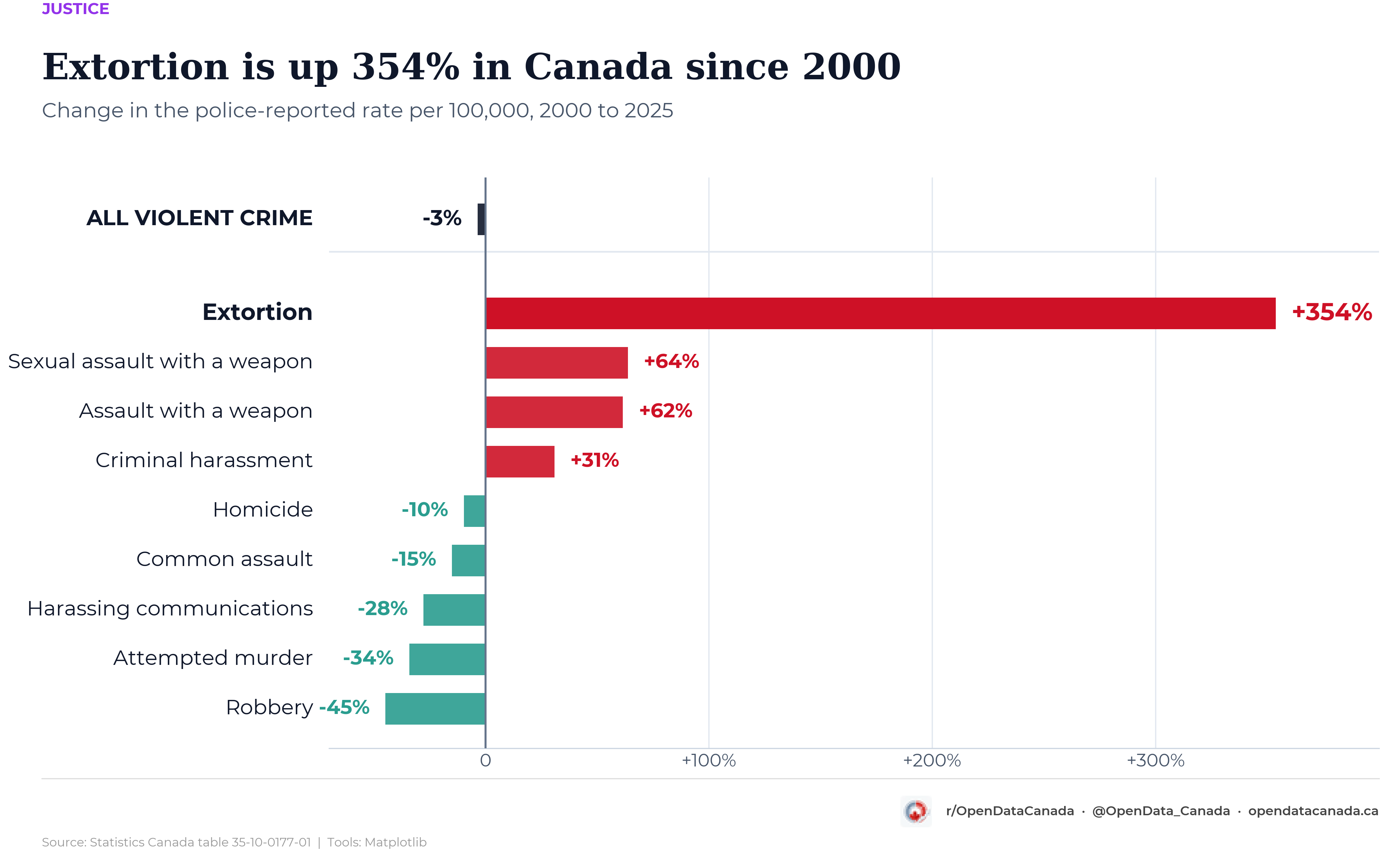
One offence broke away from that pattern. Extortion — threatening a person to force them to hand over money, property, or services — has risen 354% since 2000, from 6.4 incidents per 100,000 people to 29.1, or from 1,971 recorded incidents to 12,132. Eight violent offences record more than 10,000 incidents a year in Canada; among the other seven, the fastest-growing since 2000 is assault with a weapon at 62% — less than a fifth of extortion's rate of increase. And the increase is recent: not a legacy of the high-crime 1990s, but a rise concentrated in the past decade.
The rise has not continued unbroken. The national rate peaked in 2023 at 35.2 and has eased for two straight years since — to 32.2 in 2024 and 29.1 in 2025, about 17% below the peak. So extortion is not still climbing everywhere. But it has quadrupled in a generation, and even after the dip it stays concentrated in a few places — one of which is still at its all-time high.
That makes it an outlier. Overall violent crime is down 3% since 2000, and most major offences fell over the same period — robbery by 45%, attempted murder to a 28-year low, and even homicide by about 10%. The chart below ranks the biggest movers among the major violent offences since 2000; extortion sits alone at the top, well clear of everything else.
Where it's happening
The national figure hides a lopsided geography. A handful of places account for most of the extortion in Canada.
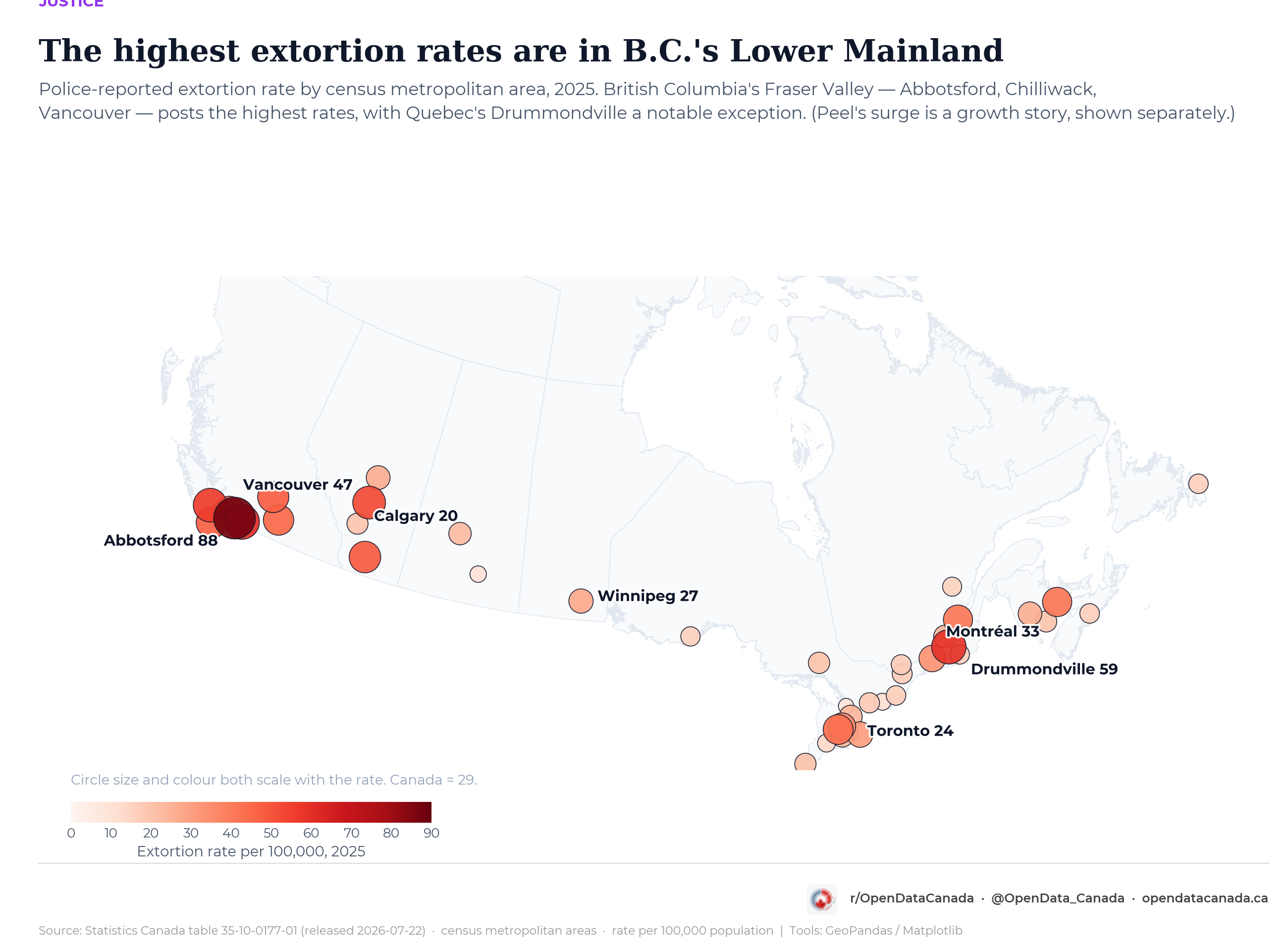
British Columbia's Lower Mainland and Fraser Valley lead the country. Abbotsford–Mission has the highest extortion rate of any Canadian metro area: 88 per 100,000, three times the national figure. It anchors a cluster of B.C. communities — Chilliwack (60), Nanaimo (56), Kamloops (48), Victoria (47), Vancouver (47), Kelowna (45). B.C. does not have the top tier to itself, though: Drummondville, Quebec (59) is the third-highest in the country, behind only Abbotsford–Mission and Chilliwack, and Red Deer (53) and Lethbridge (49) in Alberta both outrank most of the B.C. cities. But no single region is as thickly represented near the top as B.C.'s is. Among Canada's seven largest metros, Vancouver's rate is the highest and roughly double Toronto's.
The Toronto region, by contrast, sits well down the metro list. That ranking turns out to be misleading.
The Peel problem
At the metro level the Toronto region looks unremarkable — 24 per 100,000, below the national figure. But that covers millions of people across the whole GTA, and a region-wide number can stay flat while one corner of it climbs.
Break the data out by police service instead of by metro, and the picture changes. Peel Regional Police — which covers Mississauga and Brampton — recorded an extortion rate of 34 per 100,000 in 2025. That is above the national rate, above Toronto's, and it is where the trend line is most striking.
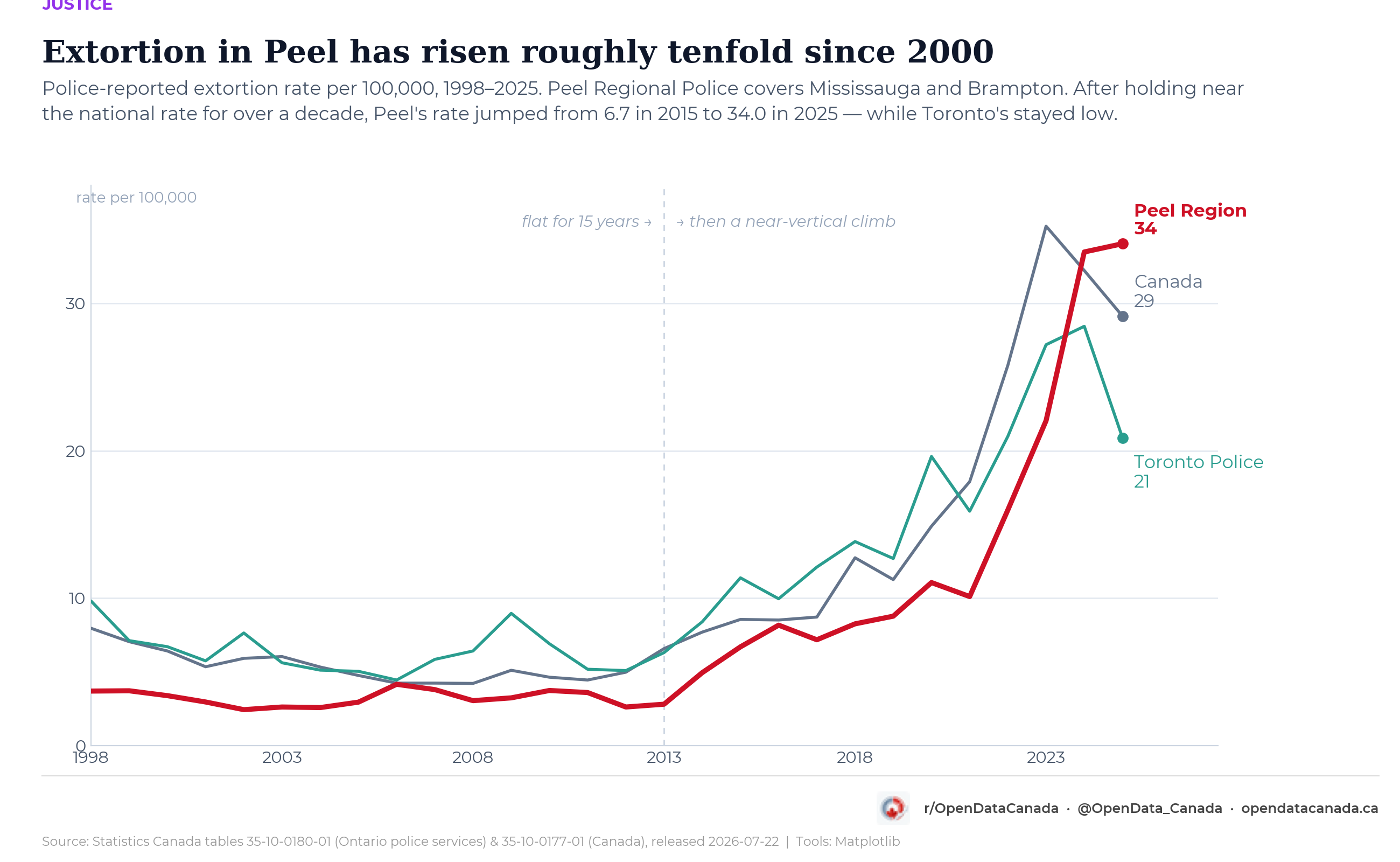
In 2000, Peel's extortion rate was 3.4 per 100,000 — indistinguishable from the rest of the country. It stayed flat for more than a decade. Then it took off: 6.7 in 2015, 11.1 in 2020, 16.0 in 2022, 22.0 in 2023, 33.5 in 2024, 34.0 in 2025. That is a tenfold increase since 2000, and a five-fold increase in the last decade alone — a far sharper rise than the national trend. And where the national rate has fallen back for two years, Peel's has not: it climbed through 2024 and held at its high in 2025, even as the country came off the boil.
Peel is not the single highest-rate service in Ontario, but almost every service above it is a statistical mirage — a village like Rama shows a rate of 87 on the strength of a single reported incident. Filter to forces policing a real population, and only one outranks Peel: Waterloo Region, at 43 per 100,000 from 308 incidents. Peel's 34 comes from 525 incidents across 1.5 million people — second among Ontario's urban forces, first among its largest. Toronto (21), York (22), Durham (24), Ottawa (18) and Hamilton (17) are all well behind.
What the numbers don't say
These numbers are easy to over-read, so a couple of things are worth keeping in mind.
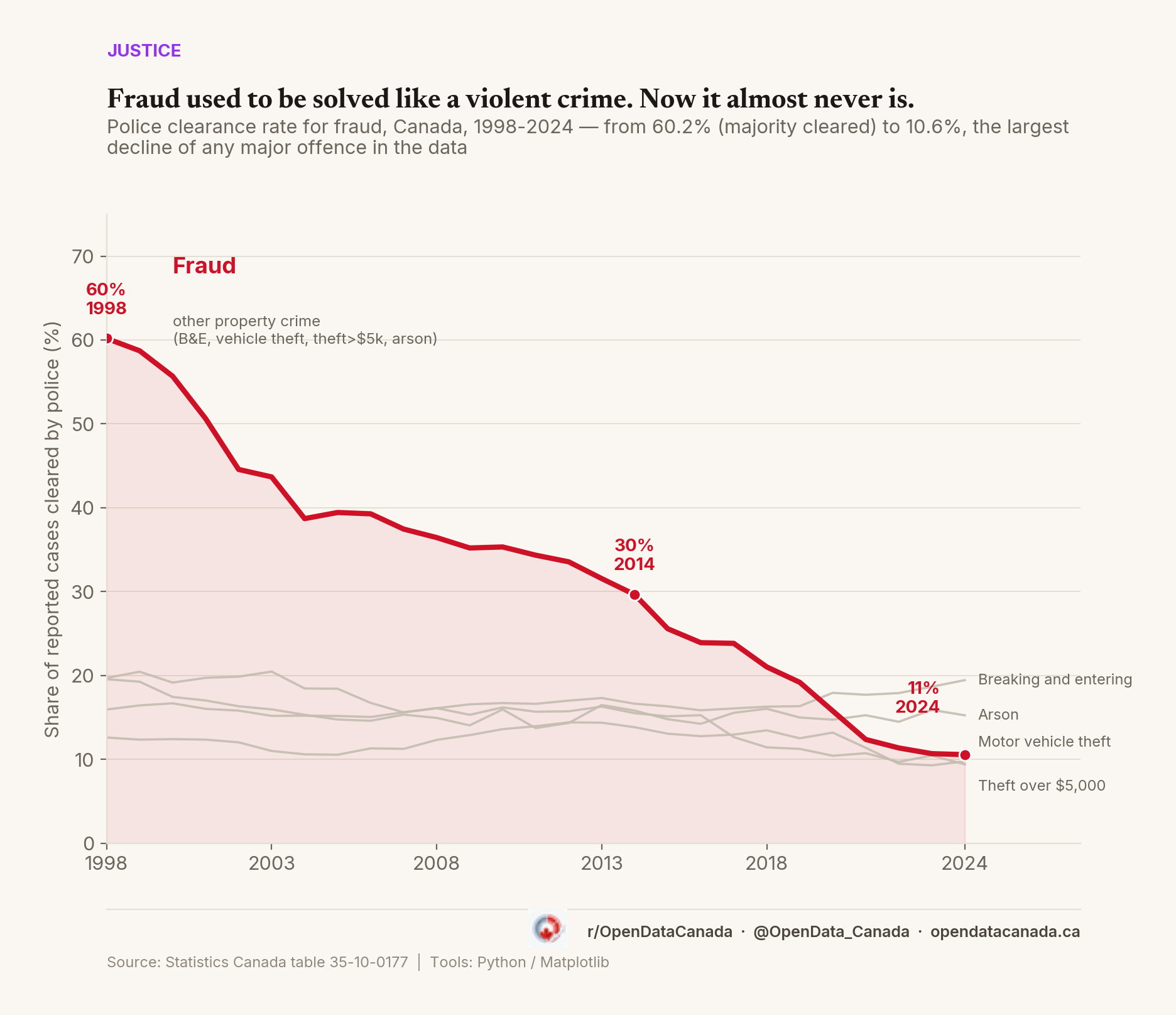
Police-reported crime measures what police record, not everything that happens. A rising rate can reflect more incidents, more victims coming forward, or a change in how forces classify complaints — the data cannot separate those, and the recent national dip should be read with the same caution: two years is a turn, not yet a trend. A related piece looks at how rarely a different property crime, fraud, gets solved at all.
"Extortion" is also a single legal category covering very different real-world events. It includes online "sextortion" — threats to release intimate images unless a victim pays — which has grown rapidly and often crosses borders. It also includes the organized targeting of business owners with threats of violence, a pattern police in several regions have described publicly. These are not the same crime, and this table cannot tell us how the total splits between them.
What the numbers do show clearly is scale and place. Extortion has multiplied several times over in a generation while most violent crime fell, and even as it eases nationally it stays concentrated — in British Columbia's Lower Mainland and Fraser Valley, and in the Mississauga–Brampton corridor, where it has risen roughly tenfold and has not yet come down. A national headline about crime holding steady misses all of it.