Economy · Small business · 4 min read
Nearly Half of Businesses Selling Soon Say They Could Shrink or Close Without a Buyer
A brand-new Statistics Canada table shows 20.3 percent of private-sector businesses in Canada plan to sell or transfer ownership within 10 years, rising to 26.6 percent among businesses more than 20 years old. Among the smaller group planning to sell within 2 years, StatCan asked for the first time what happens if a buyer can't be found: 46.8 percent called closing or scaling down likely, and 46.5 percent called selling at a reduced price, or to a less-preferred buyer, likely too.
Statistics Canada asked business owners a question it had never asked before: if you can't find someone to buy the business or take it over, what actually happens? The answers, published August 31 as part of the Canadian Survey on Business Conditions, land on a small slice of the economy but land hard. Among businesses that already plan to sell or transfer ownership within the next two years, 46.8 percent rate scaling down or closing operations entirely as very or somewhat likely if no buyer shows up. A nearly identical 46.5 percent rate having to sell at a reduced price, or to a buyer they'd rather not sell to, as likely too.
Exit plans are far more common among older businesses
The scenario question sits on top of a wider one StatCan has asked for longer: does the business intend to sell or transfer ownership at all in the next decade? Nationally, 20.3 percent of private-sector businesses say yes. Break that down by how long the business has existed and the pattern is not subtle. It rises in a straight line with age: 10.3 percent of businesses two years old or younger, 16.3 percent of businesses 3 to 10 years old, 18.0 percent of businesses 11 to 20 years old, and 26.6 percent of businesses over 20 years old.
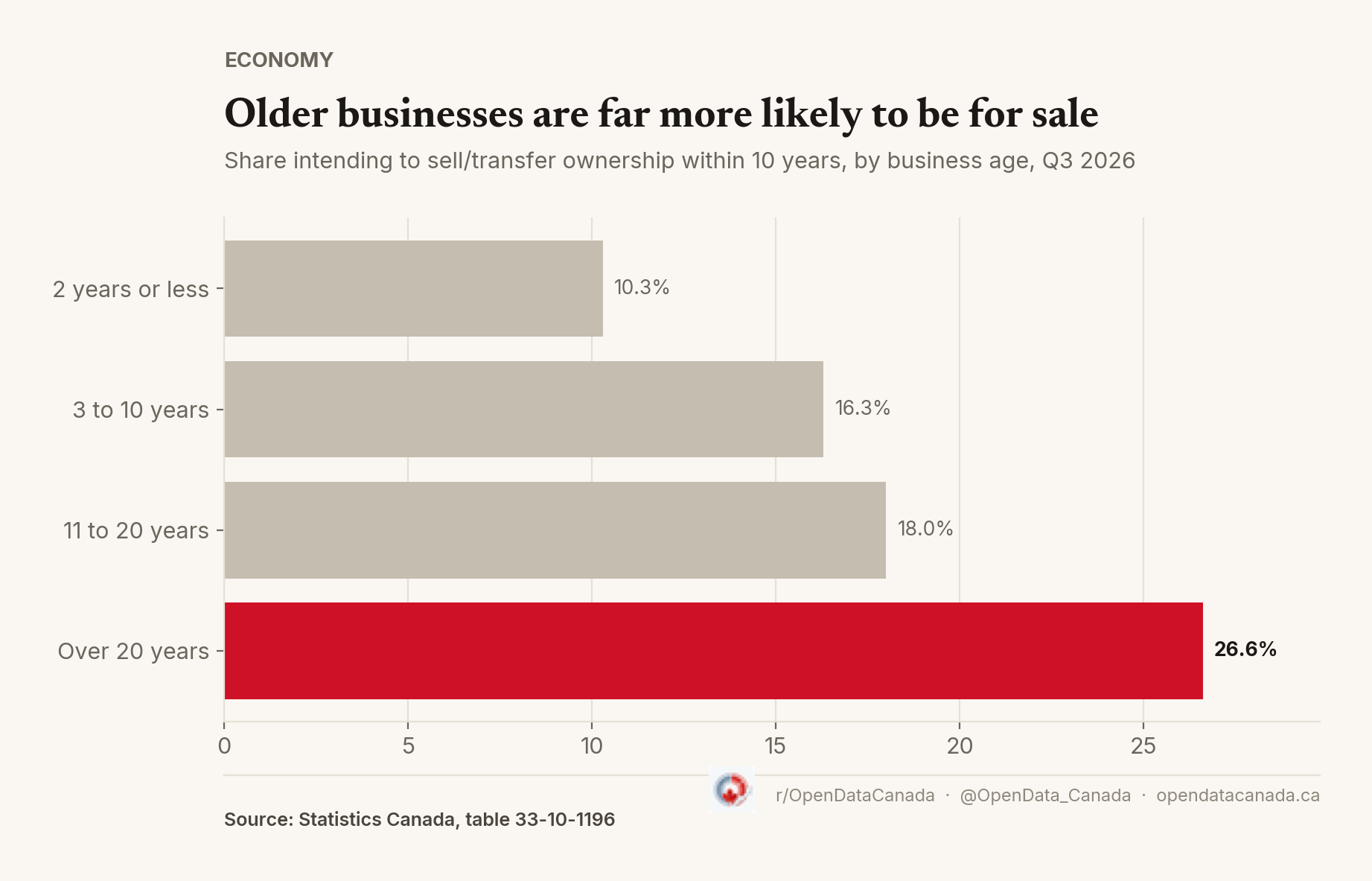
That gradient points to age, not just business type: older businesses are disproportionately the ones with an owner old enough to be planning retirement, and they are more than two and a half times as likely to say they're heading for a sale as a business that opened in the last two years.
Not every one of those owners is on the same clock. Of the 20.3 percent who intend to sell, 31.3 percent say it will happen within 2 years, 28.8 percent within 3 to 5 years, 21.2 percent within 6 to 10 years, and the rest don't know yet. The group StatCan asked the scenario question of, businesses selling within 2 years, works out to roughly 6.4 percent of all private-sector businesses in Canada, not all businesses and not even all businesses planning to sell. The 46.8 percent and 46.5 percent figures describe that narrower group specifically.
Owners rate closing about as likely as a clean sale
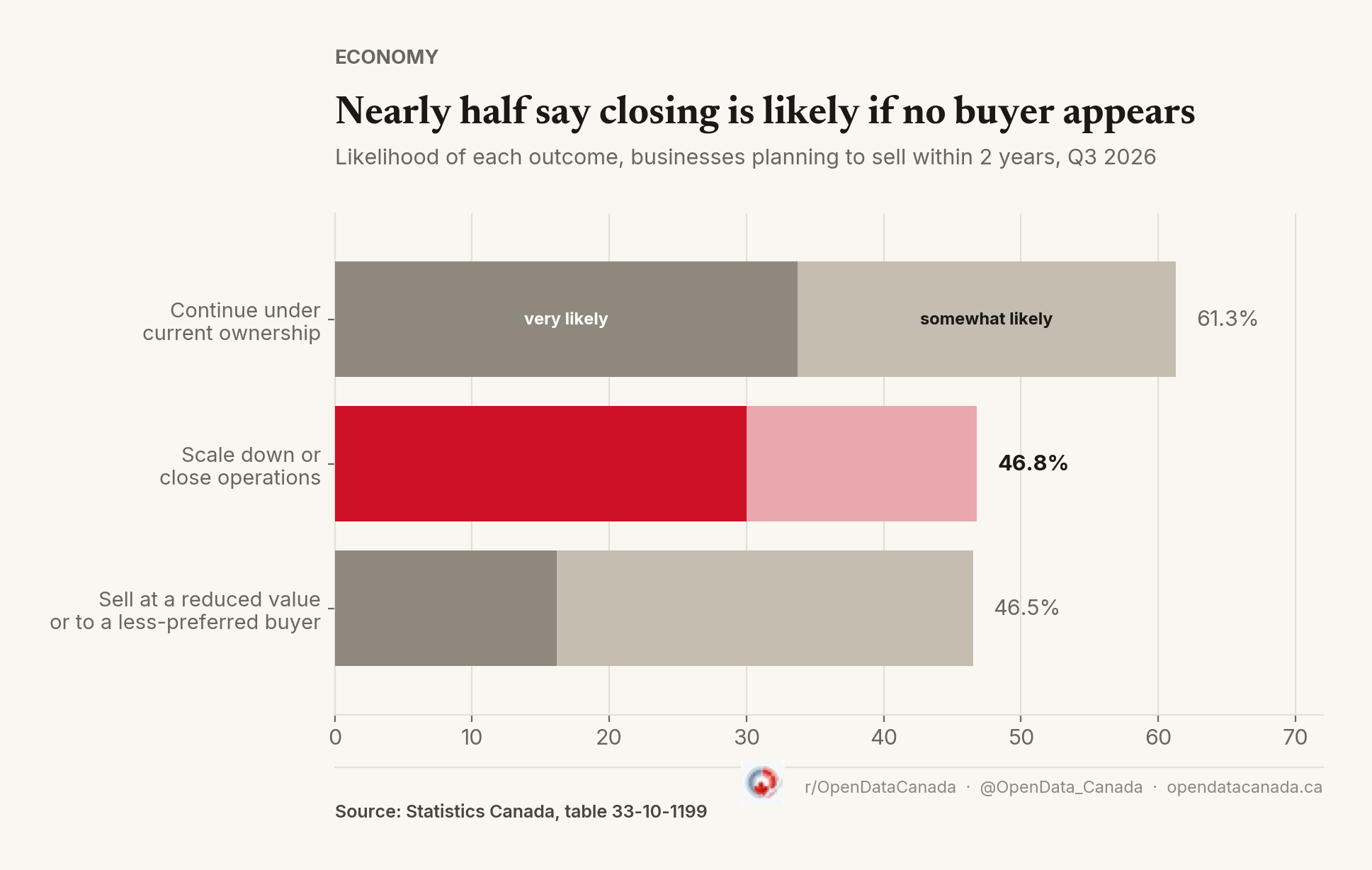
StatCan asked owners to rate three separate outcomes, and the questions aren't a forced choice. A business can rate more than one as likely, which is exactly what these numbers suggest happened. Continuing under current ownership is the outcome rated likely most often, at 61.3 percent, so a majority of owners in this group still expect the sale to go through cleanly. But that leaves plenty of room for the other two ratings to also run high, and they do: essentially the same share, just under half, sees a real chance of closing the doors, and a separate, almost identical share sees a real chance of settling for less than they wanted.
Looking only at the "very likely" ratings, the strongest end of each scale, the same order holds: 33.7 percent call continuing operations very likely, 30.0 percent call closing very likely, and 16.2 percent call a reduced-value sale very likely. Closing the business outright and selling on unfavourable terms are rated as almost equally likely, with nearly half of owners putting each outcome in the "likely" category.
Ottawa and several provinces have started building scaffolding for exactly this problem: Succession Ontario and Repreneuriat Québec both exist to match retiring owners with prospective buyers before a sale falls through for lack of one. This release is the first StatCan measurement of how large the gap those programs are reaching for actually is, at least for the leading edge of owners already two years out.
The smallest businesses are the ones that would close
Cut the same scenario question by employee count and the national 46.8 percent splits apart. Among businesses with 1 to 4 employees that plan to sell within two years, 71.1 percent rate scaling down or closing as likely if no buyer is found. That share falls to 27.4 percent for businesses with 5 to 19 employees, 22.0 percent for 20 to 99, and 8.0 percent for businesses with 100 or more. The gap between the smallest and largest is roughly nine to one.
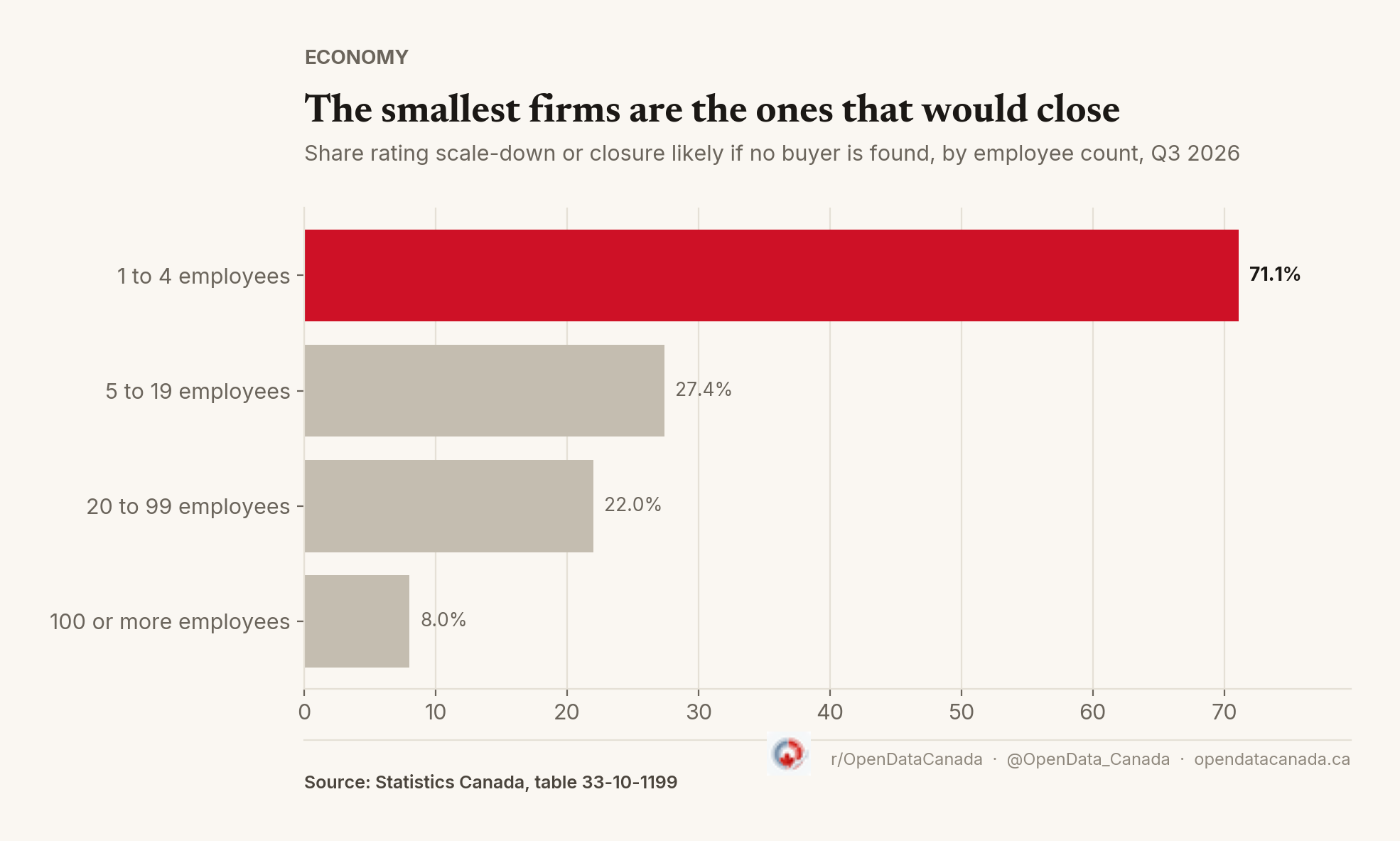
The "very likely" rating alone tells the same story: 49.7 percent of the smallest businesses call closing very likely, against 7.6 percent of the largest. A business with a handful of staff often is its owner, and the survey suggests that without a buyer, closing or scaling down is much more likely to be considered than accepting an unfavourable sale.
That sits oddly beside the intention numbers. The smallest businesses are not the ones most likely to be planning a sale: 17.7 percent of businesses with 1 to 4 employees intend to sell or transfer within 10 years, against 26.5 percent of those with 5 to 19 employees, 16.9 percent for 20 to 99, and 11.1 percent for 100 or more. The 5-to-19 band tops both ends. But once a micro-business does decide to sell, it is the one with the fewest fallbacks. The same survey series also tracks how unevenly Canadian businesses have adopted AI.