Article · Economy · 4 min read
Canada has an "entrepreneurial drought." A small-business group told MPs the numbers.
Appearing before the House Finance Committee on the spring economic update, the Canadian Federation of Independent Business said more businesses are closing than opening across several sectors, for as long as 12 straight quarters. It warned that 55 percent of current owners would not recommend starting a business today, and pressed for a lower tax rate and a deduction threshold that has not moved since 2009.
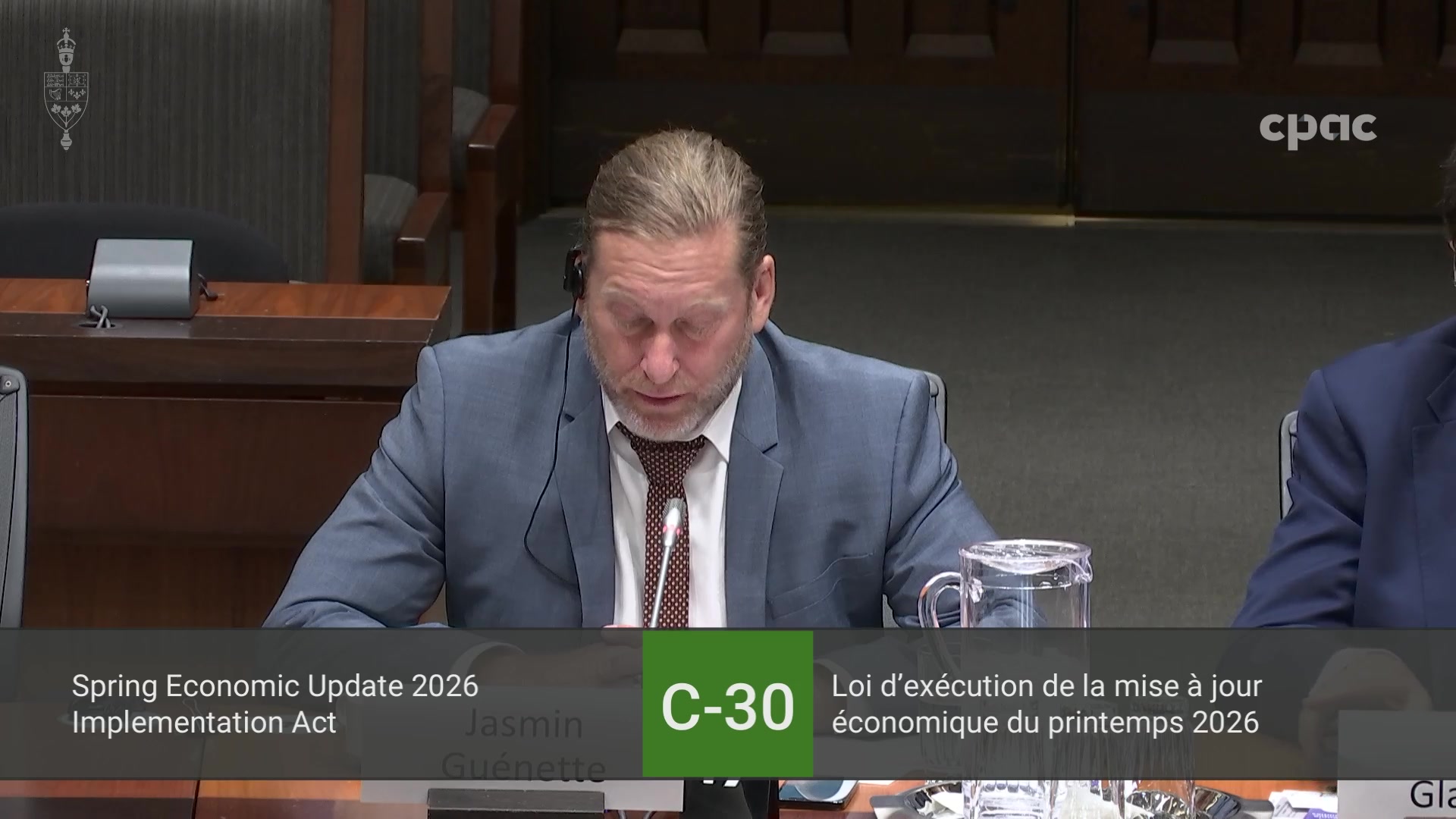
When the House of Commons Standing Committee on Finance met to study Bill C-30, the act implementing the spring economic update tabled on 28 April 2026, the Canadian Federation of Independent Business arrived with a blunt message: the update did little for the people who start and run Canada's small businesses, and the data on business formation is getting worse.
Jasmin Guénette, the CFIB's vice-president of national affairs, told the committee the country "is facing a serious entrepreneurship problem." His evidence was a run of consecutive quarters in which closures have outpaced openings.
"We have seen more business closing than opening in the agriculture sector for 11 straight quarters," Guénette said. "We have seen more business closure than new ones created for eight consecutive quarters in retail, and for 12 consecutive quarters in wholesale. We are losing more businesses than we see new ones created in many sectors, and yet the economic update did not address that."
He paired the closure figures with a measure of owner sentiment. "CFIB data shows that 55 percent of current small business owners would not recommend starting a business today," he said. "That should concern every policymaker in this room."
What the CFIB asked the committee for
Pressed by an MP on what he would add to Bill C-30 to support small and medium-sized enterprises in the short term, Guénette named two priorities: cutting the federal small-business tax rate from 9 percent to 6 percent, and raising the small-business deduction threshold from 500,000 dollars to 700,000 dollars.
The threshold figure carried the sharpest point. "The deduction for SMEs has been at 500,000 since 2009. It's never been increased," Guénette said. "And had it been indexed to inflation, it would be actually higher than 700,000." In other words, the ceiling the CFIB is asking for would only restore the real value the threshold had more than 15 years ago.
The group's broader critique was that the spring update leaned toward major projects "said to be of national interest" and toward new international markets, while leaving the structural costs facing small firms untouched. Guénette said optimism among CFIB members is low, costs are high, and the regulatory framework is "too restrictive and complex." He also flagged member concern that the update "did not lay out a real plan to go back to an overall balanced budget."
On one C-30 measure aimed at small business, the permanent capital-gains exemption for sales to an employee ownership trust, Guénette was lukewarm. He called it "a positive measure" that adds to the options for owners looking to sell, but said he was "not sure if it will really be used all that much."
What Statistics Canada's own data shows
The CFIB's figures are the organization's own, presented as advocacy before a committee weighing a government bill. So we checked them against an independent source: Statistics Canada's experimental estimates of business openings and closures, which track how many businesses open and close each month by sector.
The official numbers corroborate the core of Guénette's claim, and on wholesale they line up almost exactly. Summing the seasonally adjusted monthly data into quarters, wholesale trade recorded more closings than openings in every one of the last 12 quarters, from the start of 2023 through the end of 2025. That is the same figure the CFIB gave the committee.
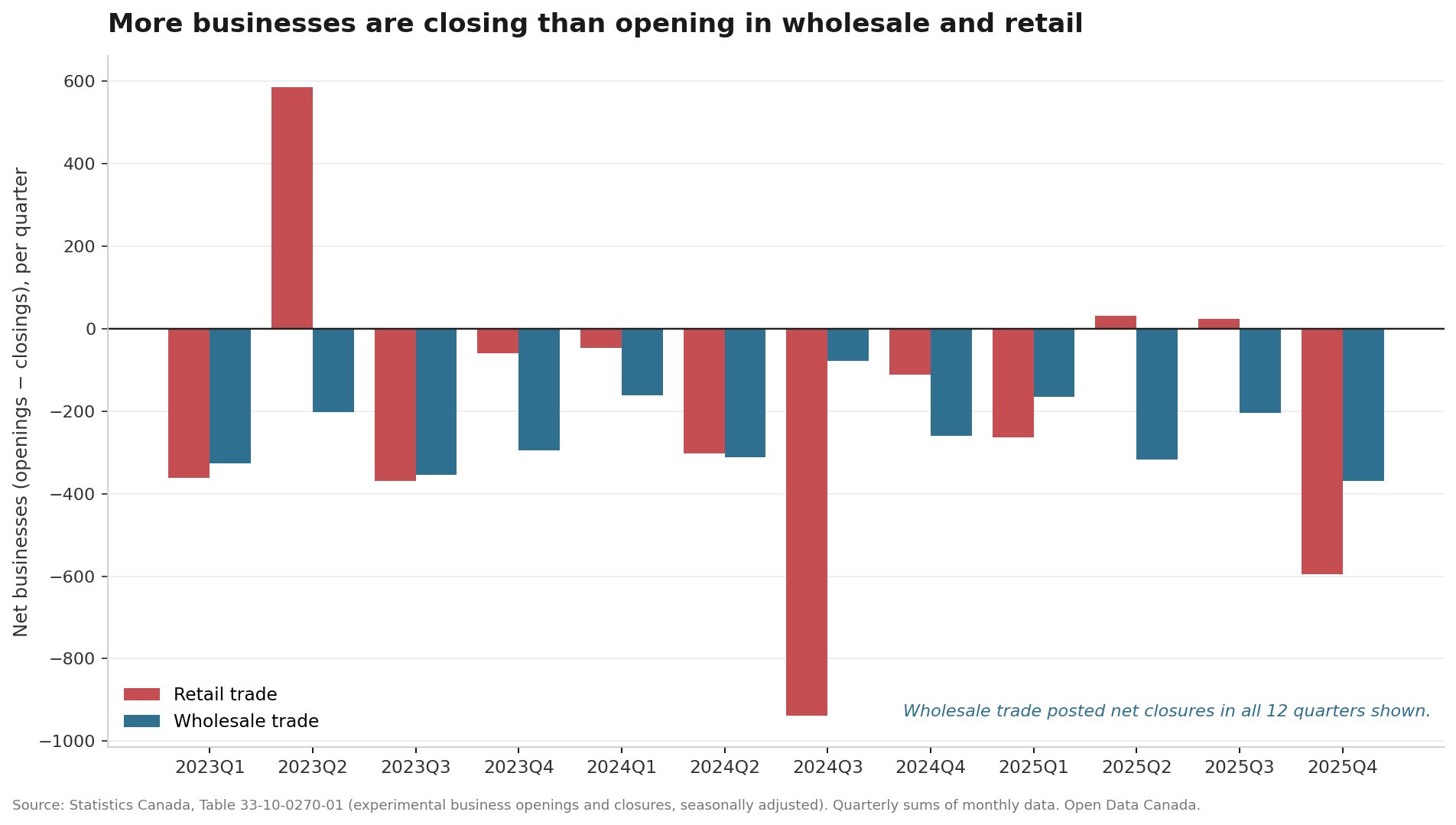
Retail trade is a more mixed picture in the official data than in the CFIB's account. StatCan shows retail in net decline for most quarters since 2023, including a steep drop in the third quarter of 2024, but with a few quarters of net gains breaking the run, rather than the eight unbroken quarters the CFIB cited. The difference likely reflects the gap between the CFIB's membership data and StatCan's economy-wide experimental estimates. The direction, though, is the same: across both sectors, closures have outpaced openings far more often than not.
Why it matters
Whether net business formation has turned persistently negative is the kind of claim that shapes how MPs read the spring economic update. On the strongest version of it, wholesale trade, the government's own statistical agency and a small-business lobby group independently land on the same number. The committee's study of Bill C-30 continues.