Article · Labour · 4 min read
Women in Public-Sector Industries Were 34% More Likely to Have a First Child
A new StatCan study links Canadian women's chances of having a first child to where they work. Women in public administration, education and health have pulled far ahead of women in administrative and service jobs since 2017. Union coverage matters too, but only modestly, and income still matters more than either.

Statistics Canada released a study today tracking employed, partnered women aged 22 to 39 from 2017 to 2023, linking Census records to tax files and birth registrations to see which women went on to have a first child. The study is observational: it identifies associations, not causes. Three characteristics stood out, in this order of strength: family income first, industry of employment second, union coverage a distant third. StatCan groups public administration, education and health together as "public-sector industries" for this analysis, distinct from a broader government-versus-private split.
Income: the strongest association
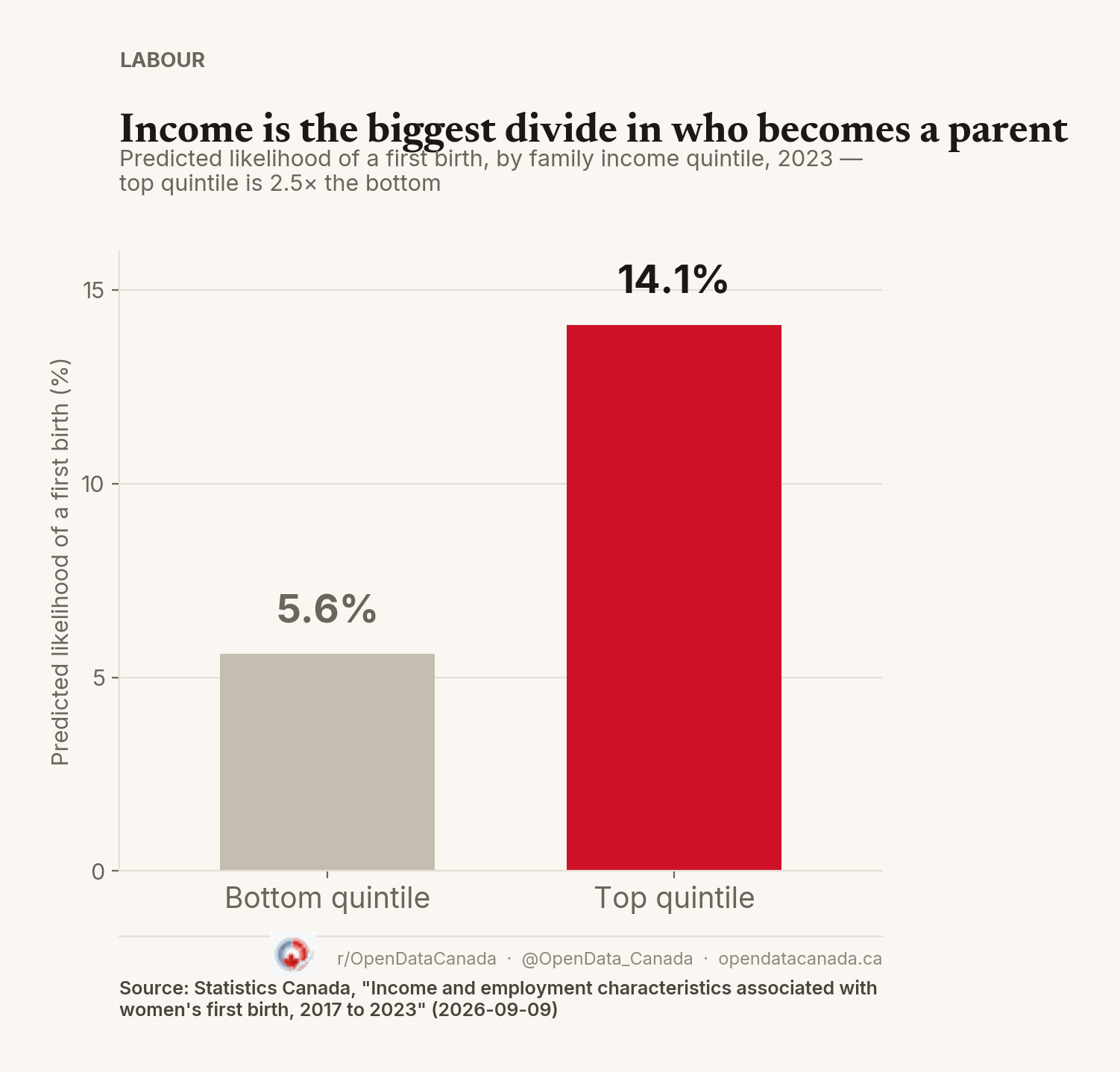
In 2023, women in the top family income quintile had a 14.1% predicted likelihood of having a first child, versus 5.6% for women in the bottom quintile: 2.5 times as likely. In 2017, that ratio was 2.1 times. First-birth likelihood fell for every income group over the study period, but it fell hardest at the bottom, which is what stretched the gap. Individual earnings mattered too, but family income mattered more and widened faster; how a couple split their earnings between partners showed no strong or consistent relationship to first-birth likelihood at all.
Industry: public-sector industries versus the rest
"Public-sector industries" here means public administration, education or health, grouped together for this analysis, not government employment specifically. Regardless of income level, women working in those industries had a consistently higher likelihood of a first birth than women working elsewhere. Differences among the non-public-sector industries were minimal; this wasn't a public-versus-every-other-industry story so much as public-sector industries versus everyone else, roughly grouped.
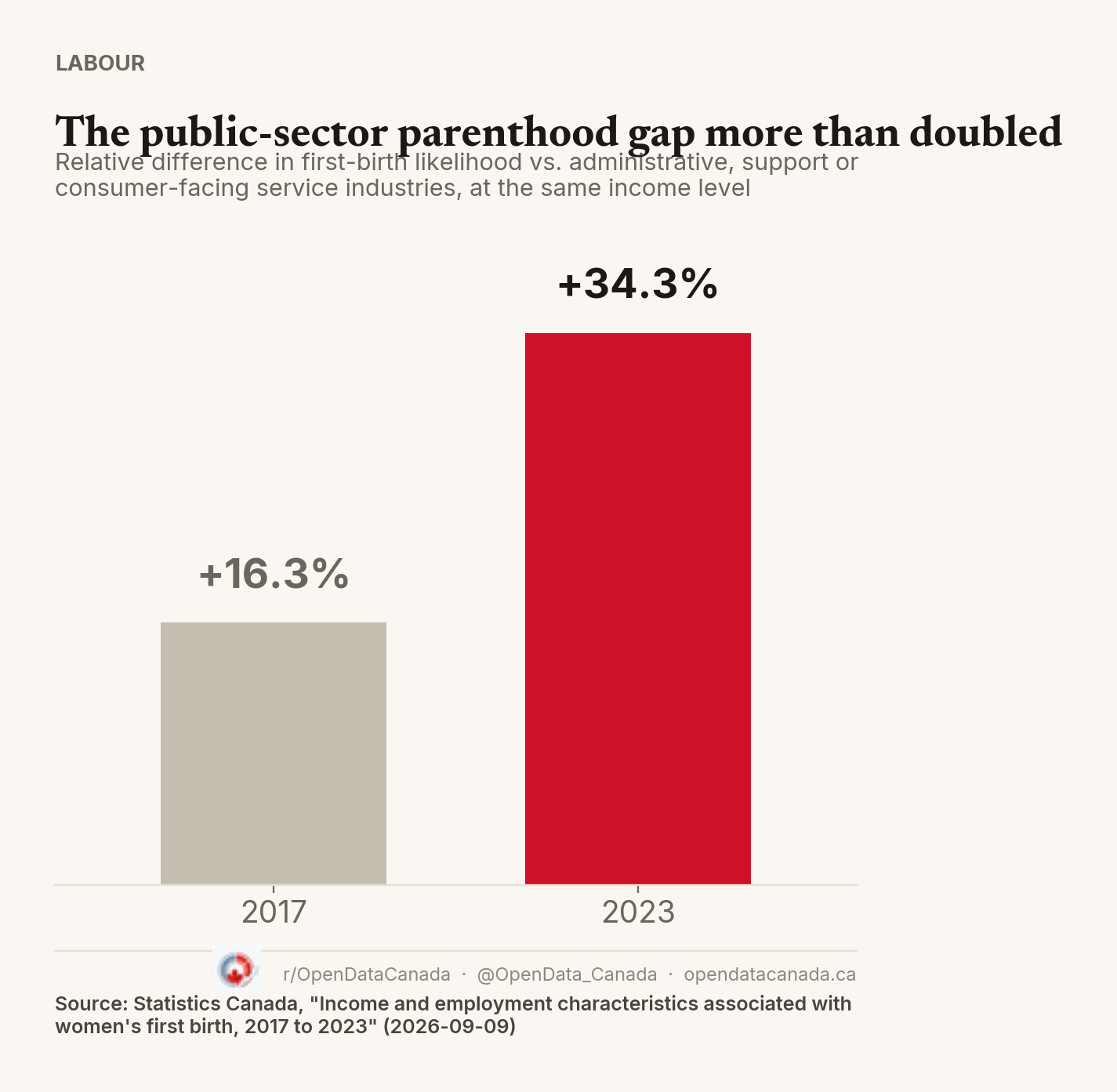
That gap widened. In 2017, a woman in public-sector industries had a 16.3% higher likelihood of a first child than a woman working in administrative, support or service industries, at the same income level. By 2023, that difference had grown to 34.3%, a relative gap, not a jump of 34.3 percentage points in either group's raw odds. The widening wasn't driven by a large increase in first-birth likelihood among women in public-sector industries. Instead, likelihood declined more sharply among women in administrative, support and service industries, which is what pulled the relative gap apart.
Unions: a real association, a small one
Women in unionized jobs also had a higher likelihood of a first child than non-unionized women at the same income level, in every year from 2017 to 2023. But StatCan flags this one explicitly as smaller than the income and industry effects.
The union effect shows up every year, holds regardless of income level, and stays in the single digits.
Self-employment, by contrast, didn't behave consistently at all across the study period, unlike either industry or union coverage. In a country where most couples are dual-earner and most employed women work full-time, StatCan reads the overall pattern as evidence that having enough stable household income, not who in the household earns it or where they work, is what's increasingly associated with whether coupled, employed women have a first child.
One divergence stands out: in 2021, first-birth likelihood rose among higher-income women even as it kept falling for the lowest-income group, timing that lines up with Canada's rare pandemic-era uptick in fertility, its only year-over-year increase since 2008.