Article · Economy · 4 min read
Foreigners bought $106B of Canadian bonds. Most wasn't new money.
Foreign investors bought a record $106 billion of Canadian bonds in the second quarter of 2026. But only about $10 billion represented net purchases of newly issued bonds.
Statistics Canada's release on foreign investment in Canadian securities landed with a headline number: 100.6 billion dollars flowed into Canadian securities in the second quarter of 2026, a new quarterly record. Bonds accounted for nearly all of it — foreign investors added 106.2 billion dollars in Canadian bonds even as they sold off equities.
The headline total treats every one of those dollars the same. Statistics Canada's underlying series doesn't: it breaks bond flows into three transaction types, and only one of them is new money. $106 billion bought doesn't mean $106 billion lent to Canada.
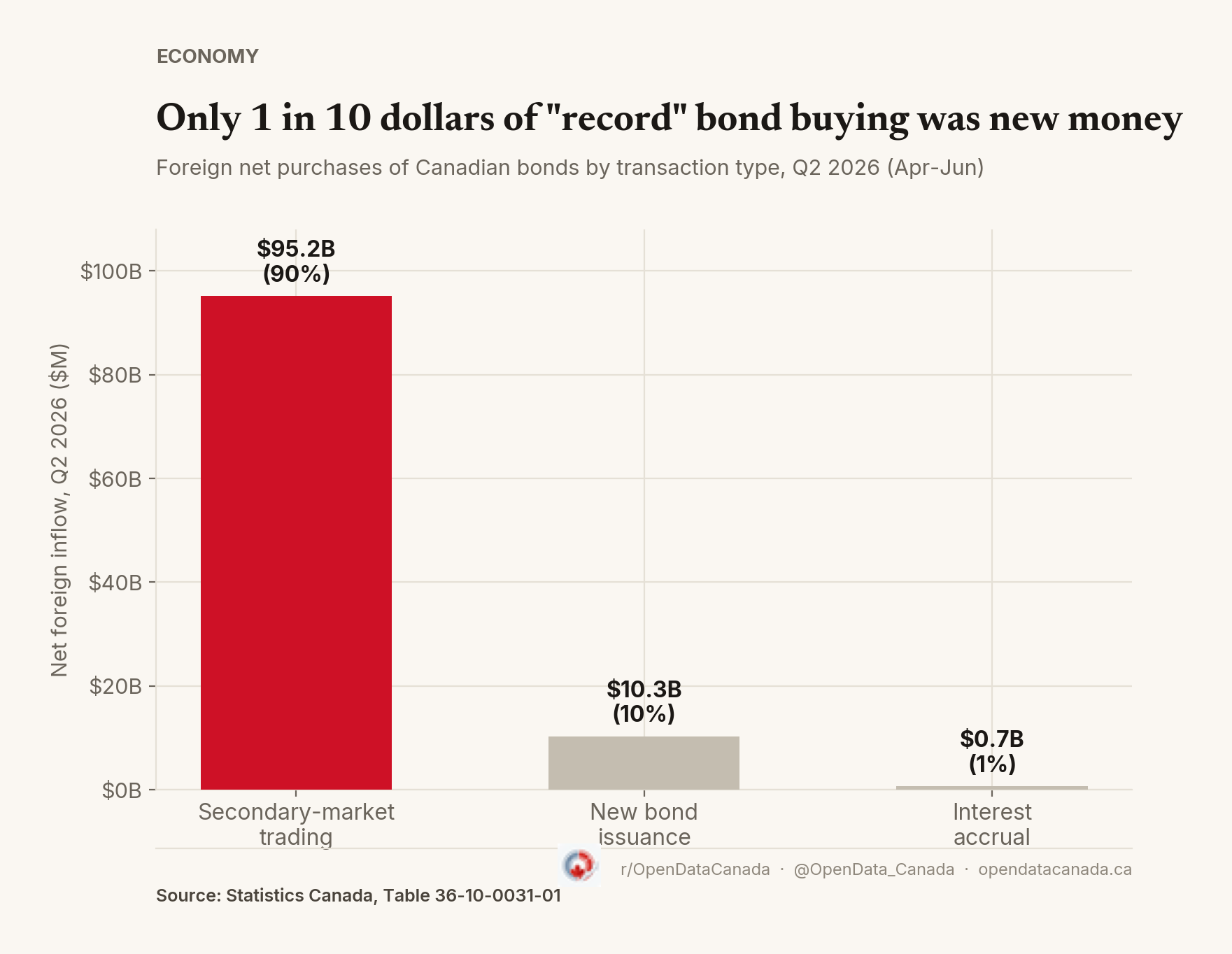
Of the 106.2 billion dollars, 95.2 billion (90 percent) was foreign investors trading bonds that Canadian governments and corporations had already issued — buying them off other holders in the secondary market. Just 10.3 billion dollars (10 percent) was new issues net of retirements — the part that represents foreign investors buying newly issued debt. The remainder is interest accruing on bonds already held. Secondary-market trades don't hand any new cash to a government or a company; the seller who cashes out is typically another investor, not the original borrower.
A record of new issuance would mean foreign investors are directly funding a surge in government or corporate borrowing. A record dominated by secondary-market trading is different: it's foreign money reallocating into Canadian bonds that already exist. The two aren't fully separate — heavy secondary-market demand can make future new issues easier to sell — but they're not the same transaction, and this quarter's total is overwhelmingly the second kind.
Statistics Canada's issuer breakdown, which covers all bond transactions (secondary trading and new issuance combined) rather than just the new-issuance slice, shows the federal government holds the largest share of foreign net bond flows this quarter at roughly 61 billion of the 106.2 billion total, with corporations and provinces splitting the remainder.
Not just a record — the biggest quarter in at least 16 years
Statistics Canada's bond-flow series goes back to 2010, and against that history Q2 2026 isn't a modest new high — it beats the prior record by a wide margin.
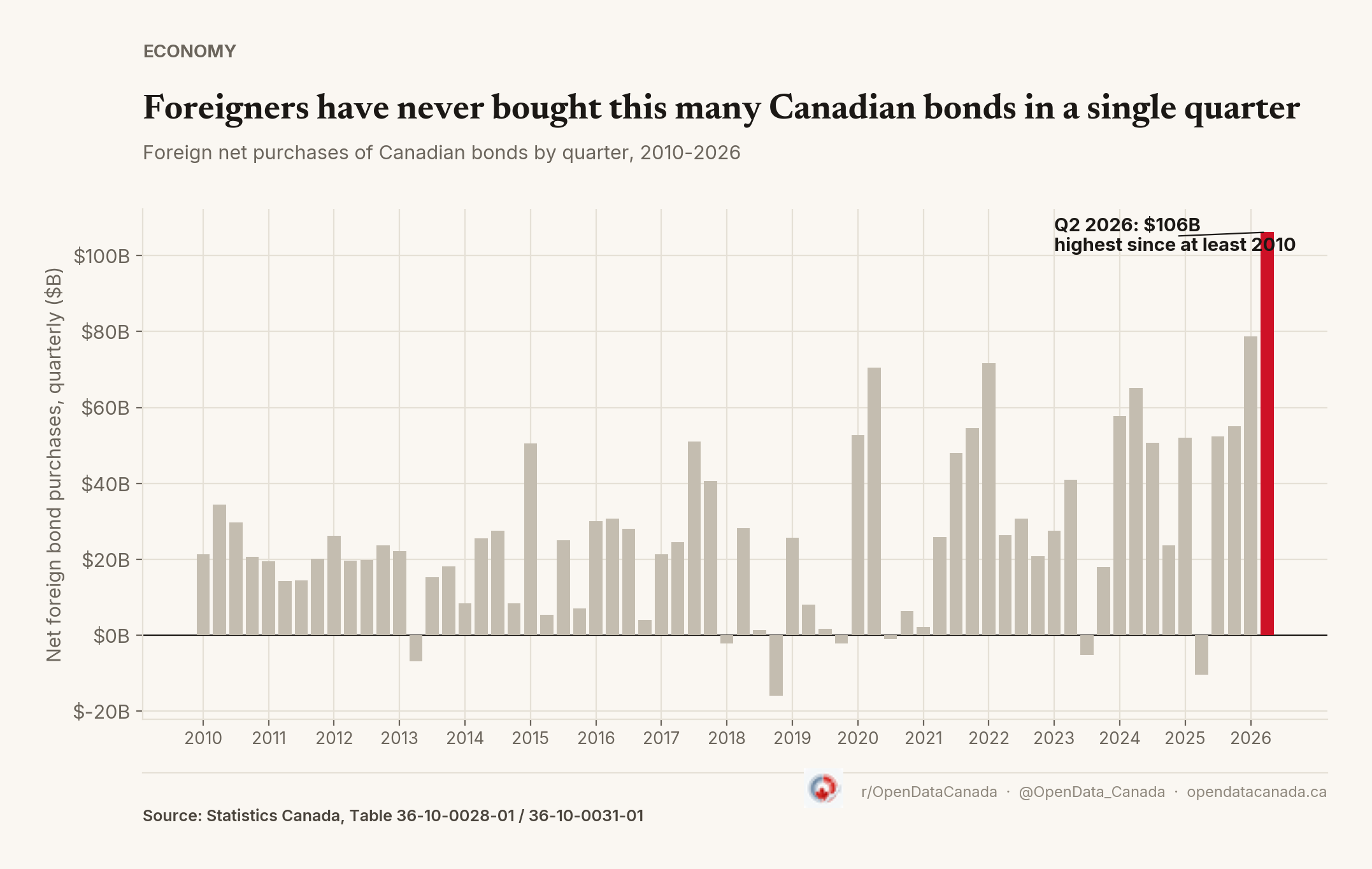
The next-largest quarters on record are Q1 2022 (71.7 billion) and the pandemic-disrupted Q2 2020 (70.5 billion) — Q2 2026 beat both by roughly 50 percent. The first half of 2026 as a whole (184.8 billion) already exceeds every full calendar year on record, including all of 2025 (149.2 billion), and is more than three times the 16-year first-half average of 55.7 billion.
So the record is real. What's misleading is treating the entire $106 billion as new financing for Canada. A reader taking away "foreigners are pouring unprecedented new money into financing Canada" is drawing a conclusion the transaction-type breakdown doesn't support. What's unprecedented is the scale of foreign buying of Canadian bonds that had already been issued — nothing in the last 16 years comes close. Foreign control of Canadian businesses, measured a different way, has fallen for 14 straight years.