Article · Economy · 6 min read
Canada's road and water networks are aging back to 2005 levels
Canada's headline measure of infrastructure health has climbed for two decades. The data underneath tells a different story: the country's roads are back where they stood in 2005, and waterworks have fallen every year since 2014. The national average hides the decline of two networks people use daily.
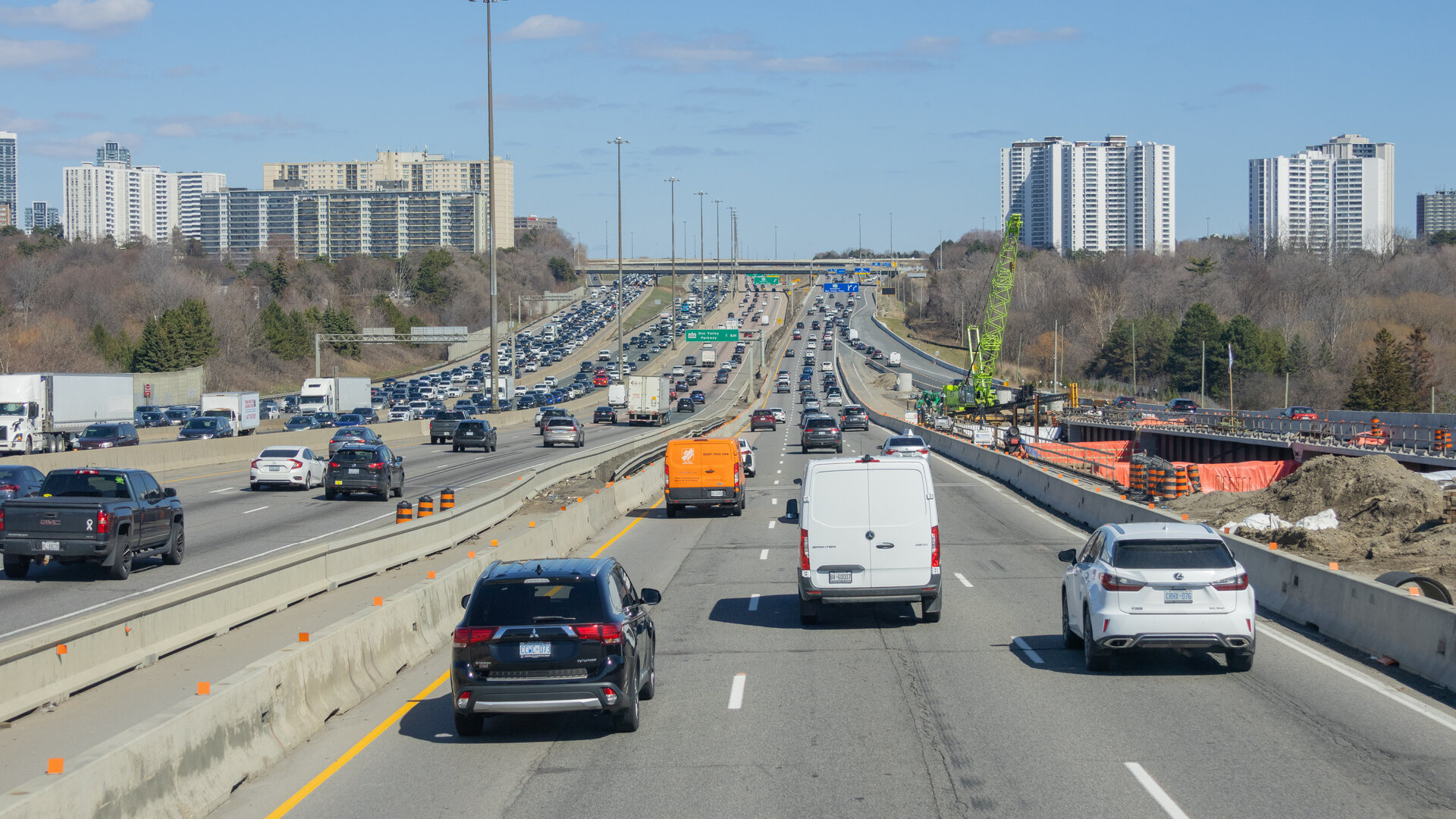
Statistics Canada published its Infrastructure Economic Accounts on June 12. The headline figure points one way. The categories underneath it point another.
For all Canadian infrastructure combined, the remaining useful service life ratio rose from 52.4 percent in 2005 to 59.5 percent in 2025. The ratio is a summary measure of how much economic life the country's built assets still have, as a share of their total cost. It went up in every one of those years. On its own, it reads as steady improvement.
For the infrastructure most Canadians use every day, it does not hold.
What the national average leaves out
The aggregate figure covers every category of fixed infrastructure in the country: roads and highways, bridges, waterworks and sewage systems, along with energy facilities, telecommunications networks, and other structures. Two of those categories have pulled the average up, and they are the two that drew the most private capital over the past decade: energy and communications. New pipelines, data centres, cell towers, and transmission lines are young assets with most of their service life still ahead of them. They lift the overall number.
Set those aside and look at what governments build and maintain for public use. Road structures have gone backwards. Waterworks sit well below their peak.
Roads have given back 13 years of gains
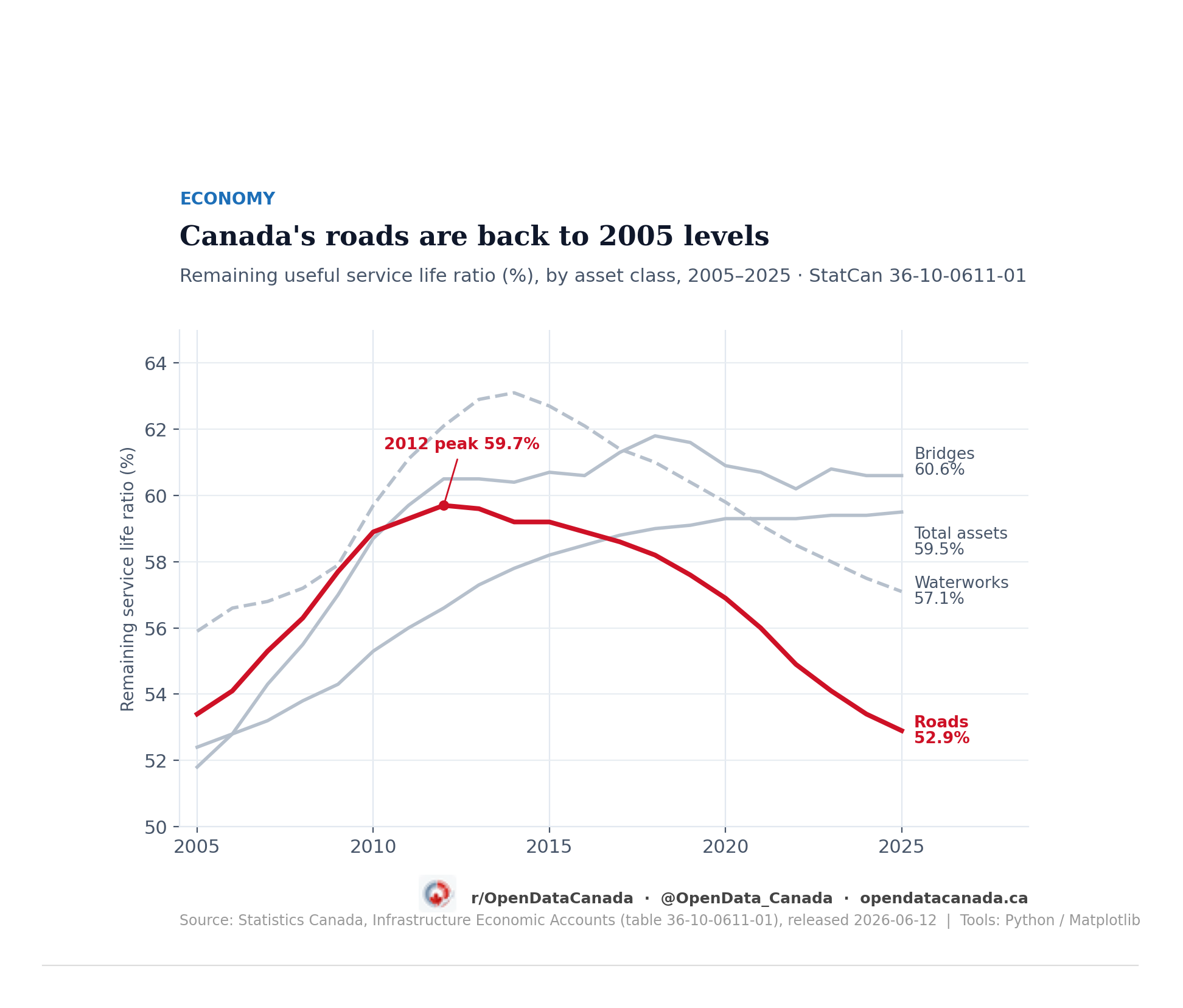
The ratio for highway and road structures, a group that includes roads, sidewalks, and other surface transport assets, peaked at 59.7 percent in 2012 after rising from 52.8 percent in 2004. It has fallen every year since: 59.6 percent in 2013, 59.2 percent in 2014, and on down to 52.9 percent in 2025. That puts roads below their 2005 reading of 53.4 percent, and almost exactly back at the 2004 level of 52.8 percent.
Measured in economic age, the gains built up from the mid-2000s through the 2012 federal stimulus have been wiped out. On this accounting basis, the road network is no younger than it was when the Harper government launched its Building Canada Plan.
Water systems peaked in 2014 and have slipped since
Water infrastructure followed a similar path, a couple of years later. The ratio for waterworks, which covers treatment plants, distribution mains, and related assets, rose from 55.9 percent in 2005 to a peak of 63.1 percent in 2014. It has dropped every year since, down to 57.1 percent in 2025. That is a decline of 6.0 percentage points over eleven straight years.
Waterworks still sit above where they were in 2005, but the slide has not let up. At the current pace, they would be back to 2005 levels sometime in the 2030s.
Bridges are the clear exception. Their ratio climbed from 51.8 percent in 2005 to 61.8 percent in 2018 and has held roughly steady since, at 60.6 percent in 2025. Sewage systems have barely moved the whole time, staying between 51.8 and 53.4 percent.
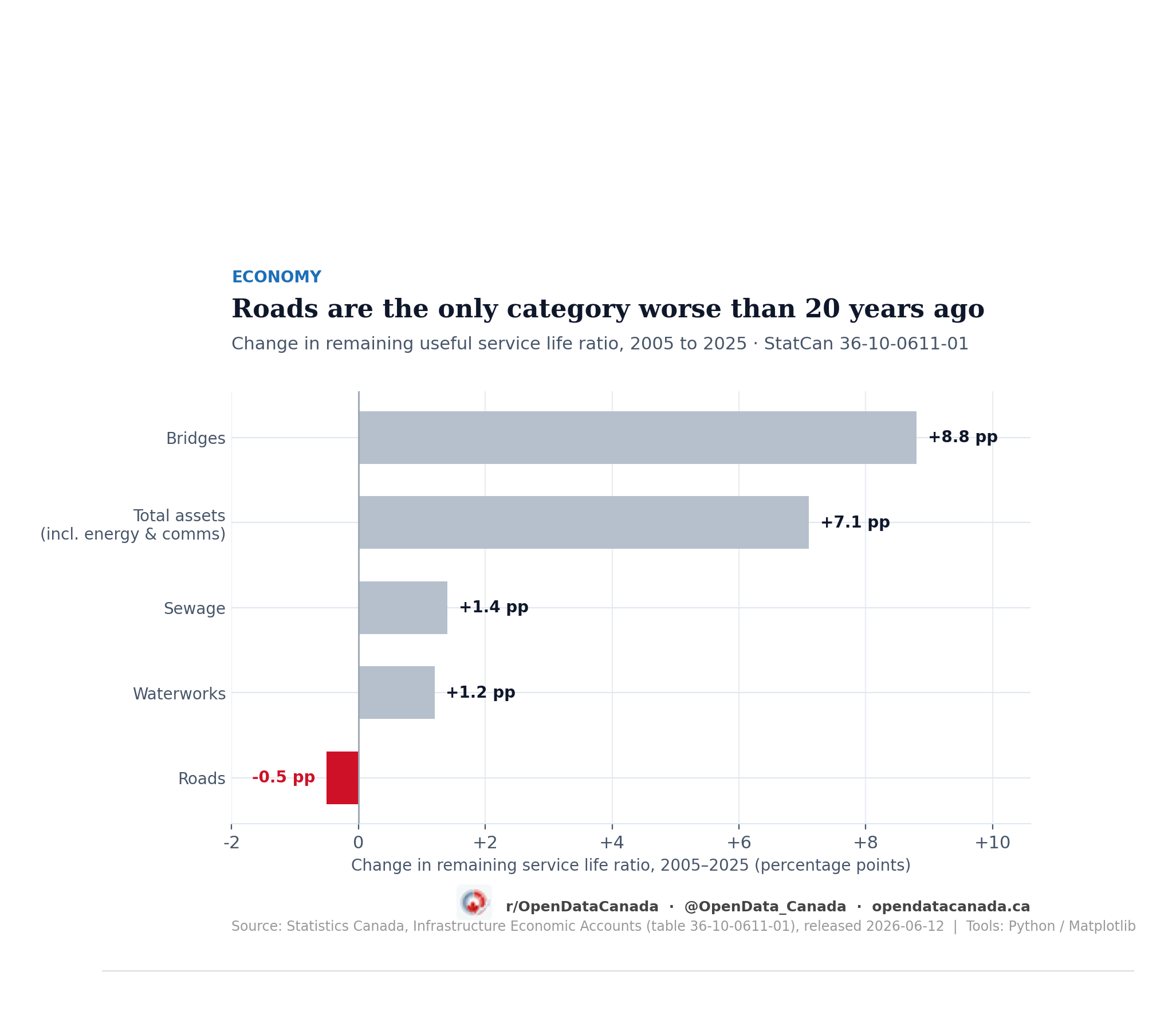
Over the full twenty years, roads are the only major category that ended lower in 2025 than it started in 2005. The drop itself is small, 0.5 percentage points, but it runs against every other category, and it follows a 6.8-point fall from the 2012 peak.
What the ratio does and doesn't capture
The remaining useful service life ratio is not an engineering condition report. Statistics Canada derives it from the capital stock accounts through a perpetual inventory model, measuring net book value as a share of gross capital stock, both at current replacement cost. A road can look economically aged on this measure while being well maintained, and the reverse is also true. The ratio tracks capital investment against economic depreciation. It says nothing about pavement roughness, structural integrity, or safety. For those, the sources to consult are Statistics Canada's Core Public Infrastructure Survey, which rates the physical condition of road assets directly, along with provincial and municipal pavement condition surveys.
What it does capture reliably is whether investment has kept pace with the economic aging of the stock. For roads, the data say it has not, for more than a decade.
One note on the data. Statistics Canada issued a correction in March 2022 affecting the 2021 vintage of this series. Across the five series examined here, there is no visible break around 2021 and 2022, and the 2025 figures are the most current release. The road trend runs thirteen straight years, long enough that a correction of that size would not change the direction.
The Carney government's infrastructure bet
The Carney government has made major infrastructure investment a centrepiece of its economic platform, including federal support for roads, transit, and water systems. The Infrastructure Economic Accounts do not track what governments promise to spend. They track what actually gets built, and how much economic life it holds. Roads are back at 2005 levels despite the spending rounds of 2009 and 2014 to 2018, which points to a straightforward gap: replacement and maintenance have not kept the network's economic age from rising.
Whether the latest commitments change that will show up in the 2026 and 2027 releases of this table.
Read next