Labour · 3 min read
Youth unemployment's biggest climb in 50 years — without a recession
Canada's youth unemployment rate rose from 10.0% in 2022 to 13.8% in 2025. We checked it against the full StatCan record back to 1976: every bigger 3-year rise in that history rode a recession. This one hasn't.
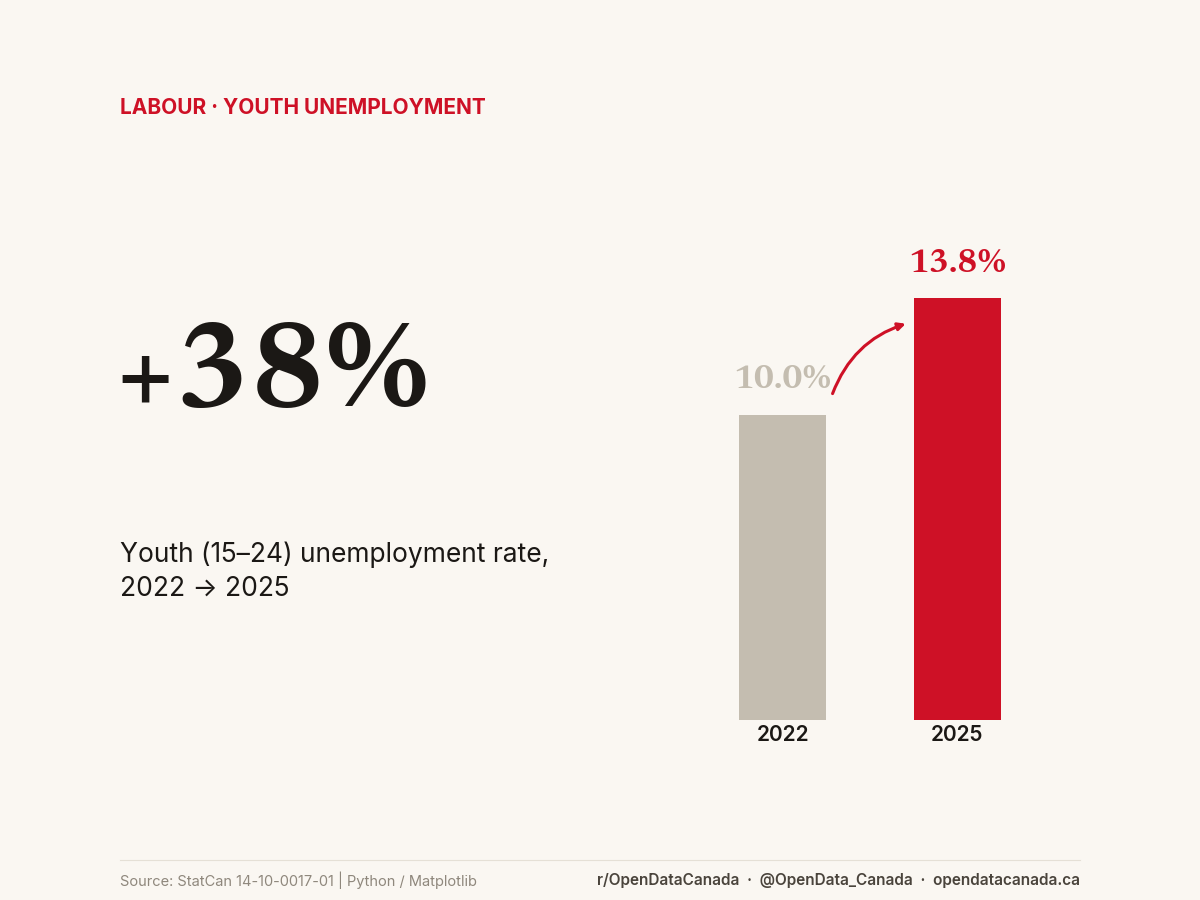
Canada's youth (15-24) unemployment rate climbed from 10.0% in 2022 to 13.8% in 2025, a 3.8-point rise. On its own, that number invites an obvious question: how unusual is this, historically?
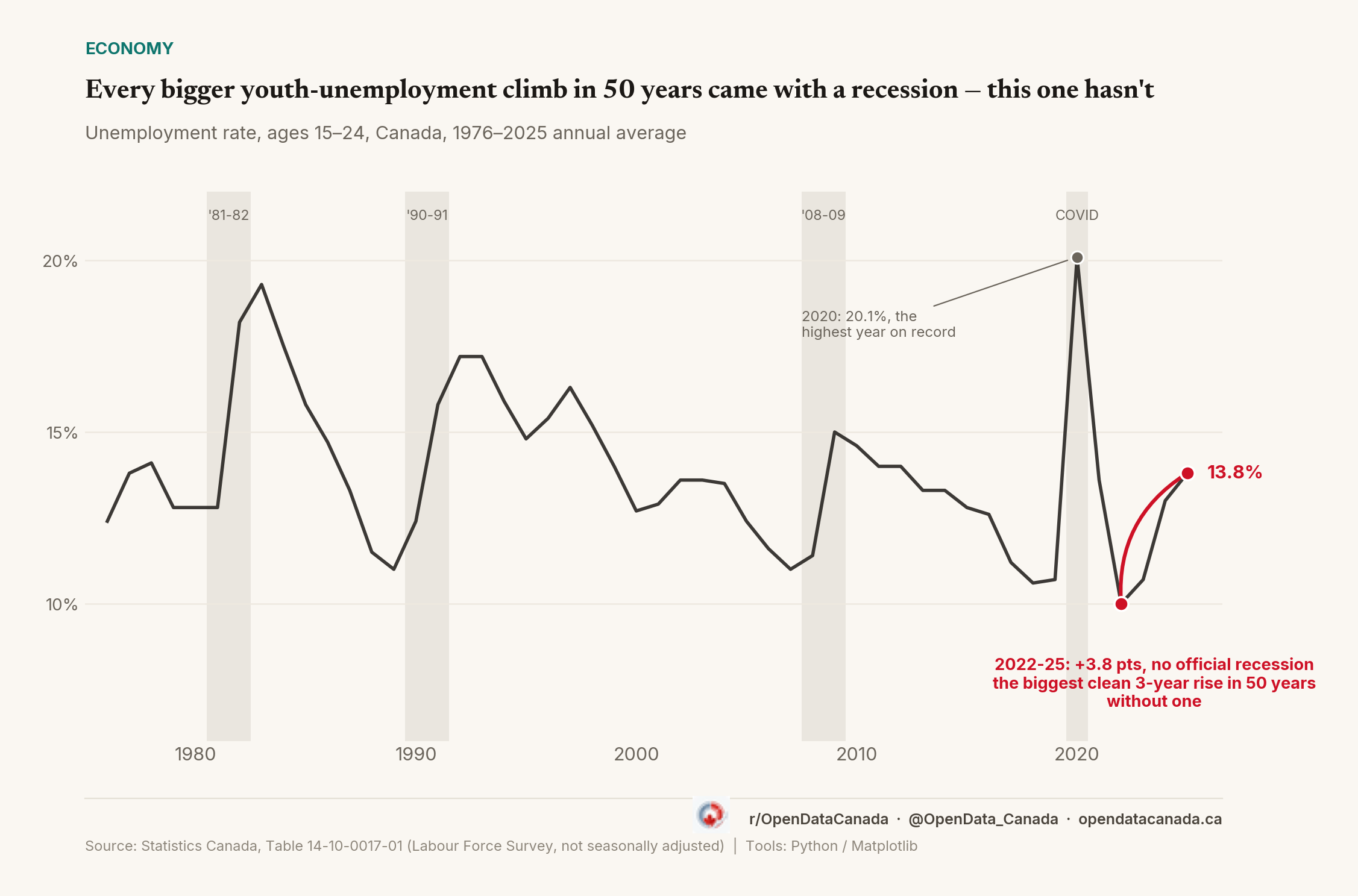
We pulled Statistics Canada's full youth unemployment series back to 1976 — 50 years of annual data — and checked every 3-year window in it, not just the recent one. The answer: this climb is real, and it is structurally unusual. Every 3-year rise in youth unemployment bigger than 2022-25's, going back half a century, happened during a defined recession — the early 1980s (+6.5 points), the early 1990s (+6.2 points), the 2008-09 financial crisis (+3.6 points), and COVID (+8.9 points, the sharpest on record). 2022-25 is the largest 3-year climb in the entire series that isn't tied to one.
No recession has been officially declared for 2022-2025. The C.D. Howe Institute's Business Cycle Council — Canada's conventional arbiter of recession dates — said as recently as September 2025 that a technical two-quarter GDP dip in mid-2025 still didn't meet its bar.
It's not just a national story
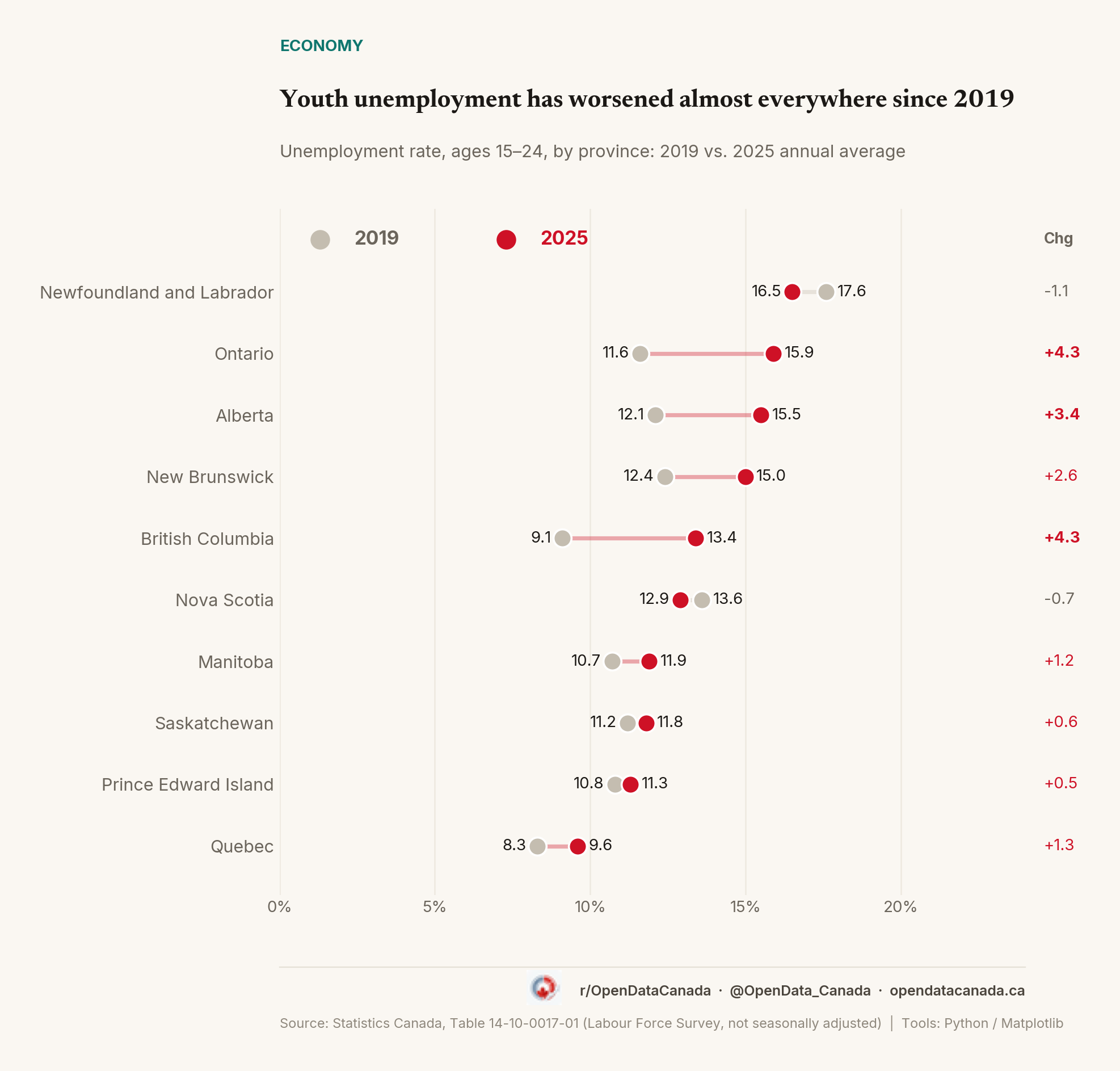
Comparing 2019 to 2025 province by province, youth unemployment worsened almost everywhere. Ontario and British Columbia rose the most, both by 4.3 points — Ontario from 11.6% to 15.9%, BC from 9.1% to 13.4%. Alberta rose 3.4 points, from 12.1% to 15.5%. Only two provinces — Nova Scotia and Newfoundland and Labrador — saw youth unemployment ease, and only slightly (−0.7 and −1.1 points). Quebec has the lowest rate in the country at 9.6%, but even it rose, from 8.3%.
What's driving it is contested
A Bank of Canada deputy governor has pointed to immigration volume — specifically the surge in non-permanent residents and international students — as a possible structural factor colliding with a slower hiring cycle. That theory dominates public discussion of the numbers too: in the highest-upvoted Reddit threads on the topic, the most common complaint isn't the headline number, it's that entry-level jobs that used to go to teenagers increasingly don't. None of this is proof of causation — the unemployment rate itself doesn't say why it rose — but it's the dominant public read on it.
2020 remains the worst single year for youth unemployment on record, at 20.1%. But 2022-2025 is the most structurally unusual pattern in the data: a rise this size with no downturn behind it, landing hardest in Ontario and British Columbia, and easing almost nowhere.