Article · Politics · 6 min read
The outsized power of the supply lobby
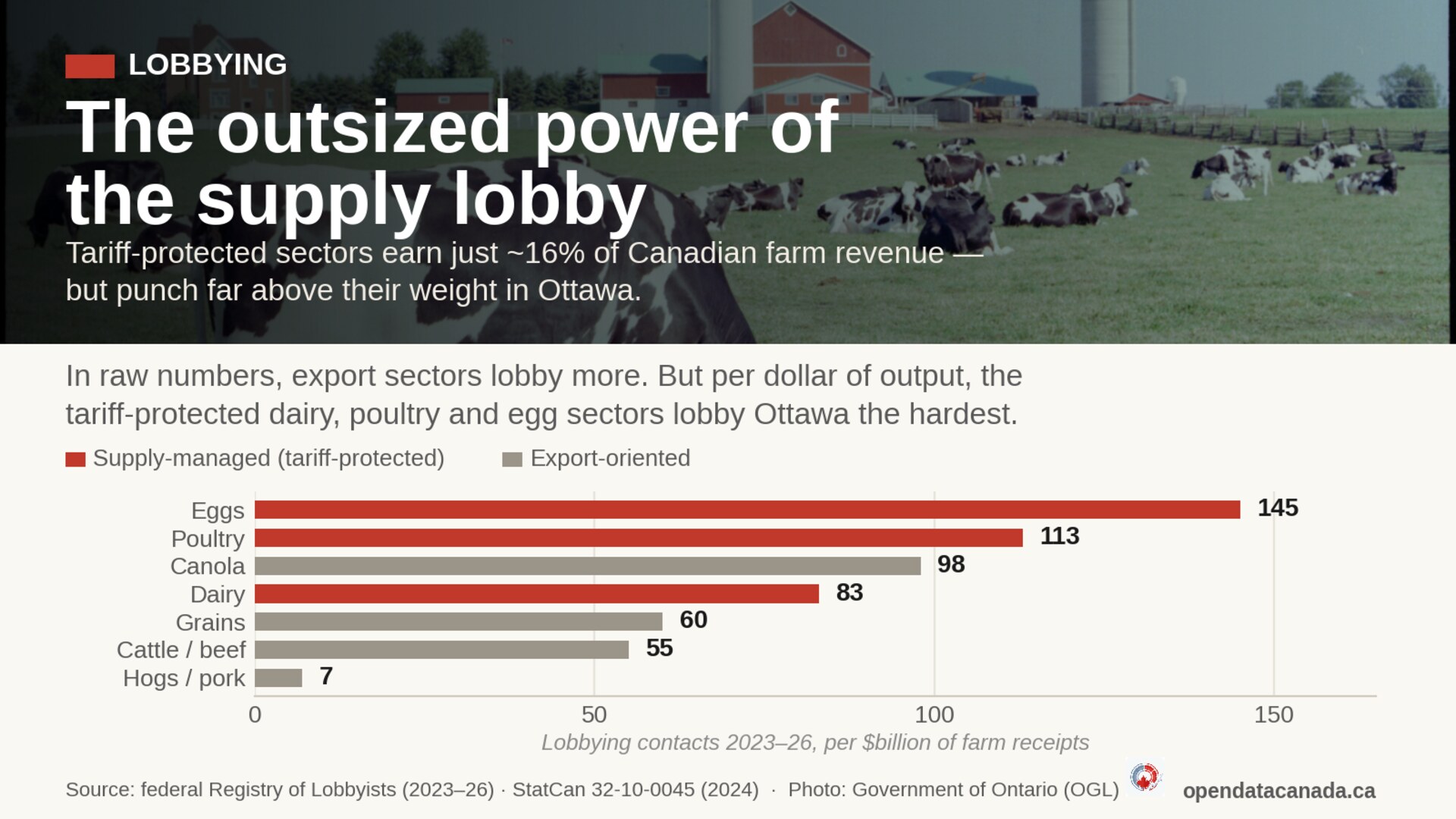
Tariff-protected dairy, poultry and eggs earn about 16 percent of Canadian farm revenue. Measured against that revenue, they lobby Ottawa harder than any other part of agriculture, and the pace is climbing ahead of a 2026 trade review.
Milk, cheese, chicken and eggs all cost more in Canada than in the United States, and the reason is a policy called supply management: production quotas plus import tariffs of 200 to 300 percent that keep foreign competitors out. Less obvious is how much work goes into keeping that system in place. A monthly tracker shows which Canadian grocery items have risen the most since 2020.
We matched three and a half years of filings from the federal Registry of Lobbyists against each farm sector's cash receipts, as reported by Statistics Canada. The protected sectors earn a small share of Canada's farm income. Set the lobbying against that income, and they turn out to be the most active farm lobby in the country.
In raw numbers, the exporters lobby more
Supply management does not dominate the lobbying registry. By raw volume, the export sectors do far more of it. Canola on its own logged about 1,264 communications over the period, more than every dairy group combined. Add beef, grains and hogs, and the export side out-contacted the supply-managed sectors by roughly two to one.
Those are also much bigger industries, so the raw counts mostly track their size. The more telling figure is how much each sector lobbies relative to what it earns.
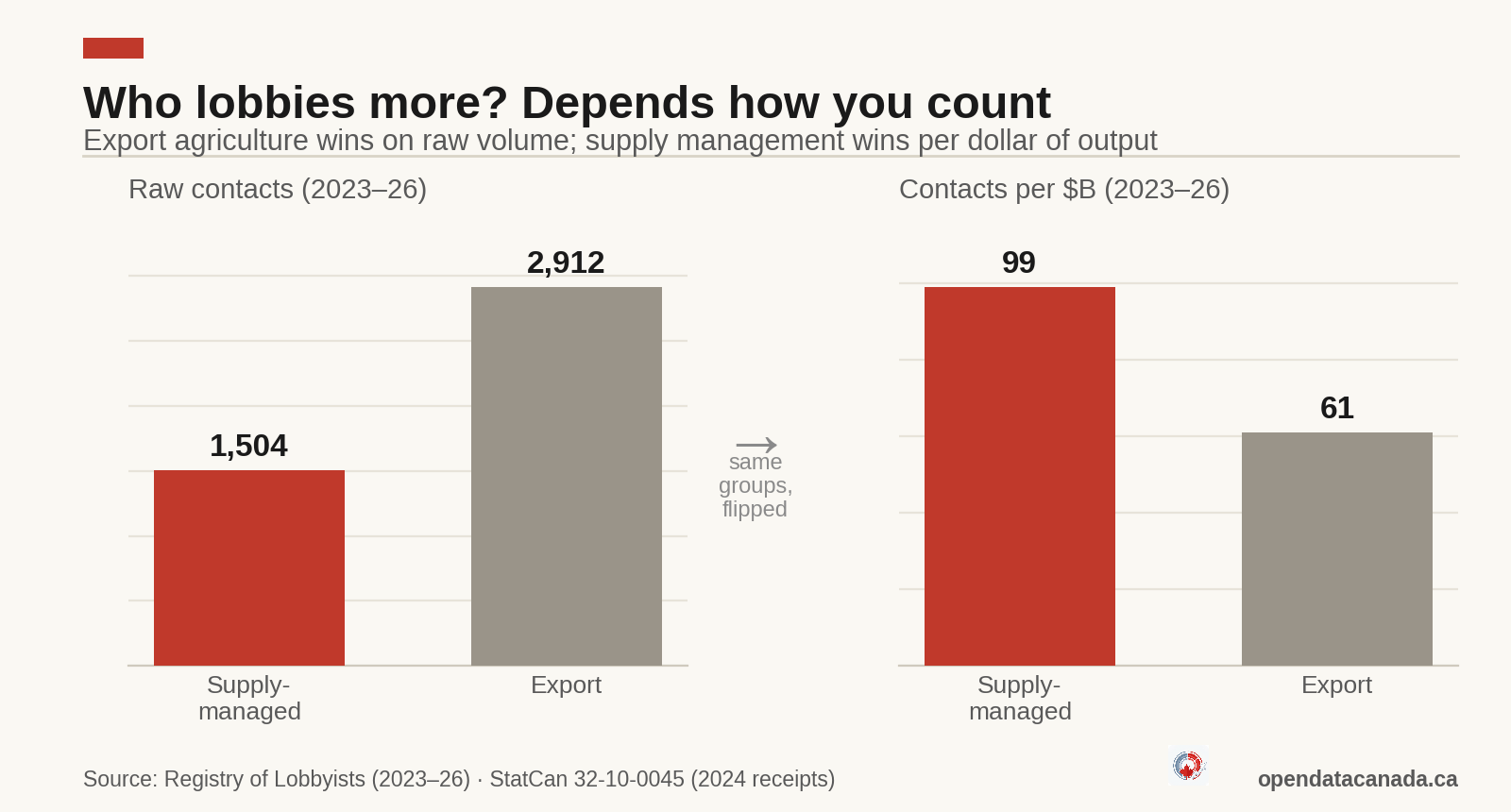
On that measure the order reverses. Across the three and a half years, the supply-managed sectors recorded about 99 contacts for every billion dollars of receipts. The export sectors recorded 61. For their size, in other words, the protected sectors lobbied about 1.6 times as hard.
The intensity ranking
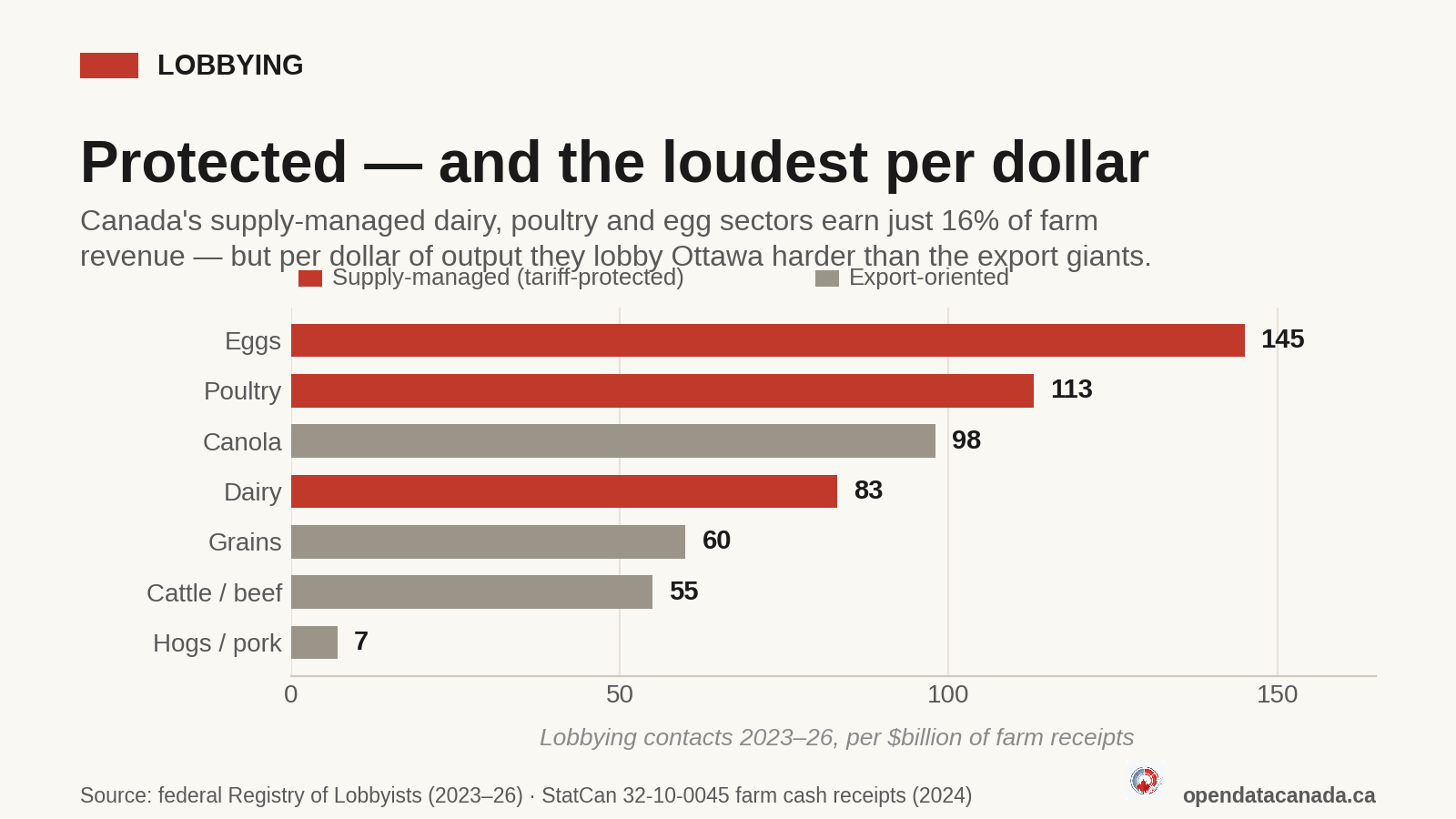
Split the numbers out by commodity and the two most lobbying-intensive farm sectors in the country are both supply-managed: eggs and poultry. Canola is the odd one out on the export side, lobbying almost as hard for its size as dairy does. Even so, the protected sectors fill the top of the table, and export hogs sit at the bottom.
These sectors also lobby through one national marketing board each, such as Dairy Farmers of Canada or Egg Farmers of Canada, rather than the scattered firms and associations that speak for canola or beef. Reaching contact totals this high from a single organized voice per sector, rather than hundreds of separate companies, makes the effort look all the more deliberate.
There is a lot to protect. Production quota is an asset that farmers buy and sell. In Ontario, dairy quota trades near the regulated cap of 24,000 dollars per kilogram of butterfat a day, which puts the quota on a typical family farm at 2 to 3 million dollars before land, barns or cattle. Nationally the quota system is worth somewhere around 35 billion dollars. Those values hold only as long as the tariff wall does, so the sectors have every reason to defend it.
They lost the first bill, then passed a second
The lobbying does not run at a steady level. It arrives in waves, and the waves line up with one campaign: an effort to write supply management's protection into law so that no future government can bargain it away at the trade table.
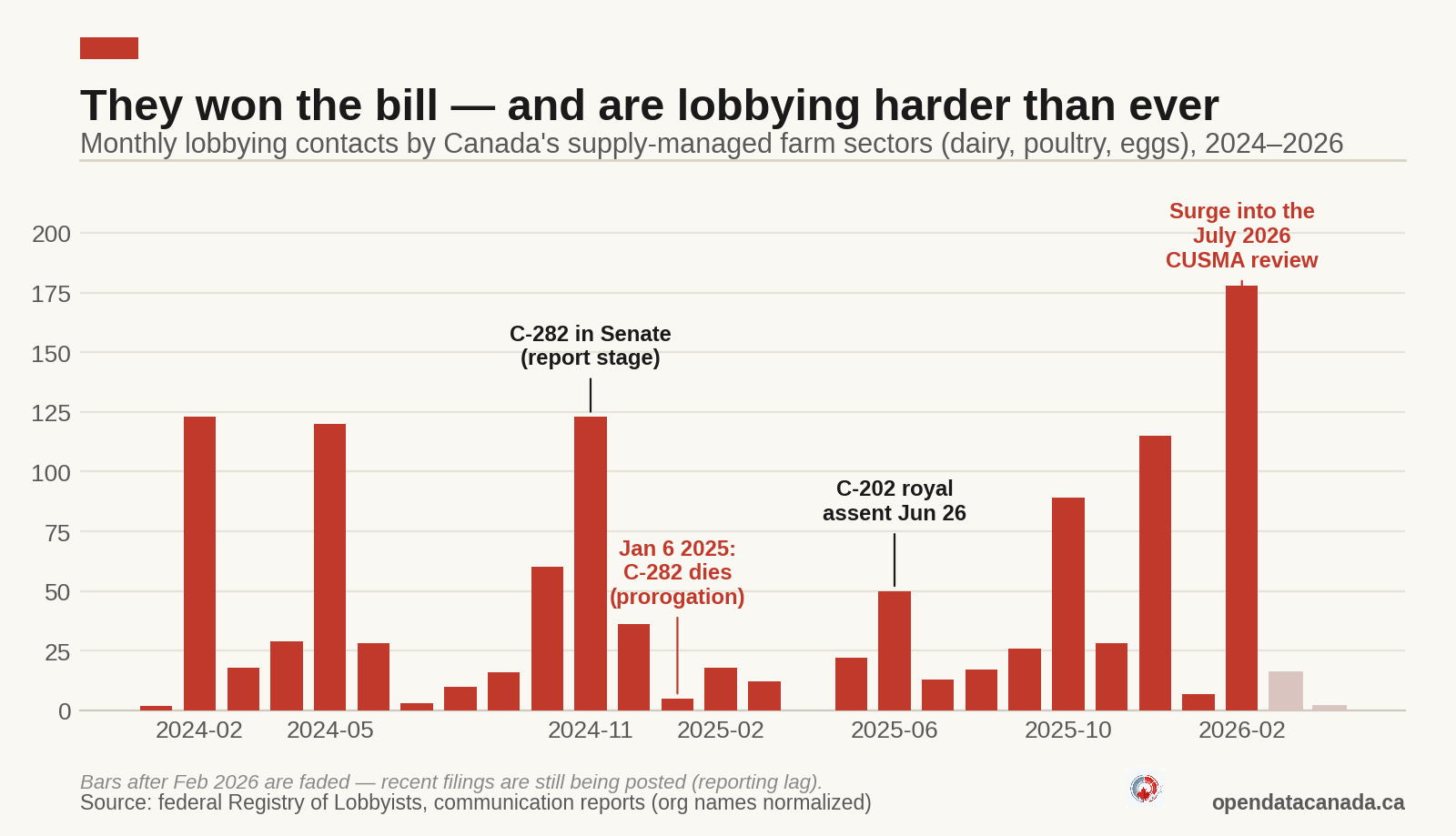
The first try, Bill C-282, passed the House in 2023 and made it deep into the Senate before dying on the order paper when Parliament was prorogued on 6 January 2025. The sectors regrouped behind a near-identical bill. Bill C-202 was reintroduced in 2025, cleared the Commons in a single day, and received royal assent on 26 June 2025. It is now law, and it stops the trade minister from giving up any tariff-rate-quota access on supply-managed goods.
Winning the bill did not slow things down. If anything the lobbying picked up. The busiest single month in the whole record is February 2026, eight months after C-202 became law, as the sectors get ready for the mandatory CUSMA (USMCA) joint review on 1 July 2026. Canada's dairy and poultry protections are expected to be back on the table there. Canada's forced-labour import ban rests on the same CUSMA framework.