Investigation · Population & Migration · 6 min read
Canada TFW: How a Low-Wage Hiring Ban Pushed Restaurant Managers Into the High-Wage Stream
When Ottawa banned low-wage foreign-worker hiring in struggling cities in September 2024, approvals for low-wage restaurant managers collapsed. The same job reappeared in the high-wage stream, which the ban does not cover.
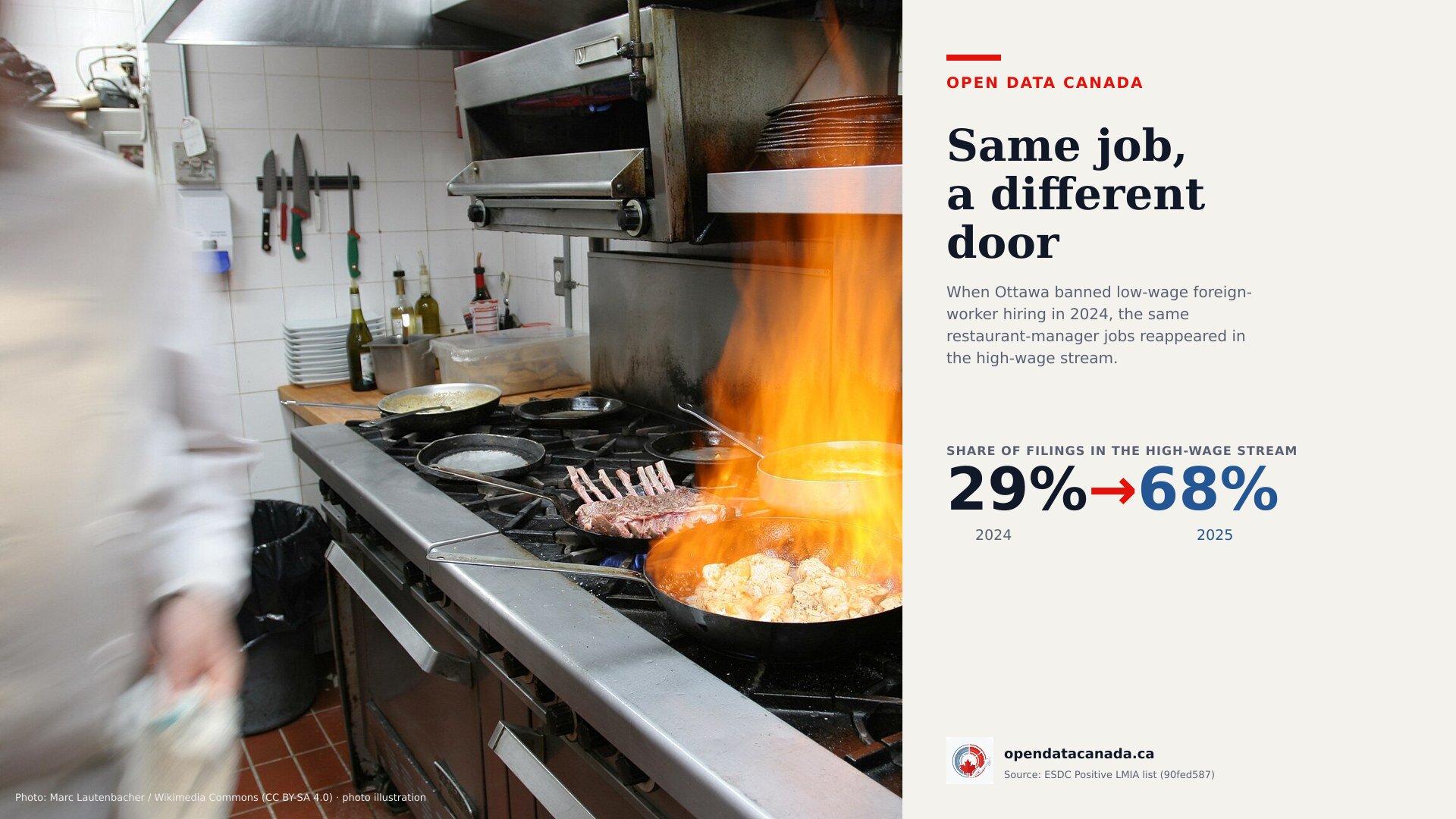
On 26 September 2024, the federal government closed off a category of hiring. Employers could no longer obtain a low-wage Labour Market Impact Assessment — the permit required to hire a temporary foreign worker — for a job in any large city where unemployment had reached 6 per cent or higher. The stated goal was plain: if locals are out of work, stop importing cheaper labour.
By the numbers, the policy worked. Approved low-wage positions across the program fell from about 27,300 in the first quarter of 2024 to roughly 8,000 to 9,000 a quarter through 2025, a drop of nearly 70 per cent, concentrated in the big-city provinces the ban targeted.
The federal government's own quarterly employer lists, however, show one occupation responding to the ban in a way its architects may not have anticipated.
The flip
Every approved foreign-worker position is filed in one of two streams: low-wage or high-wage. The only thing separating them is the pay an employer offers relative to a federal line — the provincial median hourly wage. Offer a dollar below it, the job is low-wage. Offer a dollar above, the same job is high-wage, and the September ban no longer applies.
For "restaurant and food-service managers," the streams swapped places within months. Through 2024, most of these positions were filed as low-wage. In 2025, that reversed: high-wage filings surged while low-wage ones drained away, and the total number of manager positions barely moved.
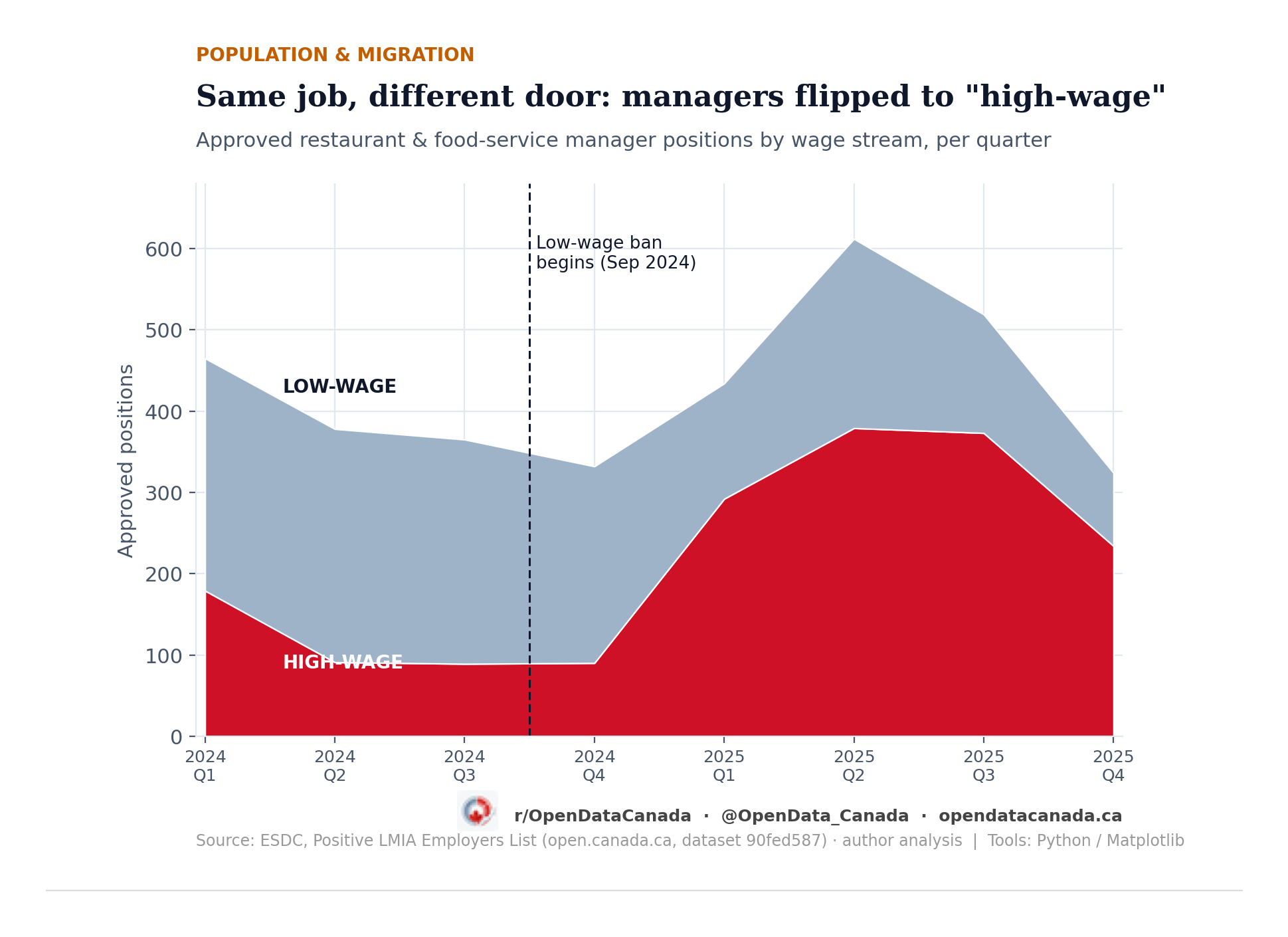
The high-wage surge is large by any historical measure. High-wage manager filings ran between roughly 50 and 180 a quarter for the four years from 2021 through 2024. Every quarter of 2025 ran higher than that entire prior range, between 234 and 379, and the increase was concentrated in Ontario, British Columbia and Alberta, the provinces whose largest cities the ban had closed. In the rest of the country, where the ban bites less, the same occupation barely moved.
Why managers, and not cooks
If employers were relabelling every category of worker, every low-wage occupation would have shifted at roughly the same rate. They did not. The pattern follows the math of the wage line with a precision that tracks the underlying economics.
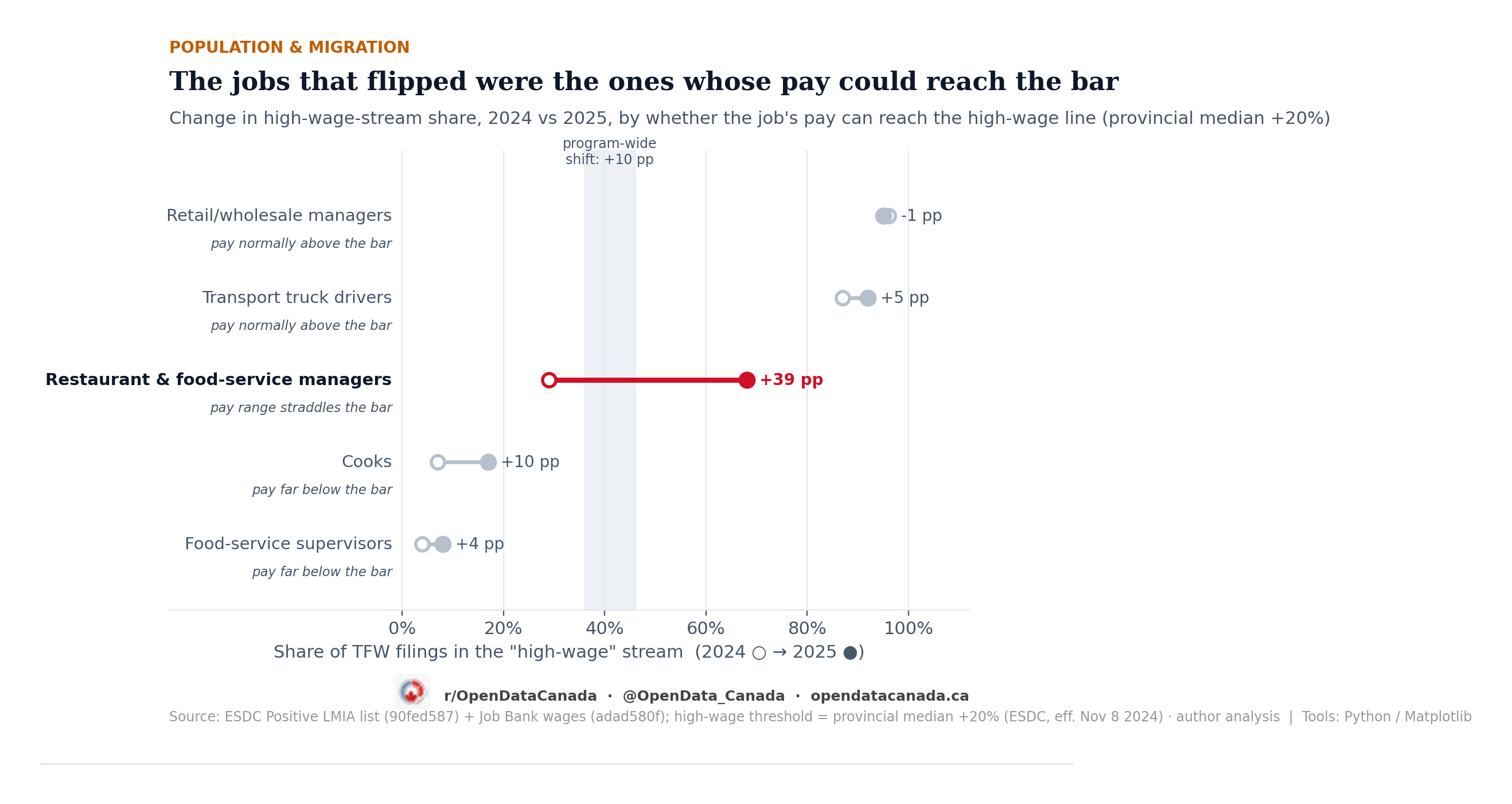
According to the federal Job Bank, a restaurant manager's typical wage already sits close to the threshold — near the top of a band that overlaps it. Nudging one position over the line costs little. A cook, who typically earns around 18 dollars an hour, sits far below the bar; filing a cook as high-wage would mean paying well above the going rate, and the rules forbid inflating a wage solely to change streams. So managers' high-wage share leapt 39 percentage points, four times the program-wide drift of 10 points. Cooks rose 10 points; food-service supervisors, four. Occupations that already pay above the line, such as retail managers and truck drivers, had no room to move and stayed flat.
That gradient, where the closer a job sits to the wage line the harder it flipped, is consistent with targeted reclassification rather than a general policy quirk, which would lift every occupation at roughly the same rate.
The bar was also rising during this period. The line dividing the streams was the provincial median wage when the ban took effect in September 2024; on 8 November 2024 it was raised to the median plus 20 per cent. The high-wage share climbed anyway, meaning employers cleared a higher bar to keep hiring.
What the data cannot say
This is a strong pattern, and the honest limits matter.
The public employer list records the wage stream — low or high — but never the actual dollar figure an employer offered. The data can show which stream a filing used; it cannot show an employer paying exactly enough to clear the line. The case rests on the shape of the movement, its timing, its geography, and its tracking of the wage math, rather than any single paycheque.
The numbers are also modest in absolute terms. Stripping out the program-wide drift, the manager shift attributable to the ban amounts to a few hundred positions a year nationally, real and concentrated but limited in scale. And "manager" is an elastic title; some of the increase reflects genuine managerial hiring.
What the data supports is narrow and sturdy: after Ottawa shut the low-wage stream for restaurant managers in struggling cities, the same job reappeared, in the same provinces, through the high-wage stream, concentrated in the one title cheap enough to reclassify. The crackdown redirected the hiring more than it stopped it.