Article · Sport · 5 min read
Canada was 90th in the world in 2013. It hosts the 2026 World Cup as its strongest team ever.
When Canada plays a men's World Cup match on home soil for the first time this June, it does so as the strongest team in its history. A decade ago it sat 90th in the world, behind Trinidad and Tobago and Gabon. Measured in Elo, soccer's results-based strength rating, the climb since has carried Canada past the United States and into second place in North America, behind only Mexico.
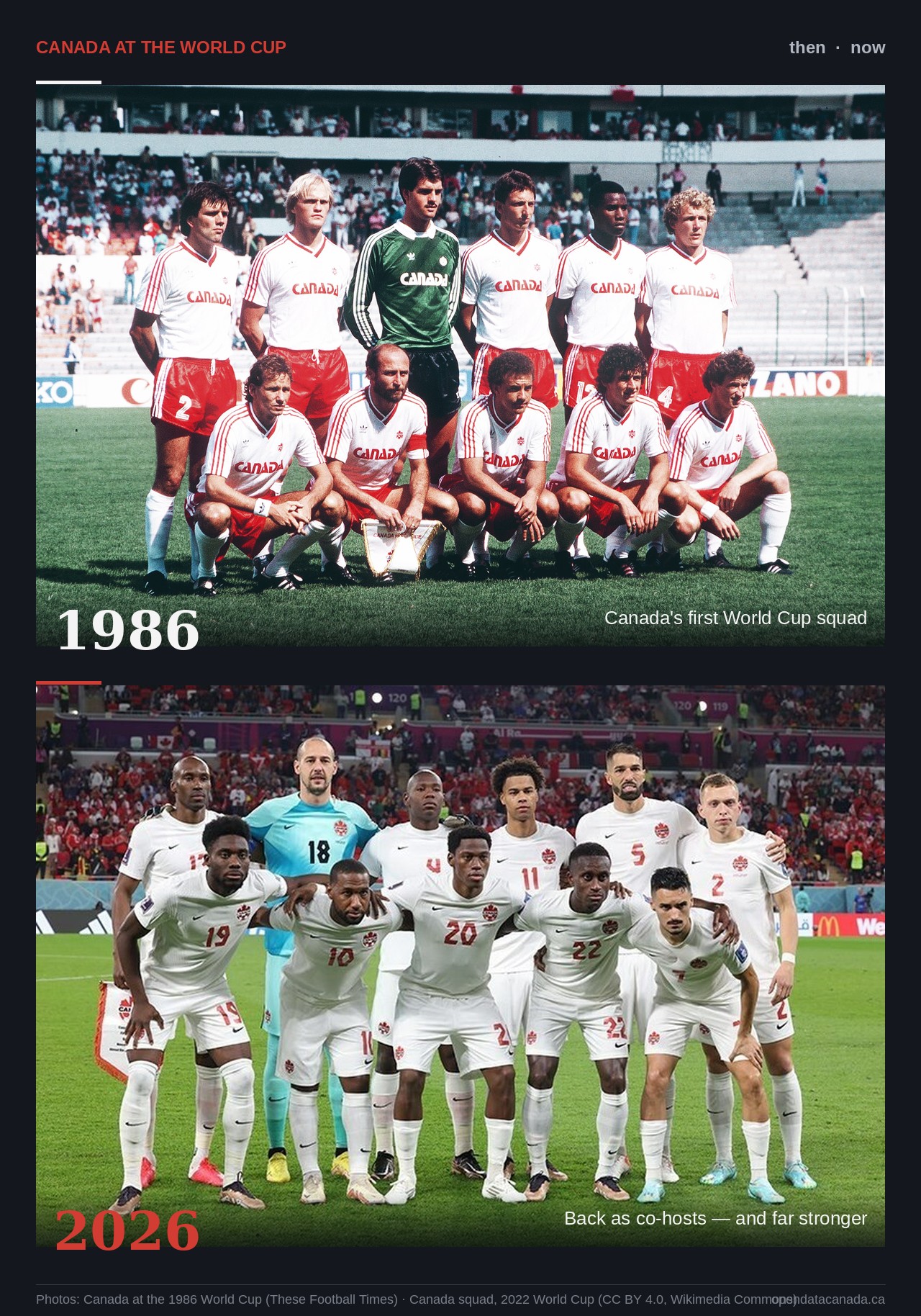
This June, Canada plays a men's World Cup match on home soil for the first time, as co-host with the United States and Mexico. It is easy to under-read the milestone. Canada had reached exactly one men's World Cup before, Mexico 1986, where it lost all three games and scored no goals, and then spent most of the next three decades as one of the weaker national teams on the planet.
A better measuring stick than the FIFA ranking
The FIFA World Ranking is the number everyone quotes, but it is a blunt tool. It only starts in 1992, and it runs on a formula FIFA has rewritten twice. So this piece uses Elo instead, the rating system from chess, adapted to soccer. A team's Elo rises and falls after every match based on the result, the goal margin, the opponent's strength and how much the game mattered. It is a measured strength score rather than a leaderboard position, it runs back to the 1980s, and it tracks the FIFA ranking closely (the two correlate at 0.97) while extending further back and reacting faster.
The climb, measured in Elo
Canada's rise was not steady. It was a long decline and a sharp recovery.
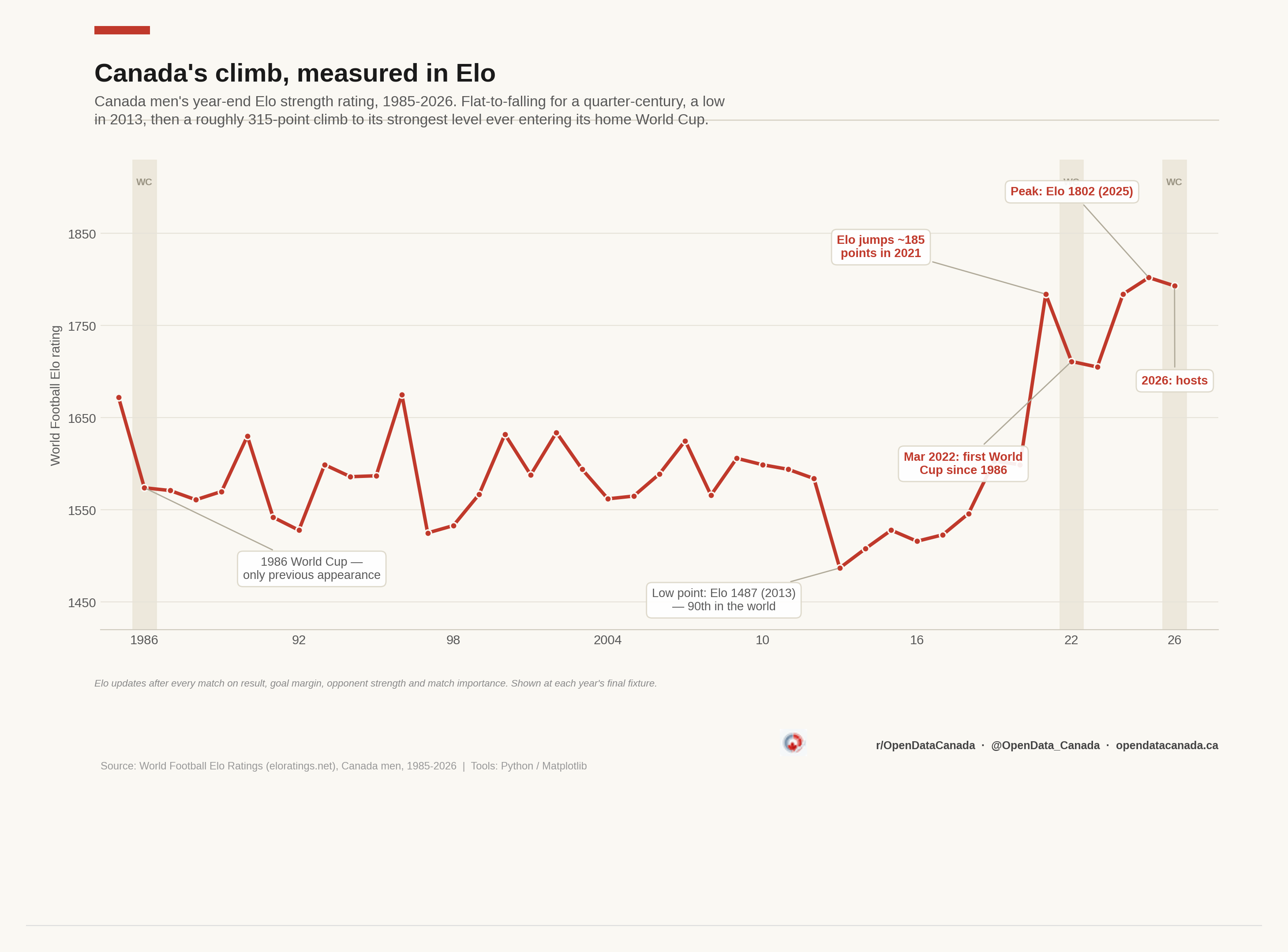
The team bottomed out in 2013 at an Elo of 1487, the 90th-best side in the world, and the following August its FIFA ranking hit an all-time low of 122nd. Then it turned. Canada's rating jumped about 185 points in 2021 alone, as a generation including Alphonso Davies and Jonathan David matured. In March 2022 a 4–0 win over Jamaica clinched a World Cup place for the first time in 36 years, with Canada finishing top of the final CONCACAF group, ahead of the U.S. and Mexico. By 2025 its Elo peaked at 1802, its highest ever, a gain of roughly 315 points from the trough that lifted Canada from 90th in the world into the top 25.
Caught up to its neighbours
The clearest place to see the change is North America itself. Tracking the three CONCACAF heavyweights since 1986 shows that Canada did not rise into a strengthening field. It rose while its neighbours stood still or slipped.
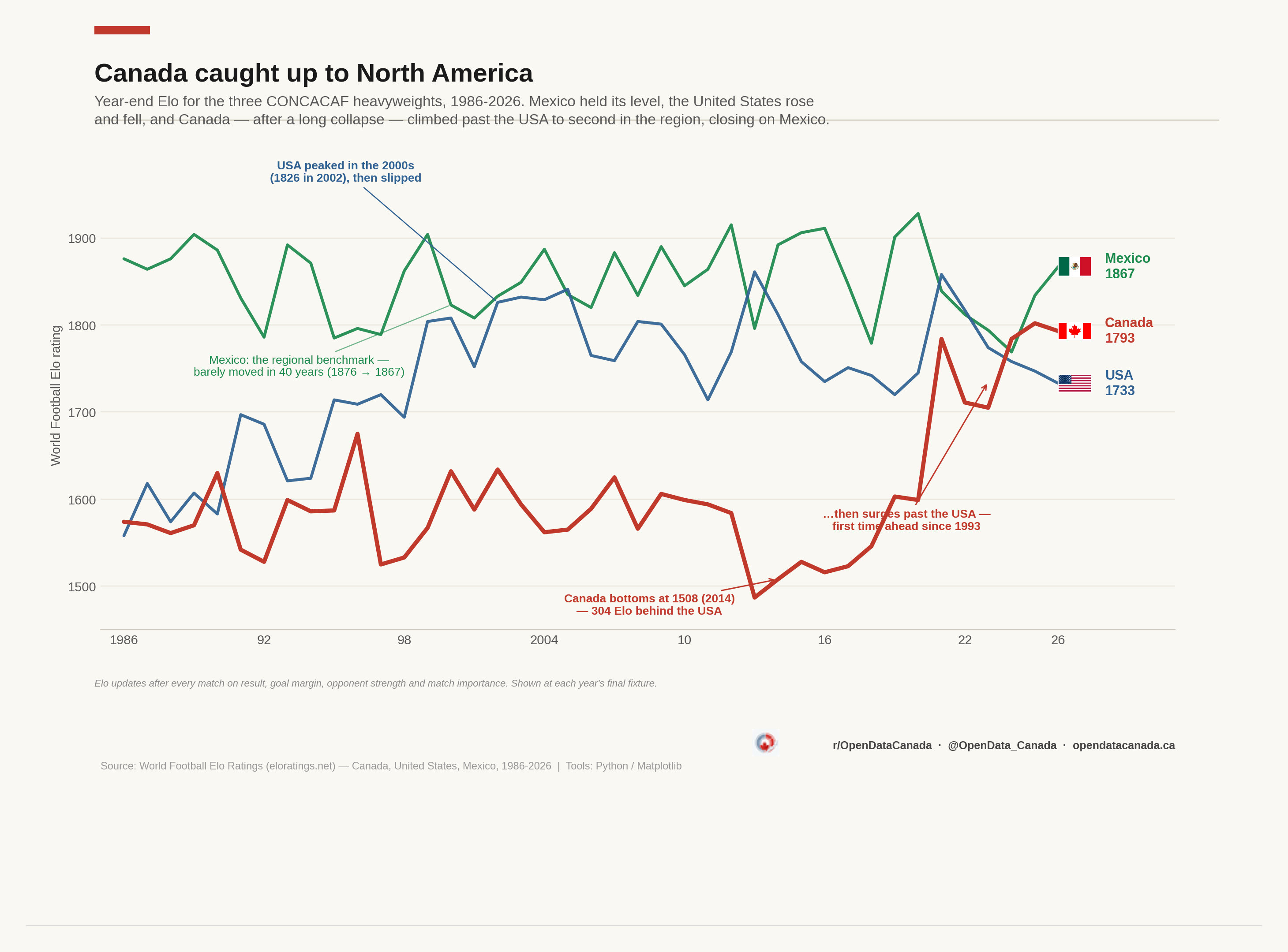
The Canada and USA story is a crossing, not a clean overtaking. Canada was narrowly ahead of the U.S. in 1986, by 1574 to 1558, but both were mediocre. The United States then passed Canada around its 1994 home World Cup and led the rivalry for nearly thirty years, by as much as 304 Elo points in 2014, when the U.S. sat 19th in the world and Canada had sunk to 84th. Only in the last few seasons has Canada climbed back above the U.S., its first time ahead since the early 1990s.
Mexico, meanwhile, barely moved: 1876 in 1986, 1867 today. That flatline is the point. The gap from Canada to the regional benchmark has shrunk from roughly 300 Elo points to about 75, leaving Canada second in CONCACAF behind only Mexico. The bar did not rise. Canada finally climbed to it.
The climb wasn't a straight line
A fairy tale would end at the World Cup. The data does not. Qualifying for Qatar in 2022 locked in nothing. Canada lost all three group games and its Elo dipped through 2022 and 2023 before resuming the climb. The rise is real, but it came with a visible setback, and the strongest form arrived only afterward.
What the data can't tell you
A rating is a thin instrument, so three honest caveats:
- It rode one generation. Much of the jump traces to a single unusually talented cohort: Davies, David and their peers. Whether the next generation sustains it is unknown.
- Hosting is a one-time push. Co-hosts qualify automatically and play in home conditions. Some past hosts turned that into a lasting step up; others did not. 2026 is a tailwind, not a verdict.
- Elo rewards recent results. A strong run lifts the number fast, and a bad one can pull it back down just as quickly.
What the data does say, clearly, is this. A team that was 90th in the world a decade ago enters its home World Cup stronger than it has ever been, having overtaken the United States and closed to within touching distance of Mexico. For a program with one prior World Cup appearance and no goals to show for it, that is the whole story. We also looked at how federal funding for soccer compares to other sports.