Article · Sport · 6 min read
Soccer is Canada's most-registered sport. Its federal funding ranks 13th.
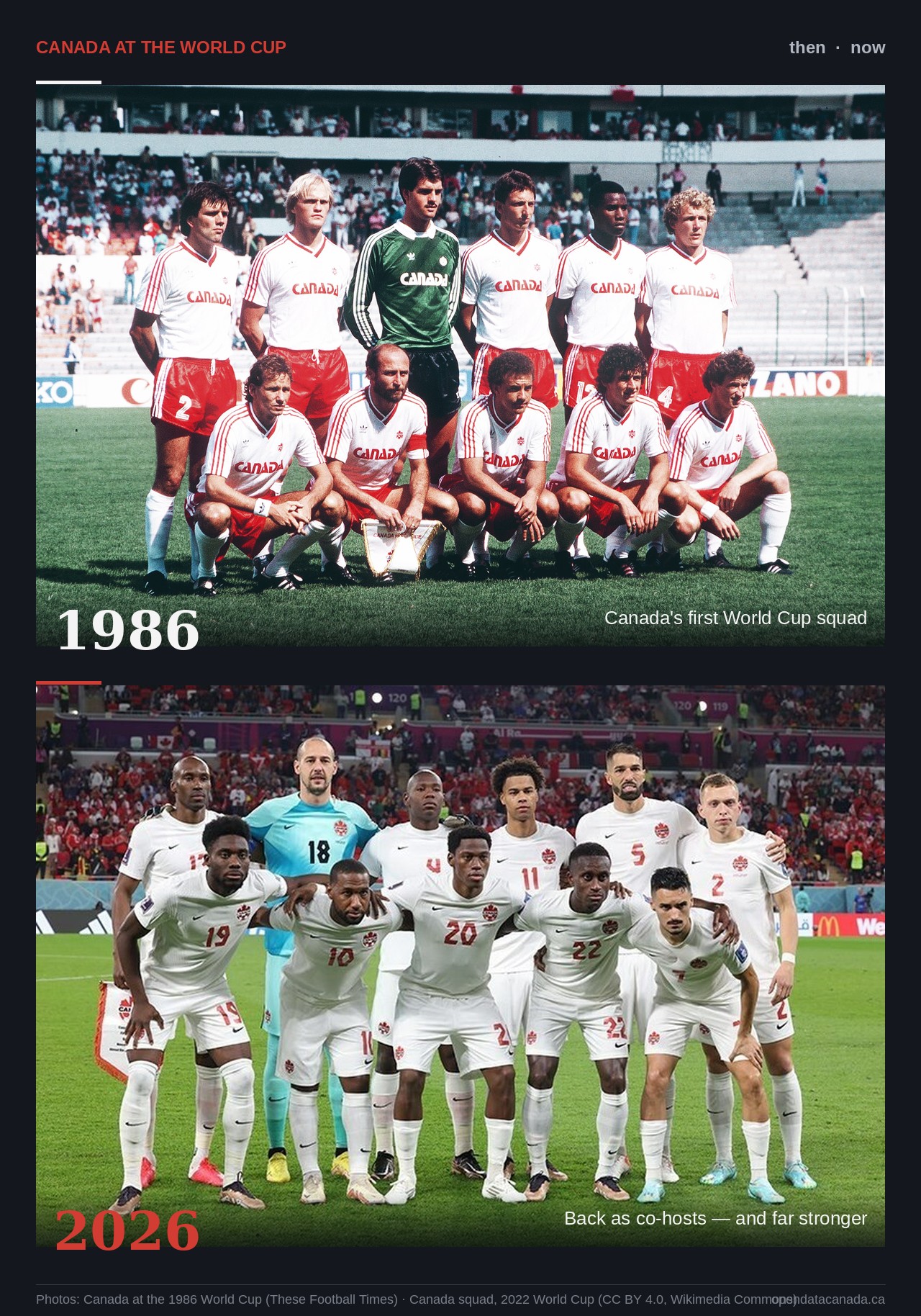
The World Cup Canada co-hosted ends this weekend. Federal grant records show soccer gets about 3 dollars a player in program funding, less than diving or curling, while 220 million dollars went to hosting the tournament.
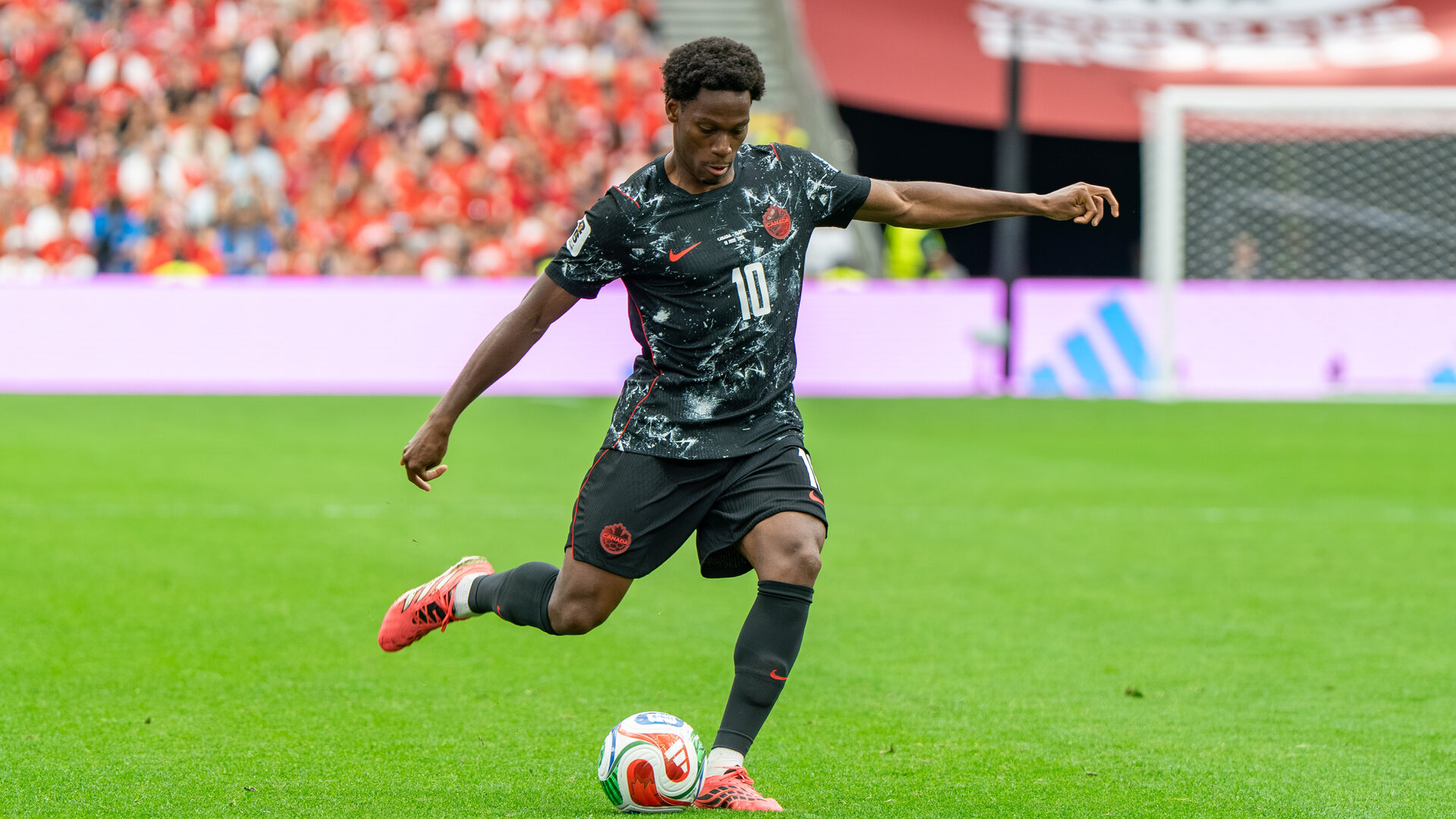
The biggest sporting event ever held on Canadian soil wraps up this weekend: thirteen matches in Toronto and Vancouver, a men's team playing a World Cup at home, and a federal government that wrote nine-figure cheques to make it happen.
So this seemed like the weekend to ask a simple question of the public record. How does Ottawa actually fund soccer the other 51 weeks of the year?
Every federal grant and contribution is disclosed in an open database. We pulled all 1.3 million rows of it, kept the 134,212 agreements signed by Canadian Heritage, and isolated the Sport Support Program, the core funding stream for the national organizations that run each sport. Since 2018, when disclosure practice was standardized, that program has committed 1.7 billion dollars.
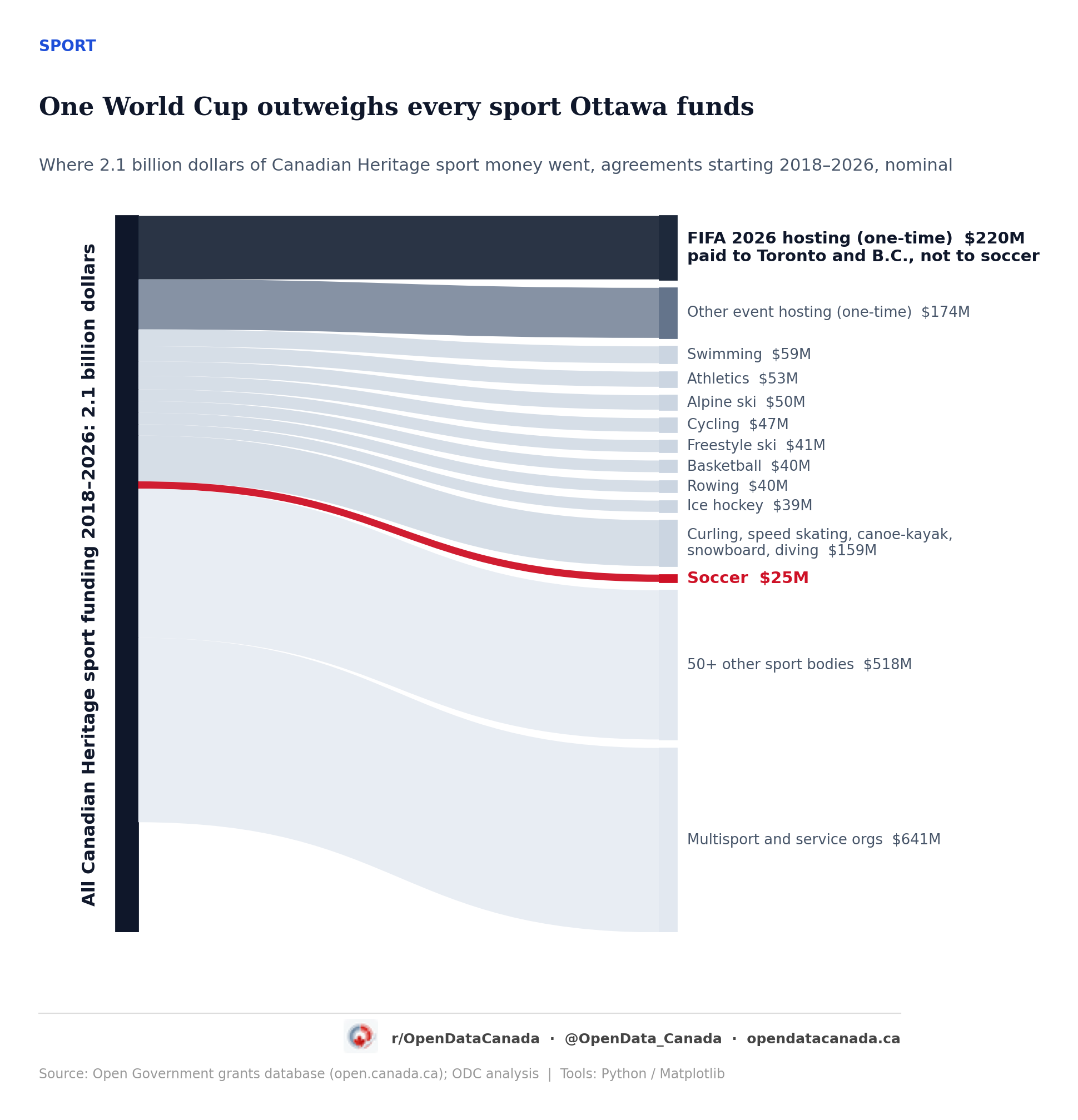
Follow the money end to end, hosting included, and federal sport spending looks like this. The red thread is soccer.
Here is where soccer landed.
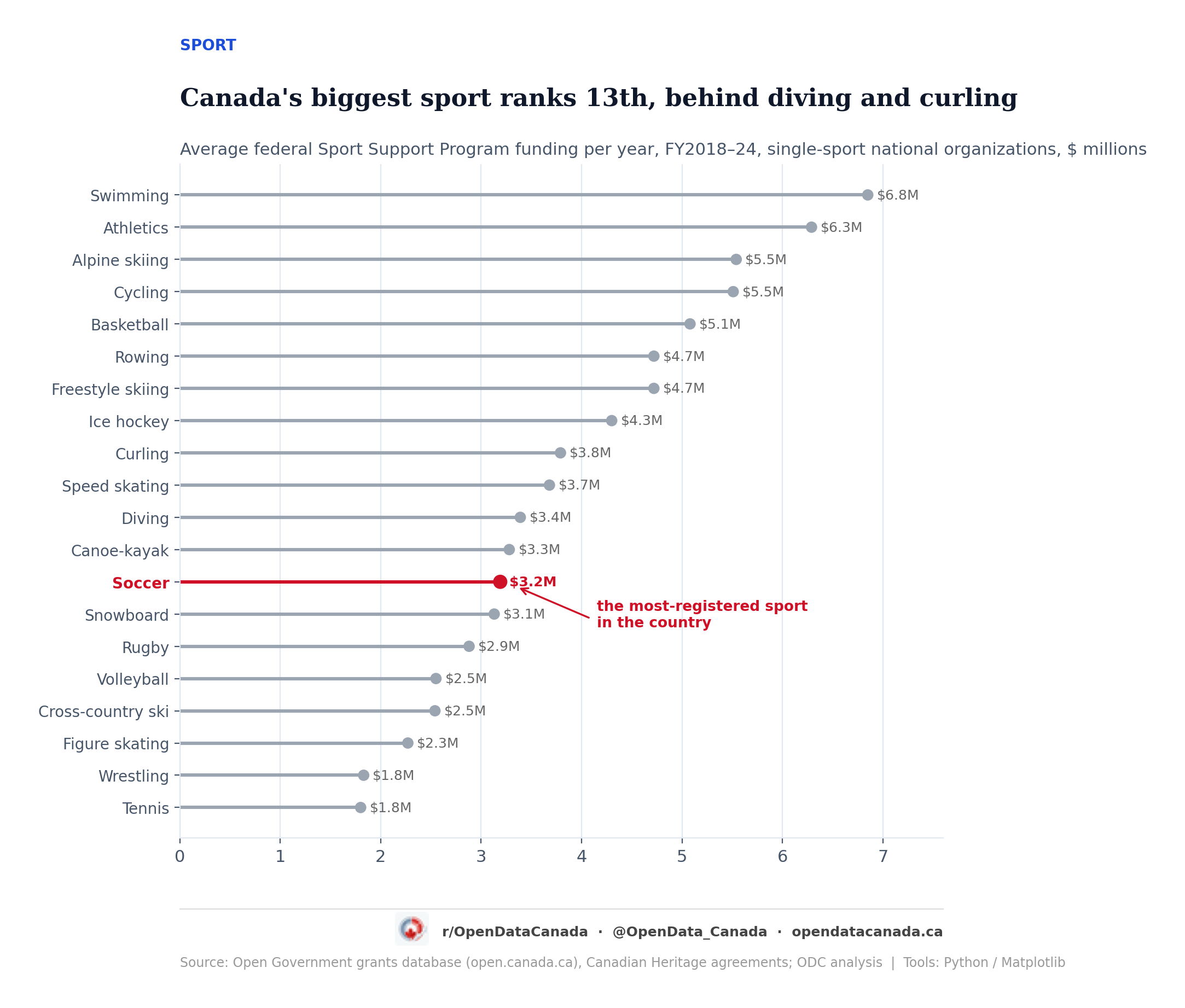
Canada Soccer, the governing body of the sport with more registered participants than any other in the country, averaged 3.2 million dollars a year in program funding from fiscal 2018 through 2024. That is 13th place among single-sport organizations. Swimming averaged 6.8 million, athletics 6.3 million, alpine skiing 5.5 million. Diving, curling and speed skating all out-earned soccer. Canada Basketball averaged 5.1 million and Hockey Canada 4.3 million, each roughly a third more than the sport that dwarfs them both at registration desks.
The formula behind the gap
This is not an oversight. It is the system working as designed.
Sport Canada allocates core funding substantially on high-performance results, Olympic and Paralympic medal potential above all. Swimming, athletics and the winter sports deliver Canada's medals, so they top the table. On that logic, the list makes sense. To be fair to the formula, the sports adult Canadians do most, swimming, cycling and running, sit at or near the top of the funding table too.
The logic only breaks when you ask what the money works out to per player.
Hockey Canada counted 603,149 registered players in its 2024-25 annual report. Swimming Canada counted 67,055 registered members. Canada Soccer reports nearly one million registered active participants, the largest base of any sport in the country. Divide each organization's federal program funding by its own registration count and the result is about 102 dollars per swimmer, 7 dollars per hockey player, and 3 dollars and 20 cents per soccer player.
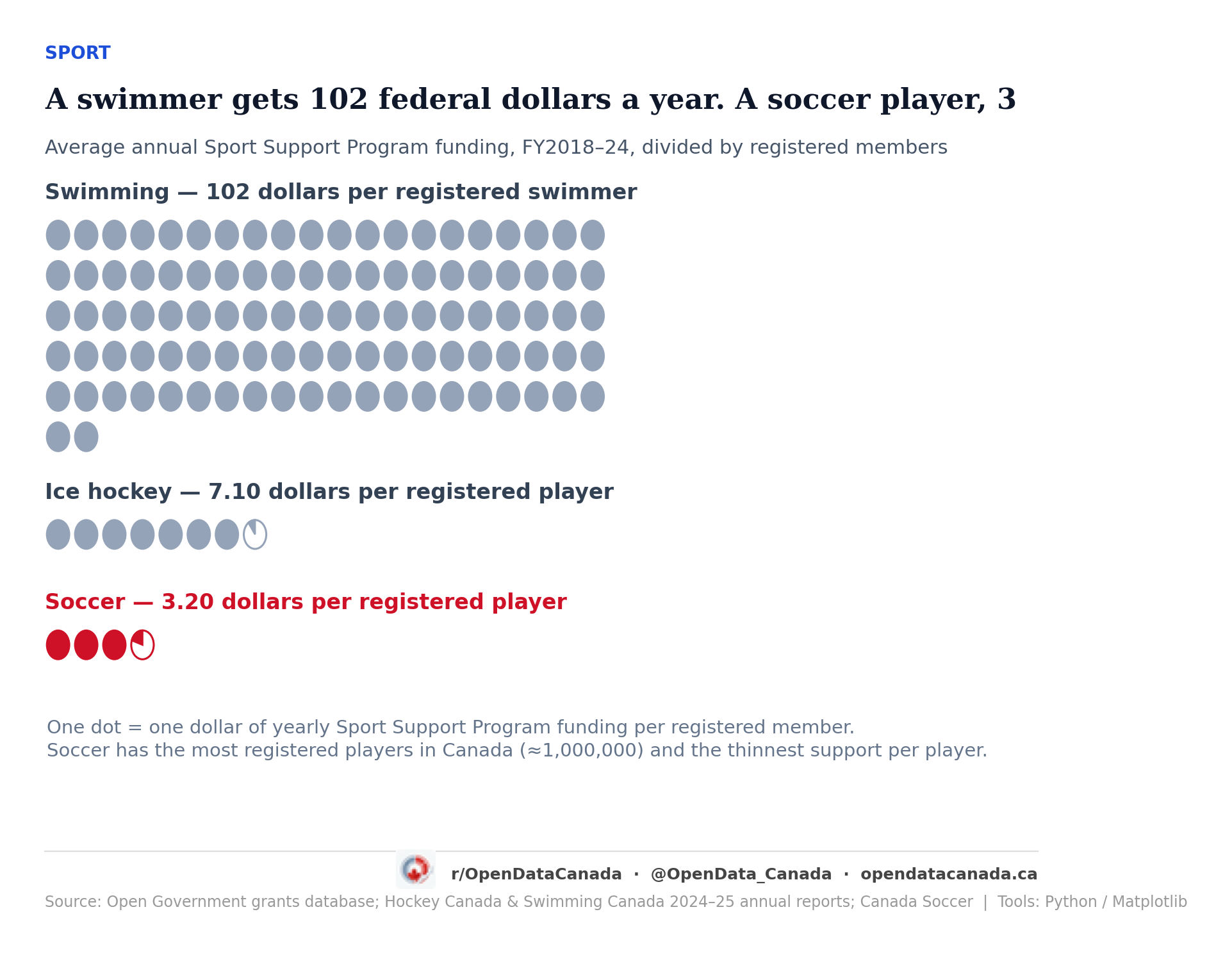
Registration counts are each organization's own, and definitions differ, so treat the ratio as an order of magnitude rather than a decimal-precise figure. The order of magnitude is the story: thirty to one.
And the pattern extends past those three. Rowing Canada reports 12,293 registered participants against 4.7 million dollars a year in program funding, nearly 400 dollars a member. Curling Canada's record 158,199 registered curlers work out to about 24 dollars each. Soccer's 3 dollars and 20 cents is the floor of the entire table.
220 million dollars for a month of football
The same database that records soccer's 3.2 million a year also records what Ottawa paid to host the tournament that ends this weekend: 104.3 million dollars to the City of Toronto and 115.7 million to British Columbia, both under a program literally named "Sport - Hosting Program - FIFA 2026", plus half a million to Canadian Tire Jumpstart for community pitches.
That is 220.5 million dollars, roughly nine times everything Canada Soccer's program funding added up to across eight years of disclosure. It is the block that dominates the top of the flow chart above, and it does not touch the sport's governing body at all.
Hosting money and program money are different instruments, and a one-to-one comparison would be unfair; stadium retrofits are not development coaches. But both come from the same public purse, and the contrast in ambition is the point. Canada spent like a soccer superpower for one month. It funds the sport's development like a mid-tier Olympic discipline every other month.
For scale: Canada Soccer's own financial statements show total revenue of 37.5 million dollars in 2024, of which 3.7 million came from government grants. The federal contribution to running the country's biggest playing sport is about ten cents on the association's dollar.
Who actually plays
Statistics Canada's 2023 survey on sport participation found 55 percent of Canadians aged 15 and over played some sport in the previous year. The same survey found immigrants over-index on soccer while the Canadian-born over-index on winter sports; soccer is the number one sport among Arab Canadians and number two among Black Canadians. The Canadian Fitness and Lifestyle Research Institute puts youth sport participation at 68 percent of kids aged 5 to 17.
Which sports those kids actually play, though, is a number the country no longer collects. Statistics Canada's tables record whether Canadians played sport, not which one; the children's health survey tracks screen time and functional difficulties, not soccer versus hockey. The last public survey that ranked children's sports dates to 2010. Canada just co-hosted a World Cup, and there is no open data on how many Canadians play soccer. The best available count is the one the sport's own association publishes.
What would change
If the question is "does federal funding follow players?", the grants database answers no, and it answers no by design. Medals are the mandate, and the formula delivers medals.
But the government did not spend 220 million dollars on hosting because of medal potential. It spent it because soccer is where Canadians, new Canadians especially, actually are. The program funding has not caught up to the bet the hosting money already made. When the stadium lights go out this weekend, the 3-dollar-a-player sport will still be the biggest one in the country, and the question of what the World Cup was for starts there.