Follow-up · Labour · 3 min read
As Dunkin' prepares for its Canadian relaunch via Foodtastic, public LMIA data shows the master franchisee hires foreign workers at nearly the same rate as Tim Hortons
Foodtastic, the Montreal company that just signed an exclusive deal to bring Dunkin' back to Canada with "hundreds of locations," has approved 109 Temporary Foreign Worker positions across its existing portfolio over the past two years. Normalized by workforce, that works out to roughly 5.7 per 1,000 employees — about 85 per cent of Tim Hortons' rate. Tim Hortons got every front page for promising to cut its TFW use. Foodtastic, with a similar per-worker rate, is opening hundreds of new stores under a "Dunkin' is back" headline.
Two announcements about fast-food chains and the Temporary Foreign Worker program landed thirteen days apart this month. The one that got the press conference was Tim Hortons' pledge to cut TFWs. The one that didn't was Dunkin's return — through a master franchisee whose existing portfolio is already in the program.
Inspire Brands and Foodtastic announced on 12 May 2026 that Dunkin' will return to Canada — first stores in Toronto and Montreal in late 2026 or early 2027, with a national rollout described as "hundreds of locations." Dunkin' last operated here in 2018.
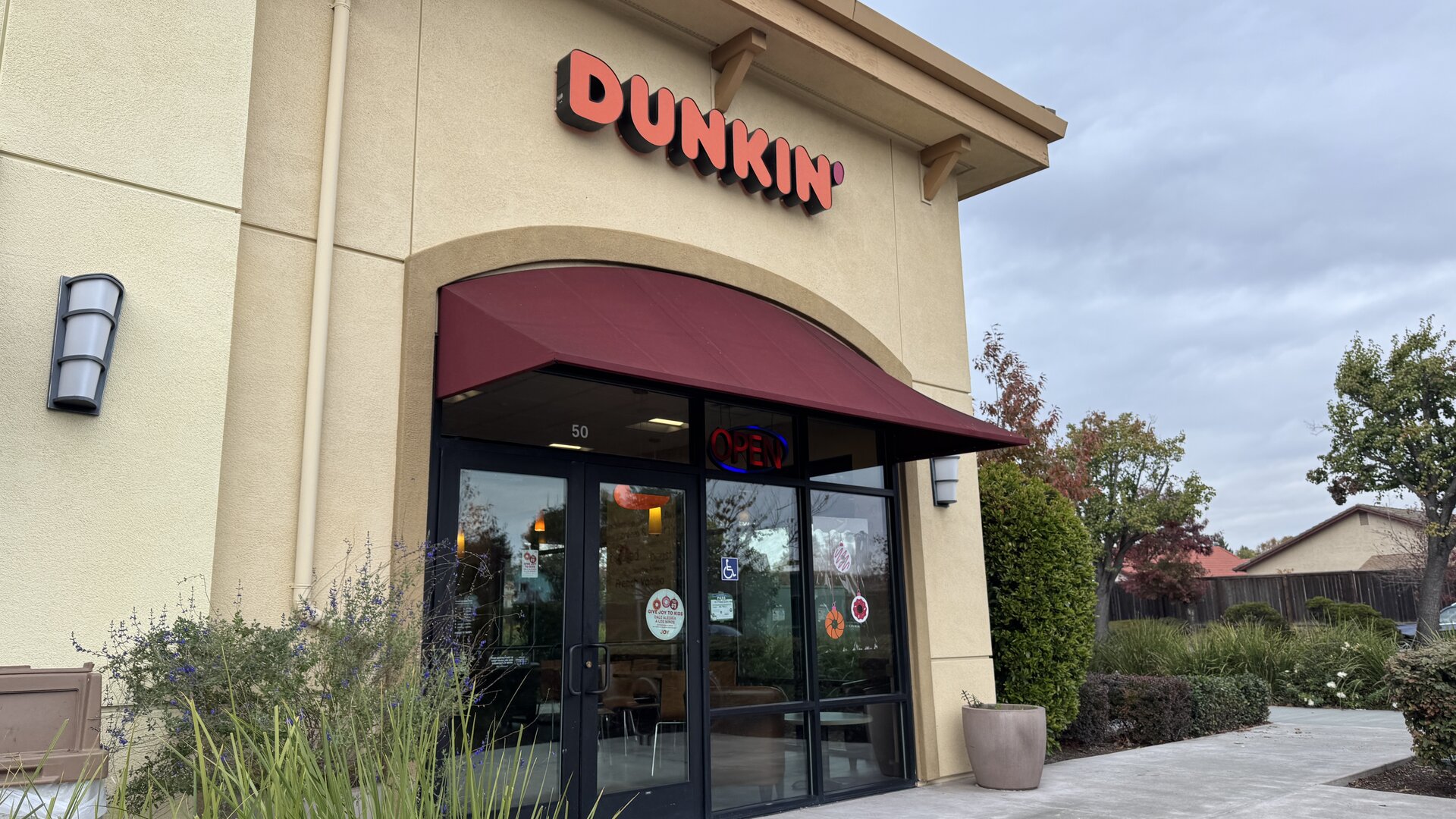
Foodtastic, founded by Peter Mammas in Montreal, is the master franchisee. It already runs Quesada, La Belle Province, Second Cup, Pita Pit and Milestones — plus more recent acquisitions including Bâton Rouge, Rôtisseries Benny&Co, Nickels and Au Vieux Duluth.
Those five core brands approved 109 Temporary Foreign Worker positions over 2024 and 2025, almost all in food-service roles in the Low Wage stream. In Open Data Canada's previous consolidated fast-food league table, that put Foodtastic eighth — behind FMI Atlantic (KFC / Taco Bell / Pizza Hut master at 123) and ahead of Domino's (93).
The 109 positions are not held by Foodtastic corporate. The LMIA file lists each application by the legal employer that filed it — typically a numbered company or named restaurant operator running one to a handful of locations under licence from a Foodtastic brand. Foodtastic itself is a holding company that licences the brands; the foreign worker hiring decisions sit at the franchisee level. That is the same structure that hid roughly 492 McDonald's positions under names like Krawchuk Enterprises and JACMAR Restaurants in Open Data Canada's 25 May analysis. What "Foodtastic's TFW use" measures is the sum of every franchise application filed under one of its brand strings — a portrait of how the network as a whole staffs itself, not a direct decision by head office.
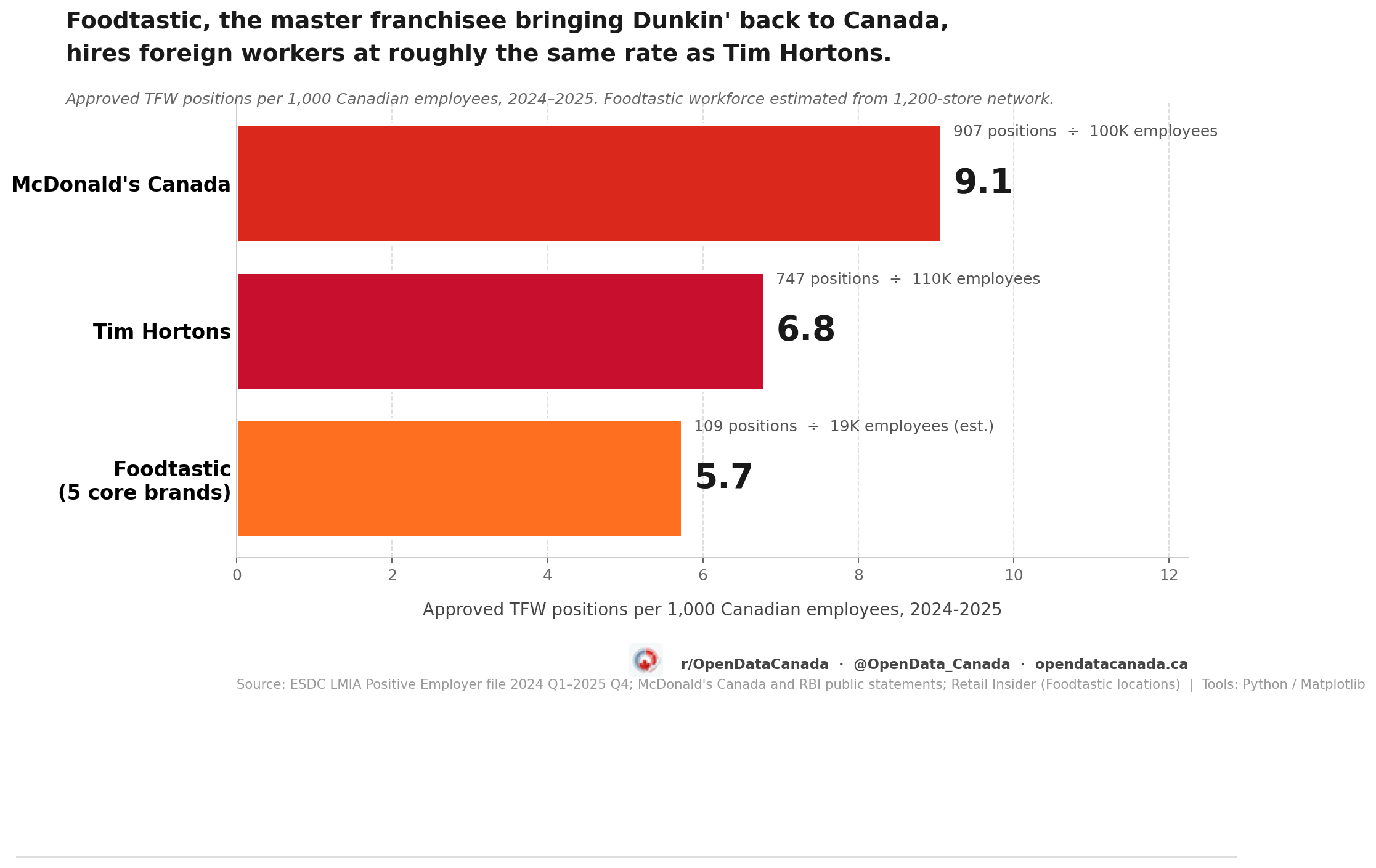
Foodtastic hires foreign workers at roughly the same rate as Tim Hortons
Foodtastic does not publish a Canadian workforce figure, but the network can be estimated from its disclosed store count and brand mix. Roughly 80 per cent of Foodtastic's 1,200-plus locations are small-format QSR or coffee shops — Quesada, Pita Pit, Second Cup, La Belle Province, Souvlaki Bar — which staff at about 10 employees per store. Around 10 per cent are mid-format Quebec brands (Benny&Co, Au Vieux Duluth) at roughly 25 each. The remaining 10 per cent are casual-dining (Milestones, Bâton Rouge) at 55 to 70. Blended, the portfolio averages around 16 employees per restaurant, well below Tim Hortons' 31 and far below McDonald's' 71. That implies a Foodtastic network workforce of about 19,000 people, and a TFW intensity of roughly 5.7 per 1,000 employees.
The two chains that publish workforce figures provide the benchmarks. Tim Hortons told reporters on 25 May 2026 that its Canadian network employs about 110,000 people. McDonald's Canada says on its own corporate site that it and its franchisees together employ "nearly 100,000." Use those denominators and McDonald's runs at 9.1 approved TFW positions per 1,000 Canadian employees, versus Tim Hortons' 6.8 and Foodtastic's estimated 5.7.
Even if Foodtastic's true workforce is 25 per cent larger than the estimate (intensity falls to ~4.5 per 1,000) or 25 per cent smaller (it rises to ~7.1), the conclusion holds: Foodtastic's network sits in the same tier as Tim Hortons, well above the Subway-and-below tier and below McDonald's.
| Chain | Positions (2024-25) | Canadian employees | Per 1,000 employees |
|---|---|---|---|
| McDonald's | 907 | ~100,000 | 9.07 |
| Tim Hortons | 747 | ~110,000 | 6.79 |
| Foodtastic (5 core brands) | 109 | ~19,000 (est.) | ~5.74 |
The 109 positions were approved while the federal government was tightening the program around the entire fast-food sector. On 26 September 2024, Ottawa cut the cap on low-wage TFW positions from 20 to 10 per cent of an employer's workforce, after a preceding freeze on most new low-wage applications in metropolitan Montreal in August 2024. The 10 per cent cap remains in force through 2026, with a higher allowance retained only for "critical sectors" — which do not include fast food. Every position in the table above was approved under that tighter regime. The federal Temporary Foreign Worker arrival count fell 12.8 per cent in 2025 (to 170,030, from 194,905 in 2024).
The Tim Hortons announcement on 25 May was framed around a "10,000 Canadians" hiring pledge. The Foodtastic-Inspire deal on 12 May was reported as a return-to-Canada expansion story — CBC, HR Reporter, Restaurants Canada and Business Wire led with the location count and the relaunch timeline. Neither framing is wrong on its face. But on the relevant data — TFW positions approved per Canadian worker over the past two years — the chain promising to cut and the chain quietly expanding sit at very similar rates: 6.8 and 5.7 per 1,000. McDonald's, which has said nothing publicly, leads at 9.1.
The Foodtastic announcement also came thirteen days before Restaurant Brands International said it would cut TFW use at Tim Hortons and stop lobbying Ottawa to lift the program's cap. Whether Foodtastic and Inspire take a similar public stance on staffing the Dunkin' rollout has not been addressed in any of the May 12 materials.
It is also worth noting that the 109 figure is a conservative count. Positions filed under Foodtastic's smaller acquisitions — Bâton Rouge, Benny&Co, Nickels, Au Vieux Duluth, La Belle et la Boeuf — are spread across small franchise rows the brand-string search misses, so the true Foodtastic-network footprint today is somewhat higher. Dunkin' will add to it.