Article · Labour · 6 min read
Canada blamed Tim Hortons. McDonald's hired more foreign workers — and stayed quiet.
Tim Hortons said this morning it will cut Temporary Foreign Workers and hire 10,000 Canadians instead. The chain's full franchise network — every "12345 Ontario Inc o/a Tim Hortons" plus the two big franchisee groups whose corporate names don't carry the brand — has 747 LMIA-approved positions for 2024-2025. Roll up McDonald's the same way and you get 907. The chain making headlines about foreign-worker cuts isn't even Canada's biggest fast-food user of the program.

Restaurant Brands International told reporters this morning that Tim Hortons franchisees will dial back their use of the Temporary Foreign Worker program, hire 10,000 Canadians, and stop lobbying Ottawa to lift the TFW cap. The announcement led every front page in the country.
The federal government also publishes a quarterly, line-by-line list of every LMIA approval issued under the program — every employer, every job code, every address. So we can check, brand by brand, what Tim Hortons' decision is actually about — and which other fast-food chains have not made the same commitment.
A brand-name search undercounts the real picture
A simple search of the LMIA file for the string "McDonald" returns 415 approved positions. A search for "Tim Horton" returns 658. On those numbers, Tim's looks like the bigger user of the program, which is roughly how this dataset has been summarized in news coverage.
It is also wrong. Most McDonald's restaurants in Canada are owned by independent franchisees, and a sizeable share of those franchisees register their operating company under a name that doesn't carry the McDonald's wordmark at all. Seven examples, all confirmed McDonald's franchisees:
- Krawchuk Enterprises Inc. of Nanaimo, BC — 115 approved positions across Vancouver Island. Job Bank confirms "dba McDonald's Restaurant."
- JACMAR Restaurants Inc. of Gatineau, QC — 91 positions, runs six McDonald's locations in the Outaouais.
- Les Restaurants Dubillard Inc. of Quebec City — 71 positions, listed federally as "Restaurants McDonald's Dubillard."
- TAYMAC Enterprises Inc. of Victoria, BC — 60 positions, dba McDonald's in Langford and Colwood.
- Eleven Foods Incorporated of Elmira, ON — 54 positions, DBA McDonald's per the franchisee's own LinkedIn.
- Les Restaurants Iana Inc. of Sherbrooke, QC — 51 positions across six McDonald's, run by the Ianuzzi family (Caroline Ianuzzi was the third female McDonald's franchisee in Canadian history).
- GRIMACE & Co Restaurant Ltd of Campbell River, BC — 50 positions. Named, yes, after the McDonald's mascot.
That's 492 positions in seven entities, none with "McDonald" in the legal name. Add them to the brand-name total and the McDonald's consolidated franchise network sits at 907 positions. Six of those seven franchisees are in either BC or Quebec — Nanaimo, Victoria, Campbell River, Gatineau, Quebec City, Sherbrooke. Ontario, despite having the most McDonald's locations of any province, barely shows up among the missed-by-search franchisees, because Ontario operators tend to file under names that include the brand string.
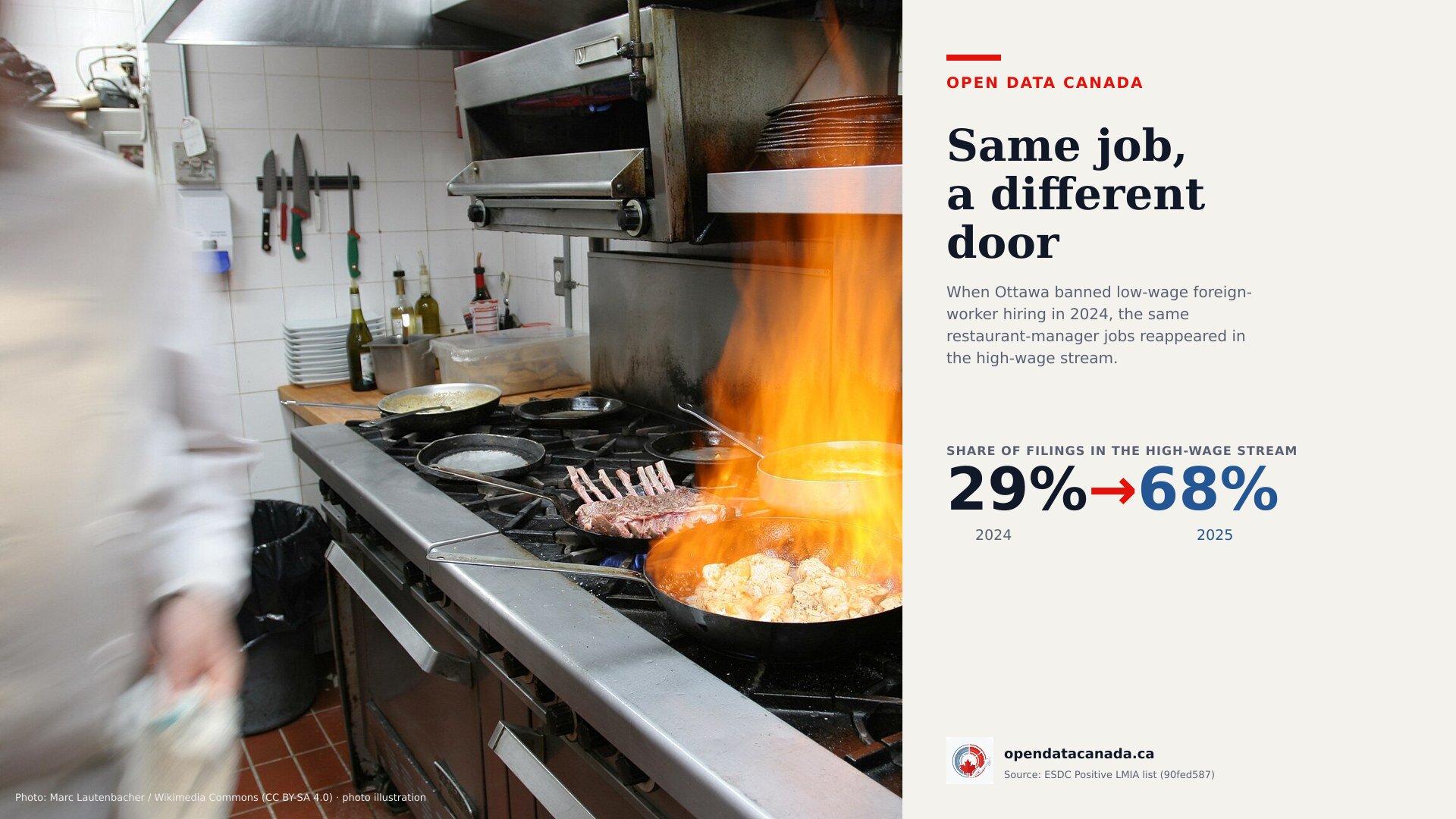
The positions themselves are food service supervisor (NOC 62020) and cook (NOC 63200) approvals — all in the federal Low Wage stream, which is defined as paying below the provincial median hourly wage. In most provinces that means at or close to minimum wage. A separate hiring ban later pushed restaurant manager approvals into the high-wage stream.
The correction is smaller for Tim Hortons but it still matters. Most Tim's franchisees include the brand string in their corporate name, so the search catches them. Two large exceptions: D.P. Murphy Group of Companies in PEI (67 positions, 30+ Tim Hortons locations across PEI, NB and Ottawa) and Pioneer Food Services Limited (22, the Tim's arm of QSR Group). That gets Tim Hortons to 747.
So McDonald's franchisees, properly consolidated, hired roughly 1.2 times more new TFWs than Tim Hortons did over the last two years. McDonald's has not announced anything about it.

The full fast-food league table
Roll every master franchisee and numbered company back to its parent brand, and Canada's fast-food sector looks like this for 2024-2025:
| Fast-food chain (consolidated) | Approved TFW positions |
|---|---|
| McDonald's (direct + Krawchuk + JACMAR + Dubillard + TAYMAC + Eleven Foods + Iana + Grimace + numbered cos) | 907 |
| Tim Hortons (44 franchise entities + D.P. Murphy + Pioneer Food Services) | 747 |
| Burger King — Redberry Restaurants master + direct | 340 |
| Subway — 83 franchise entities + Restaurex Corporation | 291 |
| Popeyes — Soul Restaurants Canada + direct | 139 |
| A&W — Western Restaurant Franchises + direct | 139 |
| FMI Atlantic — KFC / Taco Bell / Pizza Hut master | 123 |
| Foodtastic — Quesada / La Belle Province / Second Cup / Pita Pit / Milestones | 109 |
| Domino's Pizza (numbered cos) | 93 |
| Wendy's — direct + QSR Group's Wendy's arm (Quicker Foods) | 32 |
| MTY Food Group brands — Mr Sub / Country Style / Manchu Wok / Mucho Burrito / Sushi Shop / Thai Express / Yogen Früz / Wok Box / Vanellis / Big Smoke Burger | 70 |
| Dairy Queen | 66 |
| Pizza Hut (direct) | 34 |
| Mary Brown's Chicken | 21 |
| Pizza Pizza | 14 |
| Booster Juice | 11 |
Some absences are notable. Starbucks Canada approved zero LMIA positions over the period — the chain's Canadian restaurants are corporate-owned, and apparently staffed entirely with domestic hires. Five Guys, Chipotle, Cactus Club Cafe, Browns Socialhouse, and Mr. Mike's all came in at three positions or fewer combined across all entities. The fast-food industry's entire TFW footprint — every chain in the table combined — is roughly 3,000 new positions over the two-year window, and three-quarters of that sits in the top four chains alone.
"4,000 Tim Hortons workers" vs "747 Tim Hortons positions": both numbers are right
Tim Hortons told reporters this morning that about 4,000 temporary foreign workers currently staff its Canadian restaurants — a small share of the chain's roughly 110,000 Canadian roles. The LMIA file shows 747 new approved positions over the two-year window. Both numbers are accurate; they answer different questions.
A positive LMIA is a one-time authorization. A worker hired against that authorization receives a work permit typically valid for one to three years, sometimes longer. So the 4,000 workers currently inside Tim Hortons restaurants are the stock — every TFW on a still-valid permit, including approvals issued in prior years. The 747 number is the flow — new authorizations in the two most recent years.
The flow is what changed. RBI told the Globe and Mail that franchisee demand for new TFW hires has been "significantly reduced" since 2024, and the 747 figure is consistent with a chain that has already pulled back hard on new requests. The much larger McDonald's flow — 907 positions, 1.2 times Tim's — suggests that, if RBI follows through on the announcement and McDonald's doesn't match it, the brand gap will continue to widen.
What today's announcement leaves on the table
The political conversation around the TFW program has been overwhelmingly about Tim Hortons. That conversation now has an answer: Restaurant Brands International is publicly stepping back and disavowing further lobbying. McDonald's, A&W, Burger King, KFC, Pizza Hut, Popeyes and Wendy's have not. We also looked at Foodtastic, the master franchisee bringing Dunkin' back to Canada.
It is also worth noting that the program is contracting on its own. Federal arrival data show 170,030 temporary foreign workers entered Canada in 2025, down 12.8 percent from 194,905 in 2024. The Tim Hortons announcement is one large chain joining a pullback that was already underway, not the first crack in the policy. McDonald's, the larger fast-food user, has not joined it yet.
Both chains pay their top executive eight figures. Joshua Kobza, RBI's chief executive, took $14.5 million in total 2024 compensation. McDonald's CEO Chris Kempczinski took $18.2 million — roughly 1,014 times what the median McDonald's employee earned that year, per the company's 2025 proxy statement. The TFW positions both chains are approving sit in the Low Wage stream.
The numbers above suggest that, if the policy goal is to reduce fast-food reliance on the Temporary Foreign Worker program, the announcement that landed on every front page this morning is roughly a quarter of the relevant flow — and not even the largest single piece of it. McDonald's franchisees are the largest single piece. Tim Hortons just gave the press conference McDonald's never had to.