Article · Defence · 8 min read
Canada's military recruitment hit a 30-year high. Female officer intake nearly doubled.
466 women enrolled as Canadian Armed Forces officers in fiscal year 2025/26 — a 94 percent year-over-year jump and the largest single-year shift for any subgroup in 28 years of DND open data. Officer intake overall also broke a 28-year record, while non-commissioned member intake remained below its 2010 peak.

In April 2026, the Department of National Defence announced that 7,310 Canadians had enrolled in the Regular Force in fiscal year 2025/26 — the highest annual intake in 30 years. The story wrote itself: Trump tariffs were gutting Canadian manufacturing. A 20 percent raise for new privates had just landed. Permanent residents could now enlist. Of course the army was filling up.
Three weeks of coverage later, almost nobody has actually looked at who showed up.
We did. The numbers are not what the headlines suggest.
The "30-year high" is, technically, true. It's also misleading.
DND publishes its annual intake split between officers and non-commissioned members — the enlisted ranks where most working-class recruits land. The series goes back to 1997. Across nearly three decades it has been remarkably stable in shape: officers are 17 to 22 percent of intake, NCMs are the rest.
Then 2025 happens.
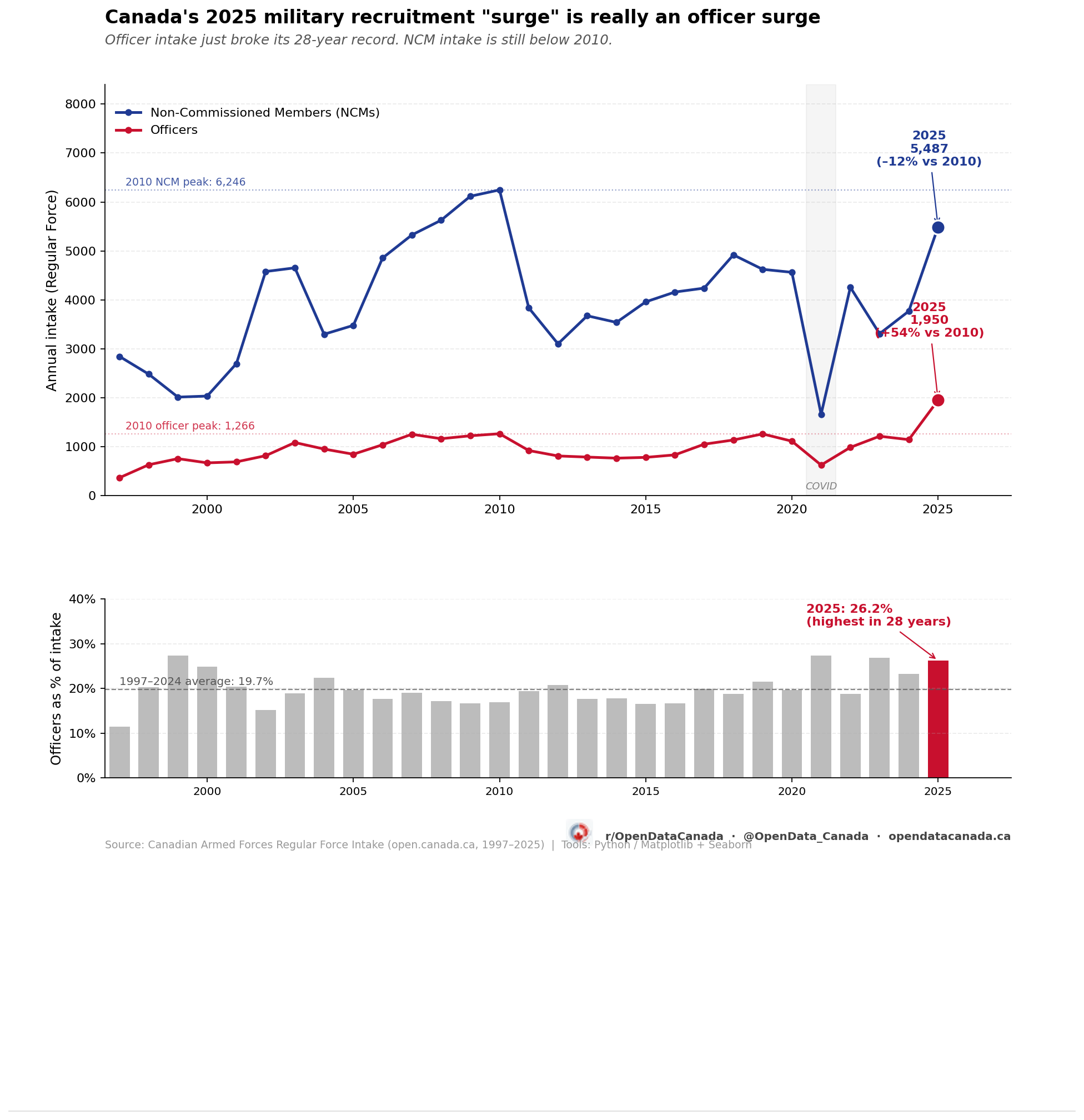
Officer intake in 2025: 1,950 — the highest single year in the entire series, beating the previous record (2010) by 54 percent.
NCM intake in 2025: 5,487 — still 12 percent below the 2010 peak.
The "recruitment surge" everyone is writing about is one line on the chart breaking through its ceiling. The other line is just walking back toward where it was 15 years ago. The officer share of total intake jumped to 26.2 percent — also a 28-year high. If you remove the officer column from the calculation, you do not have a record year. You have a normal one.
That alone reframes the conversation. Canada's military didn't surge because more factory workers gave up on the private sector. It surged because more officers did.
And within the officer surge, it's the women who broke the dataset.
CAF officers come almost entirely from two streams: the Reserve Officer Training Plan, which pays for an undergraduate degree, and Direct Entry Officer, which commissions people who already hold one. Either way, a bachelor's degree (or active progress toward one) is the entry ticket.
In 2025, women walked through that door at a rate this country has never seen.
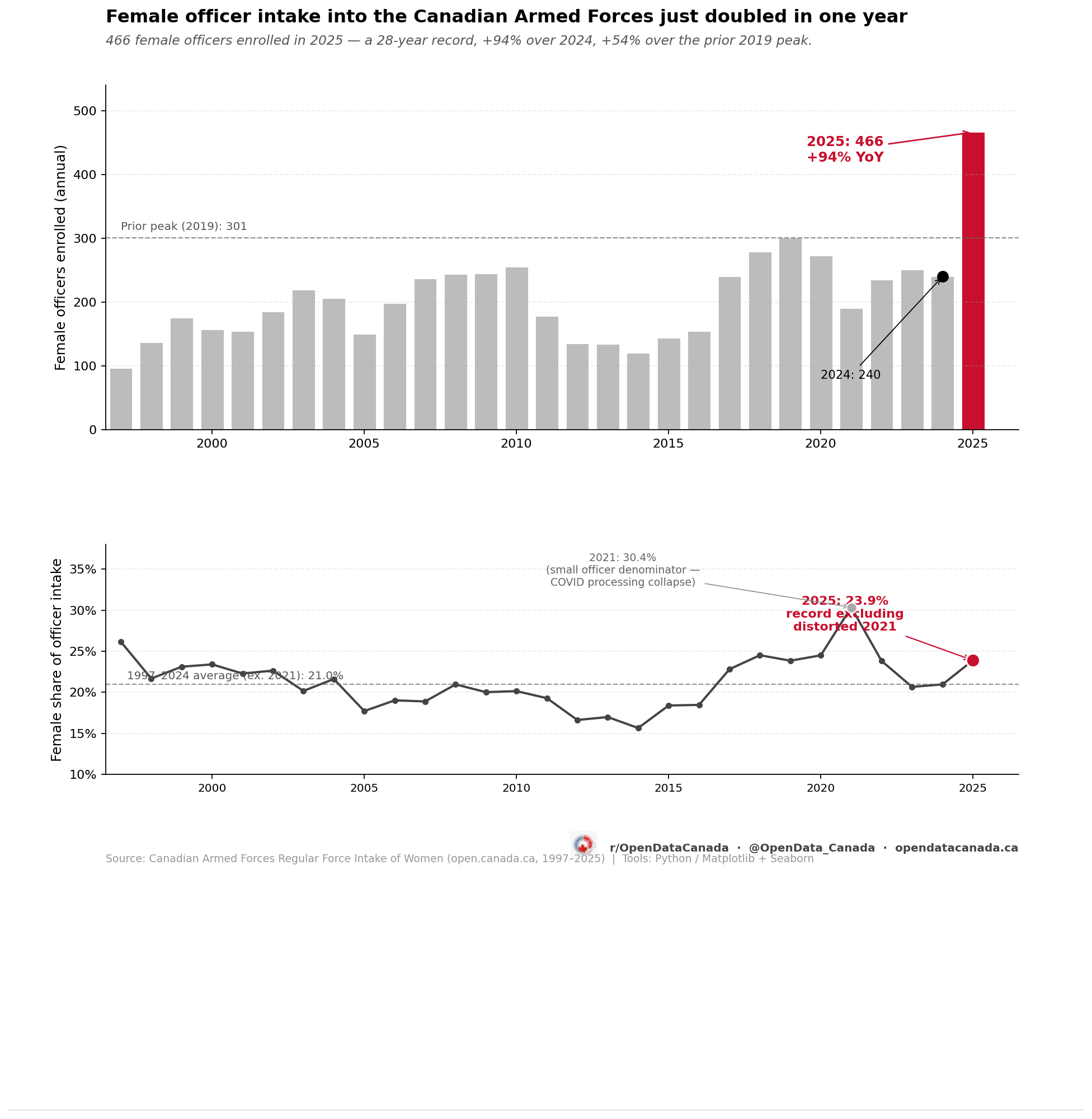
466 women enrolled as officers in 2025. The previous all-time peak was 301 in 2019. That is a 54 percent jump over the prior record — and a 94 percent jump from 2024 alone, which is the single largest year-over-year change for any demographic subgroup in the 28-year dataset.
The female share of officer intake hit 23.9 percent, also a record once you set aside 2021 — a year when total officer intake collapsed because of COVID processing delays, mechanically inflating the female share without any change in absolute female enrolment.
Men also showed up: male officer intake hit a record too (1,484). But the female line is the one bending sharpest, and it is bending in a year when the rest of the labour market is doing something specific.
Here's what's also true: the entry-level white-collar economy is broken.
Multiple Canadian labour studies — including work from the Conference Board of Canada and CMHC — put graduate underemployment in the 30 to 40 percent range, with the share rising through 2024 and into 2025. Major outlets have been describing the Ottawa and Toronto graduate hiring markets as the worst graduate job market in recent memory since mid-2024.
Three forces converged on the entry-level professional pipeline at once:
- AI compressed the bottom rung of white-collar work. McKinsey announced cuts of roughly 200 tech roles in 2025 and slowed entry-level hiring sharply, citing automation of synthesis work. Similar moves are visible across the consulting and professional-services sector.
- Tech layoffs — Shopify cut roughly 20 percent of its workforce in 2024, Lightspeed cut 7 percent, and Telus has shed thousands of Canadian jobs through 2024 and 2025 — flushed mid-career professionals back into the job market, displacing new graduates.
- The federal hiring freeze that began in late 2024 idled a channel that normally absorbs thousands of policy and analyst graduates in Ottawa.
Women now earn the majority of Canadian bachelor's degrees — 55 to 58 percent depending on the cohort year — and are mechanically over-represented in any group that hits this kind of wall. When the wall is graduate underemployment specifically, women with degrees are the demographic most exposed.
The math on the CAF officer offer looks very different in 2025 than it did in 2023.
A newly commissioned officer with a bachelor's degree starts in roughly the seventy-to-ninety-thousand-dollar range depending on rank and entry stream, with full healthcare, a defined-benefit pension, paid further training, and — for ROTP entrants — student debt that never accumulated in the first place. The 2025 pay raise applies to officers below Lieutenant-Colonel as a 13 percent hike on top of the existing scale.
That package was a respectable consolation prize in 2018, when an entry-level analyst job in Toronto paid around 80,000 dollars and came with a real career path. It is a competitive first offer in 2025, when the same Toronto analyst seat is either gone, contract-only, or pays the same money with no path attached.
If you graduated in spring 2025 with a bachelor's degree, you are statistically more likely to be underemployed than employed in your field. The CAF spent the year quietly offering you a way out.
What we cannot prove from this data alone.
Three confounders need to be named in public, not buried.
One: DND has been deliberately pushing officer recruiting harder than NCM recruiting. It has a stated shortage of more than 2,000 junior officers. Some of the 2025 surge is a recruitment system finally hitting an aggressive target it has been chasing for years.
Two: In 2025 the CAF began allowing officer candidates to start basic training after a Reliability Status security check rather than a full clearance. That released a multi-year backlog of officer applications that had been sitting in security-screening queues since 2021. A pile of 2023 applicants are now 2025 enrollments.
Three: Geopolitical anxiety — Trump's tariffs, the Russian war in Ukraine, Chinese pressure on the Arctic — may be pulling people toward service in ways no pay raise can. The data cannot see motivation.
None of these confounders are visible in the open numbers. What the open numbers do show — unambiguously — is that the 2025 cohort of new CAF recruits is materially more educated, materially more female, and materially more urban than any cohort in the dataset that goes back to 1997.
So what is the story?
The Canadian press wrote a story about patriotism, pay, and a softening blue-collar labour market. It contained real elements. It landed on the wrong demographic.
The cleanest single explanation for what actually happened — supported by the data we do have, falsifiable by data we do not yet — is this: Canada's most successful recruitment programme in 30 years was an entry-level white-collar job market collapse it did not have to design.
The Department of National Defence is not responsible for AI compressing junior analyst roles. It is not responsible for the federal hiring freeze, or for tech layoffs, or for contract gig work replacing the professional pipeline that used to absorb 22-year-olds with shiny new degrees. But it spent 2025 standing in the door with a roughly seventy-thousand-dollar-a-year offer, full benefits, paid training, and a uniform.
And a lot of people with degrees — especially women — walked through it.
That is a different story than "the army is finally cool again." It is also a far more interesting one.
Data and methods. All recruitment figures are drawn from the Canadian Armed Forces Regular Force Intake and Intake of Women datasets published by the Department of National Defence on open.canada.ca (most recent release: February 2026). Fiscal years are labelled by the calendar year in which they end. Underemployment ranges are from published work by the Conference Board of Canada and CMHC; the National Graduates Survey series at Statistics Canada documents the long-run trend. Layoff figures for Shopify, Lightspeed, McKinsey and Telus are drawn from company announcements and contemporaneous reporting in 2024 and 2025. Ministerial totals for FY2025/26 (7,310) differ slightly from DND open-data totals (7,437) due to fiscal cut-off and Reserve/Regular accounting; both indicate the same direction.